If you are the operating partner on a deal that just closed, the most useful thing you can have by day 60 is an independent read of what the acquired company's customers think, taken before anyone changes pricing, the sales team or the roadmap. AI-moderated interviews let you hear from 30 to 100 customers in a few weeks instead of the handful of calls a management-picked reference list gives you. This playbook gives you the sampling rule, the day-by-day timeline, a full interview guide you can copy and the setup in Koji, so you can run it this week.
Why the first 100 days are the customer research window
Your value creation plan was written from the data room: financials, a CIM, a diligence report and, if you were lucky, a few reference calls the seller arranged. Day one is the first time you can ask the customers directly, and the window to do it cleanly is short.

Photo by Vitaly Gariev on Unsplash
Three things have changed in the last two years.
Operations is where the return comes from. In S&P Global Market Intelligence's 2026 private equity survey (published 13 April 2026), 72% of GPs named operational improvements the top value creation lever, and 60% agreed that higher capital costs are forcing a sharper focus on portfolio company operational performance. The same release notes that many firms are held back by fragmented data and limited visibility into the metrics that matter most for portfolio performance (S&P Global Market Intelligence press release, 2026). PwC makes the same point from the operating partner side: its page on the role states that operations have driven 47% of value creation since 2010, up from 18% in the 1980s (PwC, private equity operating partner trend). PwC cites this as a long-run trend, not a 2026 survey.
You will own the company for longer. Private Equity Info reported in February 2026 that the median holding period for PE-backed portfolio companies reached 6.0 years, the longest since it began tracking the metric. From 2015 through 2022 the annual medians sat between 4.7 and 5.0 years (Private Equity Info, holding period studies, 2026). That figure is based only on companies that have already sold, so it lags. A longer hold means a longer period in which a wrong assumption about customers compounds.
The exit queue is crowded. Bain's Global Private Equity Report 2026 (released 23 February 2026) puts the stock of unsold portfolio companies at about 32,000, worth $3.8 trillion, and its headline rule of thumb is "12 is the new 5": portfolio companies now need roughly 12% EBITDA growth to earn attractive returns (Bain & Company, Global Private Equity Report 2026). A buyer at your exit will run their own customer calls. You want to have heard the answers first, and you want a documented starting point to show what you changed.
Add the part nobody puts in a deck. Every lever in a typical 100-day plan touches customers: a price move, a sales reorganisation, a roadmap cut, a support consolidation, an add-on integration. If you make those changes without a baseline, you cannot tell afterwards whether churn rose because of your changes or in spite of them. That is the cost of skipping this: you lose the ability to learn from your own plan.
What good looks like: the 100-Day Customer Baseline
Operating partners who do this well treat the baseline as a measurement, not as a goodwill exercise. The rules below are our recommended practice, assembled from diligence practice and interview methodology. They are Koji's rules of thumb, not an industry standard.
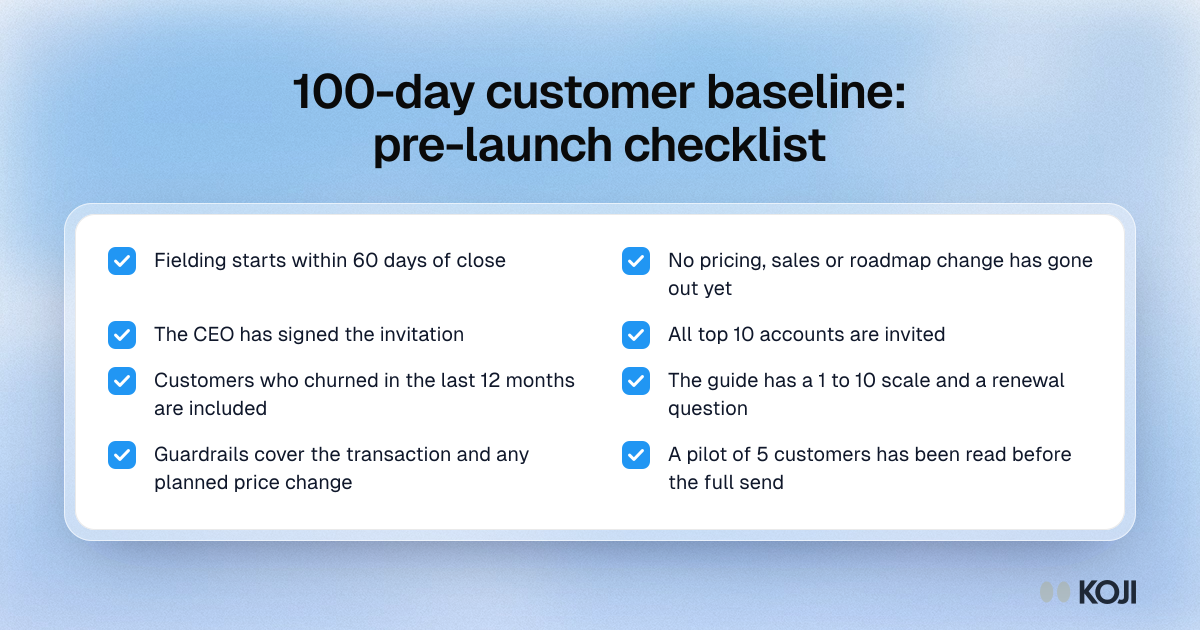
1. Field it inside 60 days of close, and before the first customer-facing change. A baseline taken after you reprice measures your repricing. If a change is already scheduled, put the baseline ahead of it, even if that means delaying the announcement by three weeks.
2. Sample by segment, not by who answers. Use this decision rule:
- Fewer than 40 customers: invite all of them.
- 40 to 400 customers: aim for 30 to 60 completed interviews, stratified by revenue band, tenure and product line, with every one of the top 10 accounts invited.
- More than 400 customers: aim for 60 to 100 completes, with the same stratification, and cap any single segment at about a third of the sample.
- In every case, add the customers who churned in the last 12 months. They are the cheapest source of "why" you will find, and they are almost never in the seller's reference list.
3. Ask the CEO to sign the invitation. The invitation comes from the portfolio company, from the CEO's address, with one sentence on why: "We have new owners who want to hear directly from customers about how we are doing." Customers answer a vendor they know. They ignore an investor they have never heard of.
4. Ask about the last 90 days, not about opinions. "Tell me about the last time the product let you down" gets a story. "How satisfied are you?" gets a 7.
5. Combine numbers and stories in the same interview. One 1 to 10 scale on dependence, one single-choice on renewal intent, and open questions for everything else. You will want to chart the first two next year.
6. Decide what each finding will change before you read it. Write the three decisions the baseline informs (for example: price increase timing, which segment gets the first sales hires, whether to keep the second product line) and tie each question to one of them.
Common mistakes
- Letting management pick the sample. You get the best relationships, not the real ones.
- Interviewing only current customers. Churned accounts tell you what the survivors are too polite to say.
- Asking about price in the baseline when a price change is coming. Keep that for a separate willingness-to-pay study.
- Treating one loud account as a finding. Report themes with counts: "11 of 42 raised permission set-up", not "customers hate onboarding".
- Running it once. The baseline is only worth its cost if you rerun it at about day 180 and again 6 to 9 months before exit, using the same questions.
Run this check before you press send.
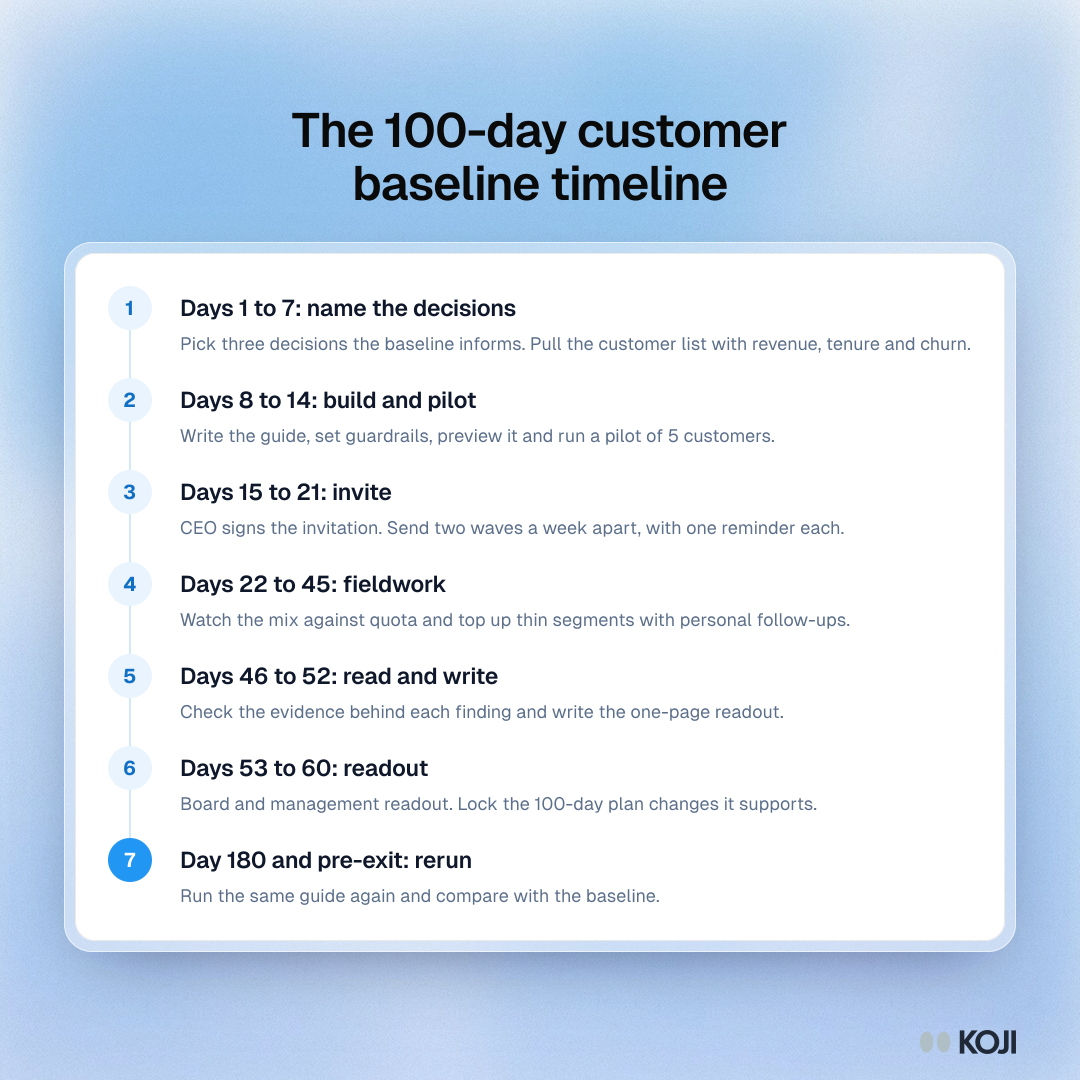
The timeline
Counted from close (day 0):
- Days 1 to 7: Name the three decisions. Pull the customer list (revenue, tenure, product, region, last renewal, churned in the last 12 months).
- Days 8 to 14: Build the guide, set guardrails, preview it yourself, and run a pilot of 5 customers.
- Days 15 to 21: CEO sign-off on the invitation. Send invitations in two waves, a week apart, with one reminder each.
- Days 22 to 45: Fieldwork. Watch the response mix against your quota and top up thin segments with personal follow-ups.
- Days 46 to 52: Read the report, check the evidence behind each finding, write the one-page readout.
- Days 53 to 60: Board and management readout. Lock the 100-day plan changes it supports.
- Day 180 and pre-exit: Rerun the same guide and compare.
How to set it up in Koji, step by step
Koji has a ready-made template for the neighbouring job (Portfolio Company NPS Interviews, in the template gallery under PE/VC). Start from it and change the brief as below, or paste the one-line brief from the interview guide section.
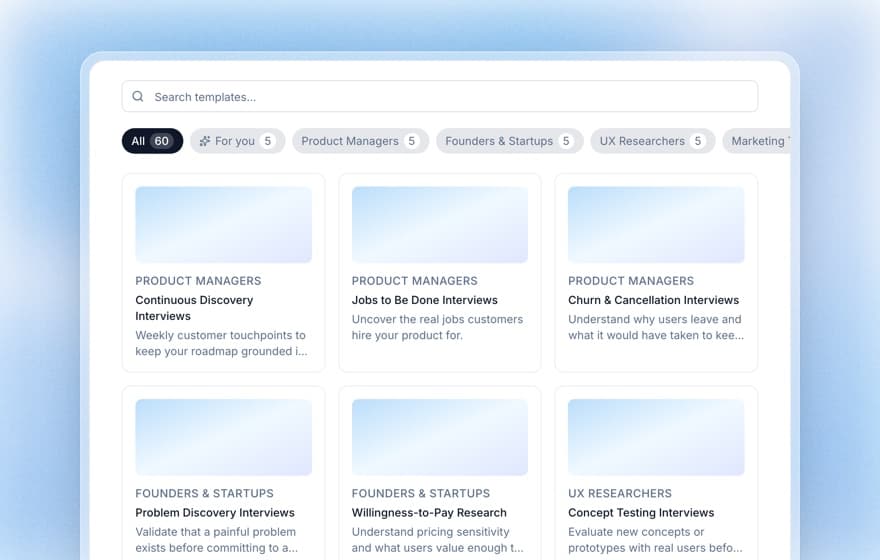
- Start a study. Open the dashboard, choose Portfolio Company NPS Interviews from the template gallery, or type your research question into "What do you want to research?" and start from there.
- Shape the research brief. Set the decision it informs (the three decisions from your timeline), who you want to hear from (paying customers with at least one renewal, plus churned accounts), and what to avoid. You can edit the brief by hand or ask the AI consultant to change it.
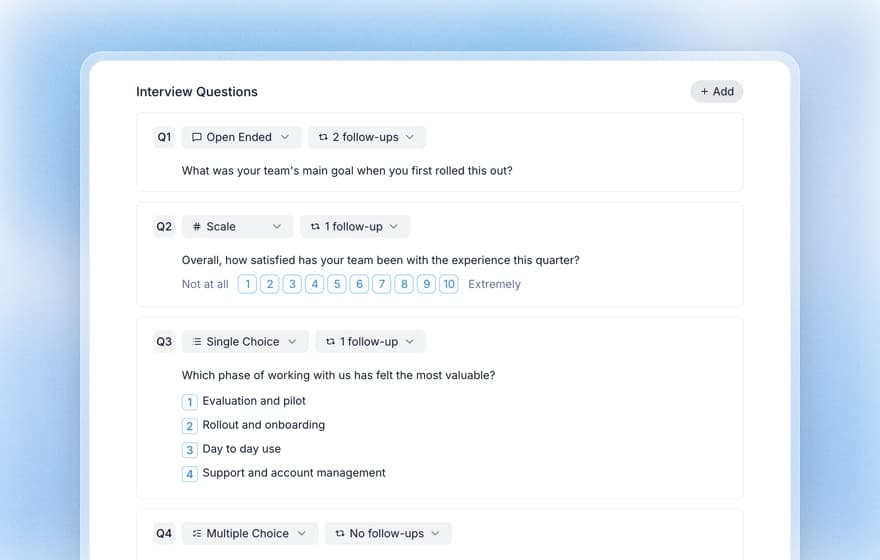
- Add structured questions where you need a number or a choice. Koji supports open-ended, scale, single choice, multiple choice, ranking and yes/no questions. Use a 1 to 10 scale for dependence and a single choice for renewal intent, so next year's rerun can be charted against this year's.
- Set guardrails. List the topics the interviewer must not raise: pricing plans under discussion, other customers' names, the transaction, any planned exit. Guardrails are set per study.
- Choose voice or text, then preview. Run the preview yourself. It is saved with its own analysis and does not count as a response. Voice, text and call links are separate channels, so you can offer more than one.
- Invite the customers. Import your customer list from a CSV so each person gets a personal interview link, send it from the CEO's mailbox, and set a response limit so one segment does not over-fill.
- Read the report. Findings come with the share of participants behind each one and the supporting quotes, so you can check any claim before you take it to the board.
Cost and plan. A text interview costs 1 credit and a voice interview 3 credits; a credit is €1 on the standard rate. The Insights plan (€29 a month, 29 credits) covers a first pilot. The Interviews plan (€79 a month, 79 credits) covers about 79 text interviews or 26 voice interviews in a month, and extra credits are sold in packs. Only conversations that pass the quality check consume credits. Check the pricing page for the current plan details before you commit.
Example questions written for this use case
- Take me back to the day you chose this product. What were you doing before, and what made you switch?
- What would break in your week if it disappeared tomorrow?
- On a scale of 1 to 10, how dependent is your team on it today?
- Tell me about the last time it let you down. What did you do?
- When did you last look at an alternative, and what stopped you?
- If a peer asked you whether to buy it, what would you tell them, including what is not in the case study?
Copy this interview guide
Paste this into any interview tool. In Koji, paste the brief below into "What do you want to research?" and edit.
Brief (one line): We are the new owners of [Company]. We want to understand how customers rely on the product today, what nearly made them leave, and what would make them expand, so we can plan the next 12 months without breaking what works.
Opening line: "Thanks for making the time. [Company] has new owners who want to hear about your experience directly, in your own words. We will report themes across customers, not individual answers by name. It takes about 10 minutes."
| # | Question | Type | Follow-up probe |
|---|---|---|---|
| 1 | Take me back to when you chose [Company]. What were you doing before? | Open | What made the old way stop working? |
| 2 | What is the product used for in your team in a normal week? | Open | Who else touches it, and who would complain first if it broke? |
| 3 | How dependent is your team on it today? | 1 to 10 scale | What would move that number up or down by two points? |
| 4 | Tell me about the last time it let you down. | Open | What did you do next, and did you tell the company? |
| 5 | How likely are you to renew at your next renewal? | Single choice: definitely, probably, unsure, probably not | What would have to be true for you to move one step toward "definitely"? |
| 6 | Have you looked at an alternative in the past year? | Yes/No | How far did it go, and what held you back? |
| 7 | Where do you wish [Company] did more? | Open | What are you doing instead today? |
| 8 | If a peer asked you about [Company], what would you tell them? | Open | What would you leave out of the case study? |
Closing question: "Is there anything about being a customer that we have not asked and should have?"
What you get
You get a report with the themes ranked by how many participants raised them, the quotes behind each one, and the scale and choice answers as distributions. Each finding links to the interviews supporting it, so a board member who asks "who said that?" gets an answer. You can publish the report to a shared link or export the data.
How to use it the next day:
- Board readout: one page: the three decisions, what the evidence says about each, the confidence (counts, not adjectives).
- Pricing and packaging: the dependence score by segment shows where there is room and where there is none.
- Sales hires and territory: the "looked at alternatives" answer by segment shows where you are exposed.
- Management coaching: the CEO reads the unfiltered stories, which beat any dashboard for credibility.
- The rerun: the same scale and choice questions at day 180 give you a before-and-after for the board.
The same playbook elsewhere
The baseline logic carries across roles. A customer success team runs it before a renewal cycle, an HR lead runs it as an onboarding check-in for new hires, and a deal team runs the outside-in version in confirmatory customer calls. Founders face the sell-side version when investors call their customers. If you are building a standing programme rather than a one-off, read how to build a voice of customer program.
Why Koji for the 100-day baseline
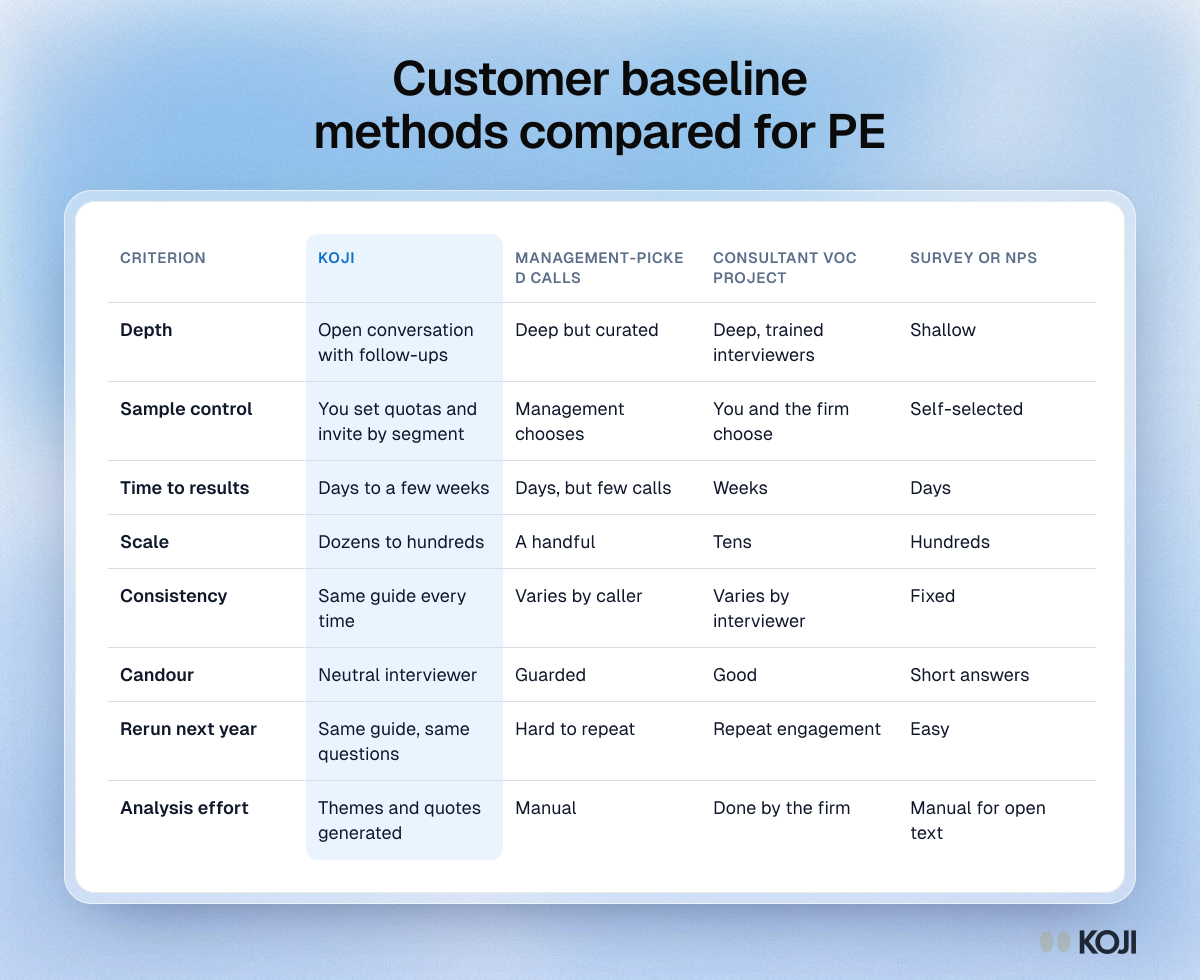
| Criterion | Koji | Management-picked calls | Consultant VoC project | Survey or NPS |
|---|---|---|---|---|
| Depth | Open conversation with follow-ups | Deep but curated | Deep, run by trained interviewers | Shallow |
| Sample control | You set quotas and invite by segment | Management chooses | You and the firm choose | Self-selected |
| Time to results | Days to a few weeks | Days, but few calls | Weeks | Days |
| Scale | Dozens to hundreds | A handful | Tens | Hundreds |
| Consistency | Same guide every time | Varies by caller | Varies by interviewer | Fixed |
| Candour | Participants answer a neutral interviewer | Guarded | Good | Short answers |
| Rerun next year | Same guide, same questions | Hard to repeat | Repeat engagement | Easy |
| Analysis effort | Themes and quotes generated | Manual | Done by the firm | Manual for open text |
Fair notes on the alternatives. A consultant-led voice of customer project is the right choice when you need a trained interviewer on the phone with a hard-to-reach executive; Strategex, for example, describes a customer due diligence programme for a PE buyer of a chemicals manufacturer that surfaced over 200 innovation opportunities (Strategex, via Axial), a result that came from skilled interviewers, not volume. Other AI interview vendors, including User Intuition, publish PE-specific guides; we have not compared prices here.
Five reasons it works for this job:
- Structured and open questions in one interview. The scale and choice answers become distributions you can rerun; the open answers carry the story.
- Personal links from a CSV. You can import the customer list and send each person a link, so you know who responded and can top up thin segments.
- Guardrails. You set the topics the interviewer will not raise, such as the transaction or a planned price change.
- Evidence for every finding. Each finding shows how many participants raised it and links to the quotes.
- Voice, text and phone. Customers pick the mode that suits them, and the same guide works in each.
Questions you might have about AI interviews
Will customers talk to an AI? They will if the invitation is short, comes from the CEO and says how long it takes. The welcome page tells participants how long it takes and that their notes are kept confidential, and a voice interview can be switched to text.
How do I know the answers are real? Each interview gets a quality rating, and only conversations that pass the quality check consume credits. Findings link back to the interviews behind them. See how the quality gate works and tracing report findings to evidence.
What happens to the data? Read AI interview data privacy and security and the GDPR guide before you launch, and check the data-handling terms with the portfolio company's counsel. Bring-your-own-key is available on Enterprise plans for teams that need it (docs).
When Koji may not be the right fit
If your portfolio company sells to fewer than about 15 enterprise accounts, run the calls yourself: each account is worth a personal conversation, and a quota makes no sense at that size. Likewise, if the customers are regulated bodies that require a named human interviewer, or you need a face-to-face site visit, Koji adds little. And an interview baseline does not replace cohort analysis; use both.
Metrics to track
- Completion rate by segment, against quota
- Median interview length
- Share of participants who say "unsure" or "probably not" on renewal
- Dependence score (1 to 10) by segment, and the change at day 180
- Number of themes raised by at least 20% of participants
- Share of top-10 accounts reached
- Days from close to the board readout
FAQ
How many customers should I interview in the first 100 days? Fewer than 40 customers: invite all. 40 to 400: 30 to 60 completes. Over 400: 60 to 100. Include all top 10 accounts and churned accounts from the last 12 months.
When should I field the baseline? Within 60 days of close and before the first pricing, sales or roadmap change.
Who should send the invitation? The portfolio company's CEO, from the company's own address.
Can I run the same study on an add-on acquisition? Yes, use the same guide and a smaller sample. Keep it separate from the platform company so you can compare.
What does it cost? A text interview is 1 credit and a voice interview 3 credits. At the standard rate that is about €1 and €3.
Run the baseline this week
Start from the template in the dashboard, or paste the brief above into "What do you want to research?". See Koji for PE and VC or browse every PE and VC playbook.