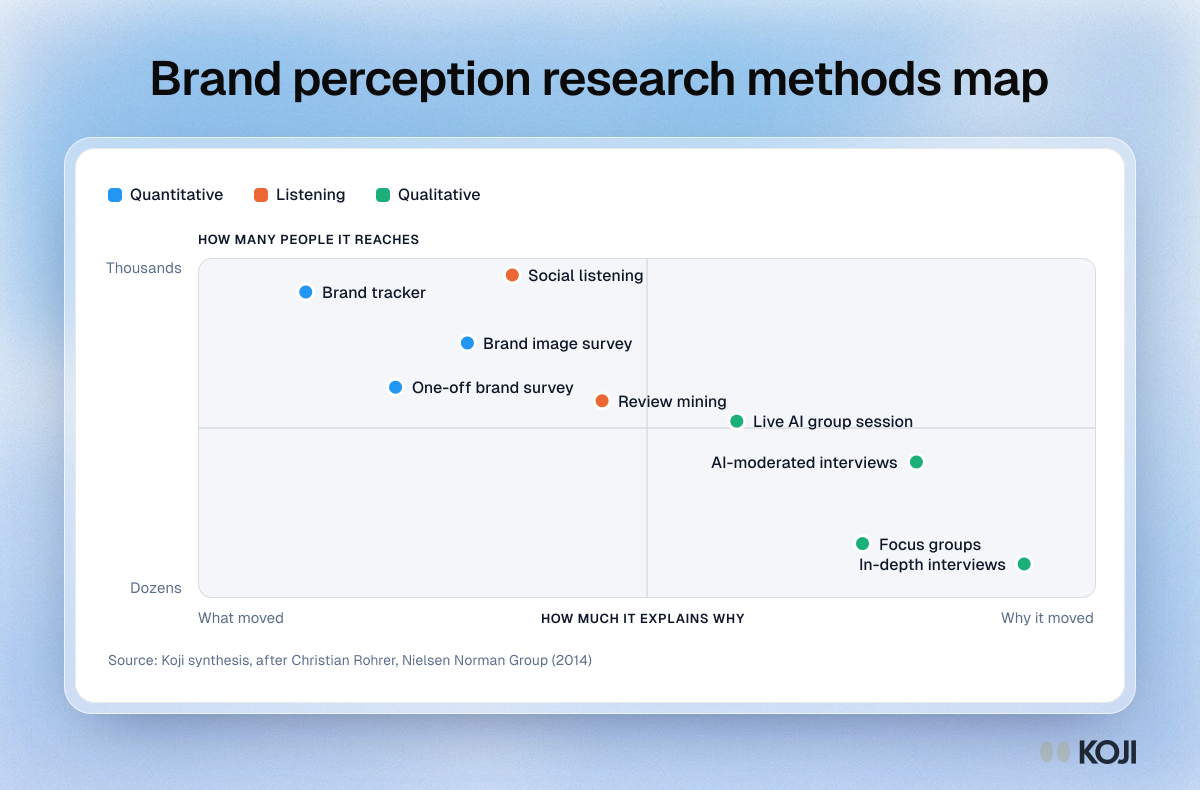
Answer first: Brand perception research software comes in four kinds, and each answers a different question. Brand trackers (YouGov BrandIndex, Tracksuit, Latana) tell you how awareness, consideration and preference move over time against competitors. Social listening tools (Brandwatch, Brand24) tell you what people say about you unprompted, at volume. Survey platforms (Qualtrics, Attest, SurveyMonkey) measure the image attributes you choose to ask about, on a sample you pick. Qualitative and AI-interview tools (Remesh, and AI-moderated interview platforms) tell you why people see you the way they do, in their own words. Most brand teams need one tool for the number and one for the reason. Pick the number tool by budget and cadence, and the reason tool by how fast you need answers after a number moves.
This guide sorts the main tools by method, says who each one suits, and shows how brand teams combine them. Every competitor fact below was checked on the vendor's own pages or listings in November 2026. If you only need a tracker, our brand tracking software comparison goes deeper on that one category.
Why the method matters more than the tool
Brand perception is hard to defend inside a company because it is hard to tie to money. Gartner's survey of 426 senior marketing leaders found that 84% of companies are stuck in a "brand doom loop": under-funded measurement leads to unclear impact, more scepticism and tighter budgets, and companies in that loop were half as likely to beat their growth targets (Gartner, June 2026). The MMA's 2026 State of Brand Marketing Accountability report, from 102 senior marketers, found that only 24% of companies are very aligned with Finance on brand measurement (MMA, 2026).
So buying a brand perception tool is really choosing what evidence you will put in front of a CFO. A tracker gives you a trend line. A listening tool gives you volume and sentiment. A survey gives you a clean measure of the attributes you chose. Interviews give you the reasons and the quotes that make a trend line believable. Buying the wrong kind for the question is the most common mistake, and it's why many teams own a tracker and still can't explain a dip.
How we chose
We included tools that brand and insights teams use to measure or explain how a brand is seen, and grouped them by method rather than scoring them against each other. For each tool we noted the method, what it is best for, how it is priced and whether prices are public. We left out pure social media management tools and full-service agencies. Within each group, tools are listed from the broadest coverage to the most focused.
1. Brand trackers: is the number moving?
Trackers survey a panel continuously or in waves and report funnel metrics (awareness, consideration, preference, usage) against a set of competitors.
- YouGov BrandIndex. Tracks 16 brand health metrics daily for more than 27,000 brands across 56 markets, from YouGov's own panel, with a free BrandIndex Lite version. Pricing is not public. Best for: daily competitive benchmarks across many markets without designing a study.
- Tracksuit. An always-on dashboard that tracks awareness, consideration, preference and usage against your competitive set, with funnel and conversion views. Pricing is not public. Best for: growing consumer brands that want their first continuous tracker.
- Latana. Brand tracking with segment-level reads, sold on modular, custom-quoted plans. Pricing is not public. Best for: brands that need to track specific audience segments, not only the general population.
2. Social listening: what do people say unprompted?
Listening tools collect public posts, news, forums and reviews that mention your brand and classify them by sentiment and topic.
- Brandwatch Consumer Intelligence. Brandwatch says it processes around half a billion posts a day from more than 100 million sources, with history back to 2010, automatic sentiment and emotion classification and competitor benchmarking. Sold as an annual subscription on custom quotes. Best for: large brands that need deep historical and global coverage of online conversation.
- Brand24. Mentions monitoring with sentiment, alerts and reports. Public pricing starts at $199 a month for the Individual plan billed annually, with a 14-day free trial. Best for: smaller teams that want listening running this week without a sales cycle.
Listening is unprompted, which is its strength and its limit: you only hear from people who post, and you can't ask a follow-up question.
3. Survey platforms: how do people rate the attributes we chose?
Surveys measure brand image directly: which words people associate with you, how you score on trust or quality, and how that differs by segment.
- Qualtrics BrandXM. Brand tracking and brand experience on the Qualtrics platform, with benchmarking against competitors and links to business metrics, plus optional research services to design and field the programme. Pricing is quote-based. Best for: enterprises already on Qualtrics that want brand data next to CX data.
- Attest. Consumer surveys with a built-in panel across many countries and an always-on brand tracker option, on custom-priced plans. Best for: brand teams that want to design their own brand reads and field them fast to consumers.
- SurveyMonkey. A general survey tool you can use for brand awareness and image surveys with your own list or its audience panel. Team Advantage is listed at $30 per user a month billed annually, with a three-user minimum. Best for: low-cost, one-off brand perception surveys when you already have the audience.
The limit of every survey is that it only measures what you thought to ask. Our brand perception survey guide has question wording and scales for this route.
4. Qualitative and AI interviews: why do people see us this way?
Interviews and group conversations are where the reasons come from: what someone was thinking when they chose a rival, which asset they'd miss, what a new logo made them feel. Human-moderated in-depth interviews and focus groups go deepest but reach the fewest people. AI-run formats trade a little depth for far more reach and speed.
- Remesh. Live and asynchronous AI-assisted group conversations, with up to 1,000 participants in a live session and up to 5,000 in an asynchronous one. Pricing is not public. Best for: fast reactions from large groups to messages or concepts in a single session.
- AI-moderated interview platforms. One-to-one interviews by voice or text, with follow-up questions on each answer and themes backed by quotes. Our comparison of AI-moderated interview platforms covers the options. Best for: explaining a tracker movement within days, and testing a rebrand, name or ad with real customers before launch.
The brand research interviews guide covers how to run this kind of study.
The tools side by side
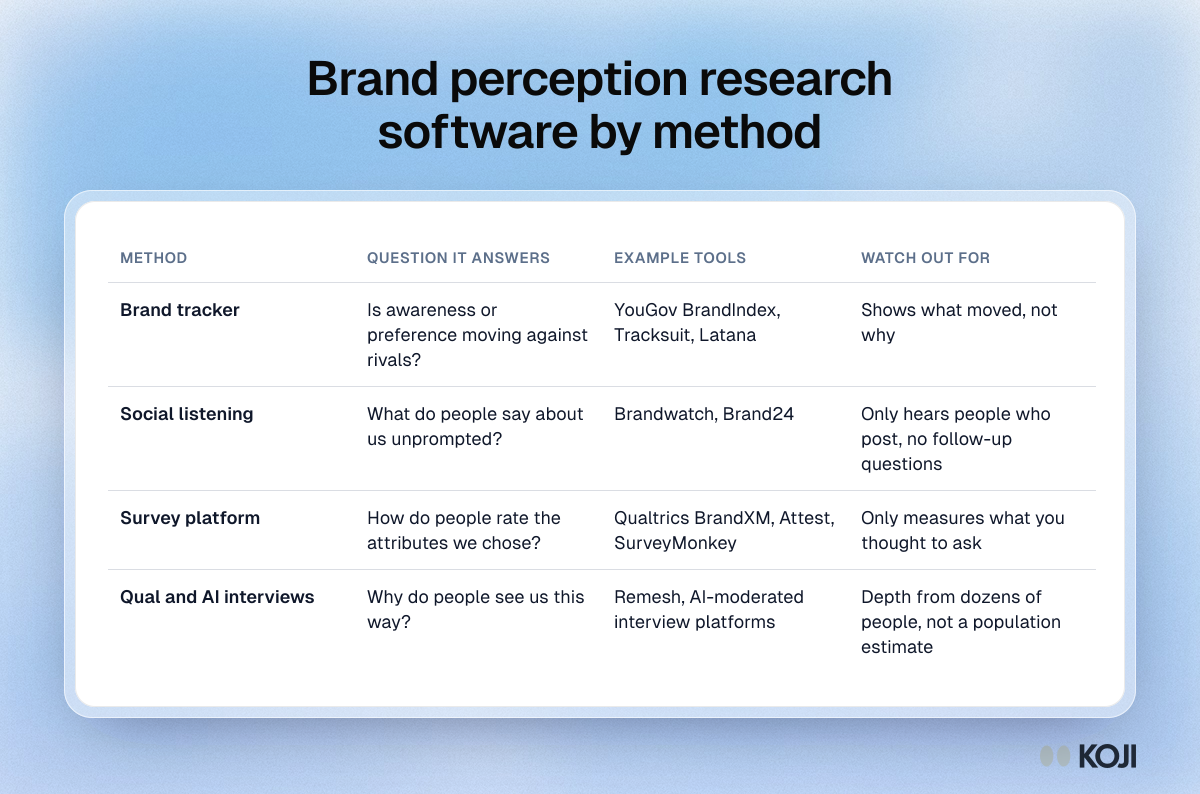
| Tool | Method | Best for | Pricing |
|---|---|---|---|
| YouGov BrandIndex | Tracker | Daily benchmarks across 56 markets | Not public (free Lite version) |
| Tracksuit | Tracker | A first always-on tracker | Not public |
| Latana | Tracker | Segment-level tracking | Not public (custom quote) |
| Brandwatch | Social listening | Deep global conversation history | Not public (annual quote) |
| Brand24 | Social listening | Listening without a sales cycle | From $199/month billed annually |
| Qualtrics BrandXM | Survey | Brand data next to CX in Qualtrics | Not public (quote) |
| Attest | Survey | Self-designed consumer brand reads | Not public (custom plans) |
| SurveyMonkey | Survey | One-off brand surveys on a budget | Team Advantage $30/user/month, annual |
| Remesh | Qual, live groups | Large group reactions in one session | Not public |
Checked November 2026 on vendor pricing pages and listings. Prices change; confirm with the vendor before you buy.
How brand teams combine them
The pattern that works is a number and a reason. A tracker or survey tells you consideration fell four points among 25 to 34 year olds this quarter. It cannot tell you that they now see you as the expensive option since a rival's campaign. That second answer comes from talking to people in that segment, ideally within a week of the wave landing, while the readout is still being written.
A practical cadence for a brand team:
- Track the number quarterly or continuously with a tracker or a repeat survey.
- Listen in between for spikes in volume or sentiment that need a response before the next wave.
- Interview after every surprising movement: 15 to 30 short interviews in the segment that moved, asking about the last time they chose in your category.
- Test before you change anything: concepts, names, logos and ads go in front of customers before launch, not after.
Our brand health report template shows how to bring the number and the reasons into one readout, and how to test a rebrand before launch covers step four.
Where Koji fits (our product)
Koji publishes this guide. Koji is an AI-moderated interview platform, so it belongs in group four. It is not a tracker or a listening tool, and it works best next to one, as the layer that explains why the number moved. More on how brand and marketing teams use it on the Koji for marketing teams page.
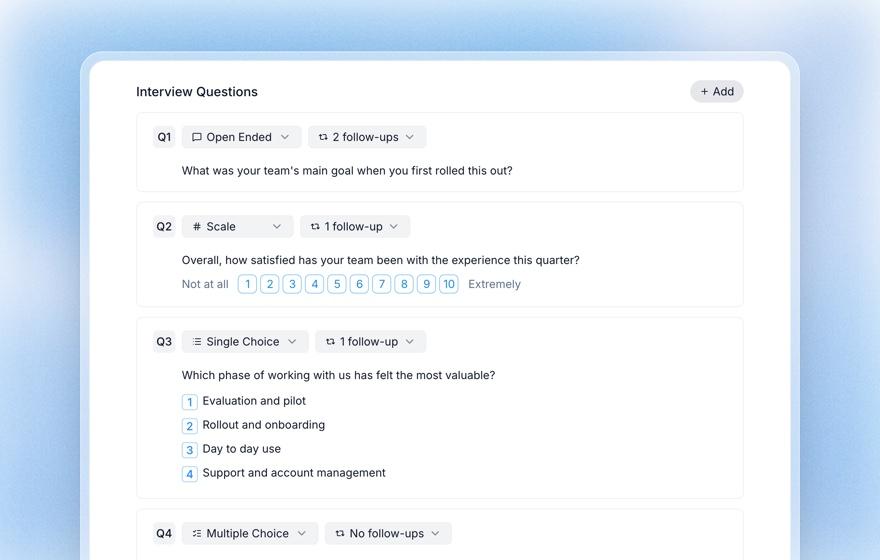
- Explaining a tracker movement: the AI interviewer runs one-to-one interviews by voice, text or phone and asks follow-up questions on each answer. Every theme in the report comes with the verbatim quotes behind it.
- Concept, logo and ad tests: attach an image to any question, or show it full screen for 3, 5, 10 or 15 seconds and then hide it, for a first-impression test followed by questions about what people remember.
- Waves and segments: duplicate a study to rerun the same questions each wave, and use branching with a value in the interview link (such as a wave or segment code) so each group gets its own questions.
- Fair choice questions: answer options can be shuffled for each participant so the first option isn't favoured.
- Reaching people: invite your own customers, or recruit from a panel in 130+ countries on paid plans. Interviews run in 33 languages.
- The readout: download any report as an editable PowerPoint deck or a PDF.
What it costs. Credits cost €1: a text interview uses 1 credit and a voice interview 3, and only interviews that score 3 or more out of 5 on quality use credits. The Insights plan is €29 a month with 29 credits, the Interviews plan €79 a month with 79 credits and three seats, and Enterprise is priced by contract. Twenty voice interviews after a tracker wave use 60 credits, about €60 before incentives or panel costs.
When Koji is the wrong choice. If you need a statistically robust trend line across thousands of people every month, use a tracker. If you need to monitor what is being said online in real time, use a listening tool. Koji gives you depth from dozens of interviews, not a population estimate.
Next step
When your next tracker wave lands, pick the segment that moved and interview 15 to 20 people in it that week. See how brand teams set this up on Koji and start with the free signup credits.