Short answer: dscout and User Interviews solve different problems. dscout is a research platform built around diary studies ("missions"), short video responses and live sessions, sold on quote-based annual contracts with no public prices. User Interviews is a recruiting marketplace: it finds, screens, schedules and pays participants for research you run somewhere else, with a published rate of about $49 per completed session on Pay As You Go. Pick dscout if you need people to record their lives over days or weeks. Pick User Interviews if you already have a way to run sessions and just need the right people in them. If what you actually need is the interviews themselves, recruited, run and analysed in one place, an AI interview platform such as Koji covers both halves, on self-serve pricing.
People search "dscout vs User Interviews" because both show up when you need participants. That's where the similarity mostly ends. One sells a way of doing research. The other sells access to people. Knowing which one you're buying saves a long sales cycle.
The quick comparison
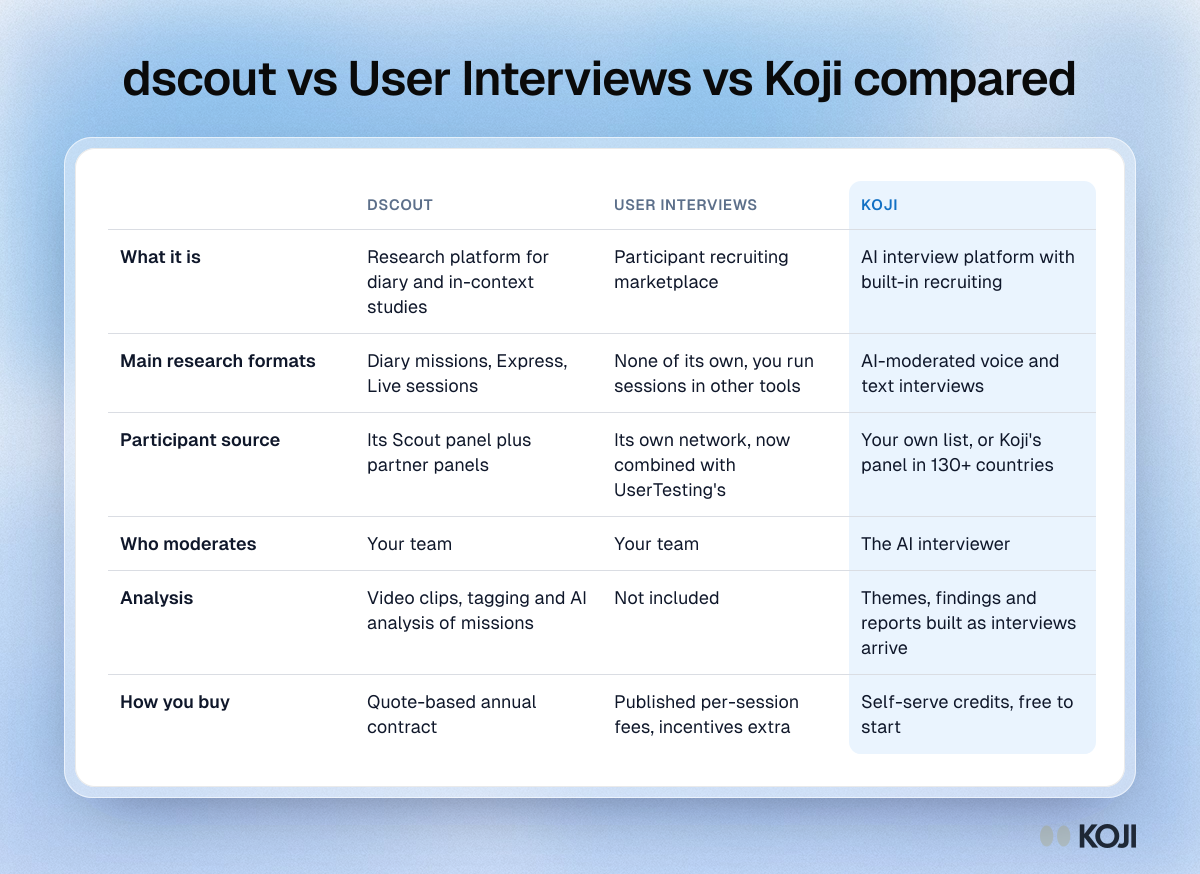
Here is how the three options line up on the things buyers usually ask about first.
| dscout | User Interviews | Koji | |
|---|---|---|---|
| What it is | Research platform for diary and in-context studies | Participant recruiting marketplace | AI interview platform with built-in recruiting |
| Main research formats | Diary missions, Express, Live sessions | None of its own, you run sessions in other tools | AI-moderated voice and text interviews |
| Participant source | Its Scout panel plus partner panels | Its own network, now combined with UserTesting's | Your own list, or Koji's panel in 130+ countries |
| Who moderates | Your team | Your team | The AI interviewer |
| Analysis | Video clips, tagging and AI analysis of missions | Not included | Themes, findings and reports built as interviews arrive |
| How you buy | Quote-based annual contract | Published per-session fees, incentives extra | Self-serve credits, free to start |
What dscout does best
dscout made its name on diary studies. Participants, called Scouts, complete "missions": a sequence of short prompts answered with video, photos and text over days or weeks, in the place where the behaviour happens. If you want to see how someone actually cooks dinner on a Tuesday, or how a nurse uses a device across a full shift, that in-context video is hard to beat.
Around the diary product, dscout sells Express (short, fast missions for quick reactions) and Live (moderated video interviews inside the platform). Its own materials describe a pool of 100,000+ active, verified Scouts, plus 3 million+ more participants reached through partner panels (dscout). The same page lists AI features for spotting AI-generated responses during recruiting and for refining questions and drafting follow-ups.
Where dscout gets harder is cost and access. There is no self-serve tier. PricingSaaS lists all three plans (Core, Select and Enterprise) as price not disclosed (PricingSaaS), and our own dscout pricing breakdown found negotiated contracts with a median near $49,250 a year. That makes sense for a research team running several longitudinal studies a year. It's a lot for a product manager with one question.
What User Interviews does best
User Interviews does one thing and does it well: it gets qualified people into your sessions. You write a screener, set targeting, and it handles outreach, scheduling, reminders and incentive payouts. Then you run the session in Zoom, Lookback, Maze or whatever you already use.
Its scale grew this year. In January 2026, UserTesting announced it had acquired User Interviews. At the time User Interviews reported a network of more than 6 million participants, and UserTesting said it serves more than 3,000 customers, including 75 of the Fortune 100 (Business Wire). Its 2026 Panel Book now describes a combined, de-duplicated network of 7.6 million participants, and reports a 7.3% no-show rate for moderated sessions (User Interviews Panel Book).
Pricing is published, which is rare in this category. Third-party listings put Recruit at about $49 per completed session on Pay As You Go and $41 on the Essential annual plan, which carries a 60-session minimum (G2). Incentives are paid on top. For B2B audiences, targeting add-ons and higher incentives push the real cost per participant far above the headline fee, as we worked through in User Interviews pricing.
The limit is the product boundary. User Interviews fills your calendar. Someone on your team still has to run every session, take notes and turn 20 hours of calls into findings.
The real difference: method versus supply
Put plainly:
- dscout is a method. You buy it because you want diary or in-context research, and recruiting comes bundled with it.
- User Interviews is supply. You buy it because you already know how you'll run research and you're short on people.
That's why "which is better" is the wrong question. A team that needs a three-week diary study of new parents won't get it from User Interviews alone. A team that needs 12 senior finance leads on Zoom next week will find dscout's contract model slow and expensive for that job.
The common thread is recruiting. In a UserTesting survey of enterprise UX teams, recruiting participants was the most-cited challenge, with 47% of votes (UserTesting). Both tools exist because finding the right people is the slowest part of research. Neither, on its own, removes the second slowest part: running and analysing the conversations.
Where Koji fits
Koji takes a third route. Instead of selling a diary method or a list of people, it runs the interviews.
You describe what you want to learn, and Koji drafts the research brief and interview guide. Participants then talk to an AI interviewer by voice or text, in their own language (28 are supported), and it asks follow-up questions the way a trained moderator would. Answers turn into themes, findings and a report while the study is still in field.
For participants, you have two options:
- Bring your own. Share an interview link, or import a CSV and give each person their own private invite link (importing participants). Personal links are available on the Interviews and Enterprise plans.
- Recruit from Koji's panel. From a study's Panel recruit tab, describe your audience in plain language, and Koji finds them through the Cint Exchange in 130+ countries. You see the price per completed interview before launch, and launching needs a paid plan. See panel recruitment for how targeting and pricing work.
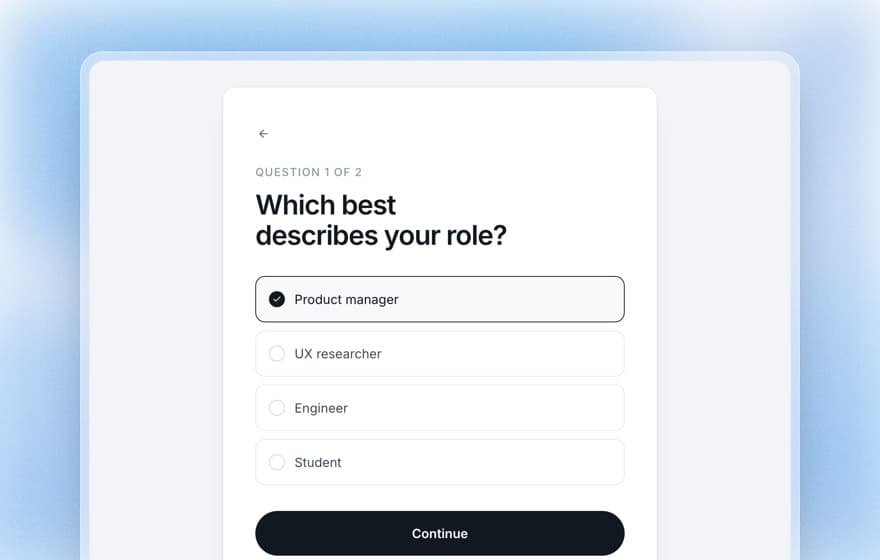
Screening questions run before every interview, whichever route the participant came in by, and anyone who doesn't qualify is turned away (screener questions guide).
You also don't pay for weak conversations. Every interview gets a quality score from 1 to 5, and only those scoring 3 or more use credits or enter the report (how the quality gate works). For panel interviews, a respondent has to answer at least 60 percent of the study's interview questions to count as a complete. Otherwise you are not charged for them.
Costs are simple. One credit is €1. A text interview uses 1 credit and a voice interview 3. Plans start at €29 a month for Insights, with Interviews at €79 a month, and there is a free tier to try it.
What Koji doesn't do is multi-week diary missions with photo and video uploads. If watching behaviour unfold in someone's kitchen over 14 days is the point of your study, dscout is built for that. Our diary study guide covers when that method is worth its cost.
Who should pick which
Choose dscout if you run longitudinal or in-context research several times a year, need participant video as evidence, and have an annual research budget that can absorb a quote-based contract.

Photo by Vitaly Gariev on Unsplash
Choose User Interviews if you have researchers who moderate their own sessions, already own the tools to run and analyse them, and mainly need a reliable supply of screened people, including B2B professionals.
Choose Koji if you want the conversations themselves: dozens of in-depth interviews with your customers or a targeted audience, run without scheduling a single call, and analysed by the time the last one finishes. It suits product managers, founders and small research teams who'd otherwise spend weeks on recruiting and moderation.
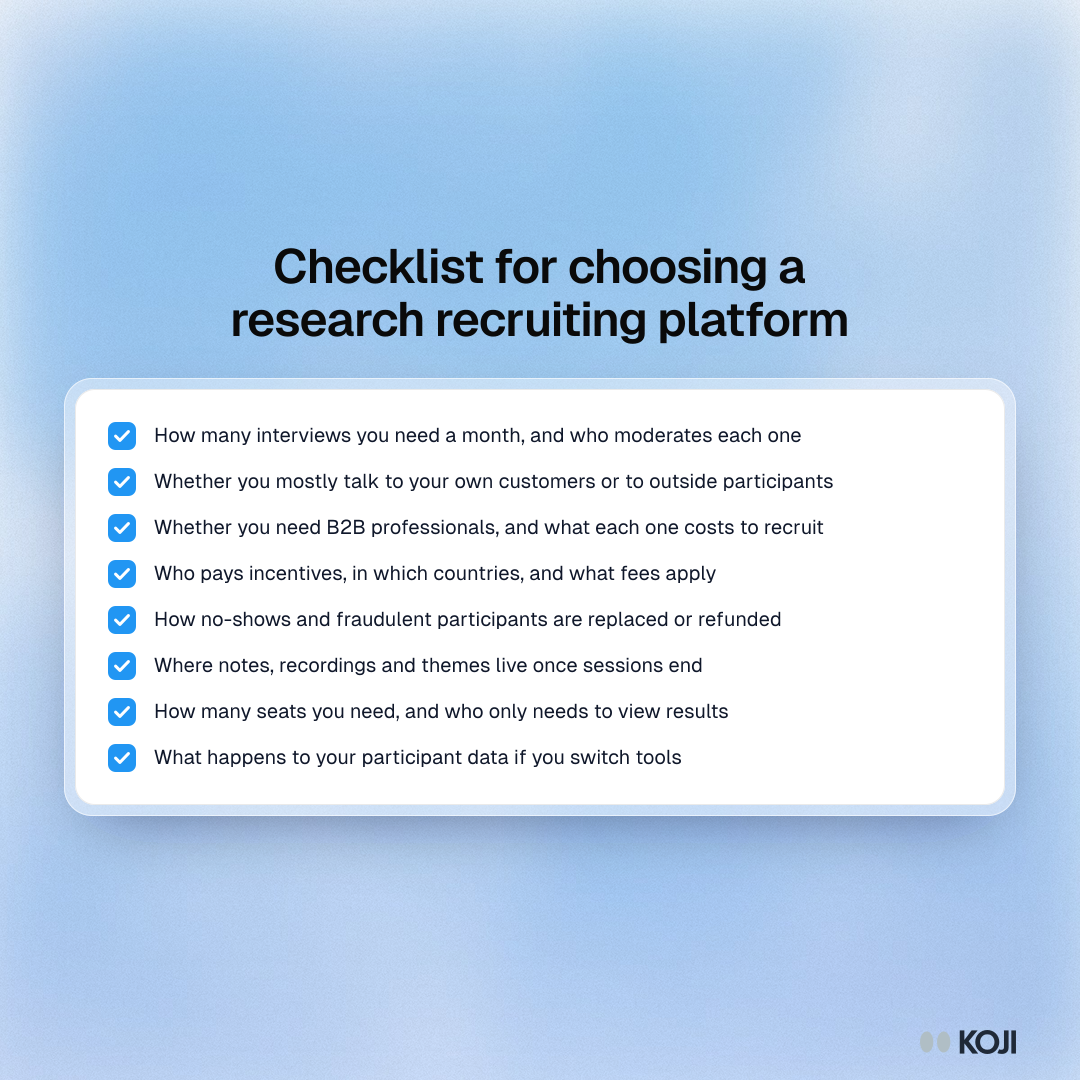
Some teams use more than one. A research team might keep dscout for an annual diary study and run Koji for the weekly questions that come up between big projects. Before you sign anything, work through the questions below with your team.
The bottom line
dscout and User Interviews are both good at what they were built for. dscout gives you rich, in-context diary research at enterprise prices. User Interviews gives you people, transparently priced, and leaves the research to you. Neither one interviews anyone for you.
If your real bottleneck is getting from a question to evidence, try running the study in Koji. Write your research question, pick your participants or recruit from the panel, and read the first findings the same day. Start free on Koji and see what your audience says.