Looppanel's current pricing has two plans. Pro is listed at $4,200 a year (about $350 a month, billed annually) with 360 transcription hours, 120 uploads and 5 editors. Enterprise is a custom quote that adds more hours, 10 editors and security extras such as SSO, PII redaction and automatic data deletion. Third-party trackers also report a month-to-month Pro price of about $395. There is no permanent free plan, and the old $30-a-month solo tier is no longer on the pricing page.
That is the short answer. The longer one is about what you are paying for. Looppanel analyzes interviews you have already run. It does not recruit participants or moderate interviews, so the subscription is only one part of what a study really costs. This guide covers each plan, what the limits mean in practice, and when an AI interviewer like Koji is the better buy.
Looppanel plans and prices in 2026
| Pro | Enterprise | |
|---|---|---|
| Price | $4,200/year (about $350/month billed annually) | Custom quote |
| Monthly billing | About $395/month (reported by third parties) | Custom |
| Transcription | 360 hours a year (30 a month) | Custom |
| Uploads | 120 a year | Custom |
| Editors | 5 included, extra editors at $75/month up to 10 | 10 included |
| Security | SOC 2 Type II, GDPR, encryption, role-based access | Adds custom SSO, PII redaction, auto data deletion |
Sources: Looppanel's pricing and security pages as indexed in October 2026, plus pricing trackers xpay and ColdIQ. Looppanel's own comparison table lists Pro editors in two different ways, so confirm the seat count with sales before you sign.
What changed from older Looppanel pricing
If you have seen Looppanel pricing quoted at $30 a month, that is out of date. Aggregators such as Toolify and TrustRadius still list earlier tiers: a Starter or Solo plan at about $30 a month with 10 transcription hours, a Teams plan at around $300 to $350 a month and a Business plan at $1,000 a month. The current page starts at Pro, so a solo researcher now pays the same entry price as a five-person team.
Is there a free trial?
Sources disagree. ColdIQ reports a one-month free trial on both plans, G2 and TrustRadius mention a trial without saying how long it lasts, and other trackers say a trial is only available on request. Some G2 reviewers say the trial was too limited to explore the product properly. Ask for the trial terms in writing before you book a demo.
What Looppanel does well
Looppanel is a focused analysis tool for researchers who run their own calls. It joins Zoom, Google Meet and Microsoft Teams calls to record them, or takes uploaded recordings. It then produces transcripts in 17 languages, automatic notes mapped to your discussion guide, tags and themes, video clips and a searchable repository.
Reviewers like how quickly it goes from a recording to a first synthesis. On G2 it holds 4.6 out of 5 from 26 reviews, and several reviewers call it a cheaper alternative to Dovetail. The complaints are mostly about customization and search, plus the trial limits mentioned above.
That speed matters. In Lyssna's 2025 Research Synthesis Report, 65.3% of researchers said synthesis takes them one to five days per project, and 59% named reading through the data as their biggest time sink. A tool that cuts that reading time pays for itself quickly if you run calls every week.
What Looppanel pricing does not cover
The subscription covers analysis. Three costs sit outside it:
- Recruiting. Looppanel's own blog says you "cannot recruit users or build participant profiles" in the product. You still need a panel, a recruiting service or your own customer list, plus incentives.
- Moderation time. Every hour Looppanel transcribes is an hour someone on your team spent running the call, plus scheduling, no-shows and prep.
- Seats beyond five. Extra editors are $75 a month each, which adds $900 a year per person on top of the $4,200.
So the real question is not "is $4,200 a lot?" It is how many interviews your team can run in a year, and what each one costs once you add the people.
The cost per interview, worked out
Take Pro at $4,200 a year with 360 transcription hours. If your interviews run 45 minutes, that is up to 480 interviews a year, or about $8.75 of software per interview. Few teams use every hour, though. A team running 10 interviews a month (120 a year) pays $35 per interview in software alone, before recruiting, incentives or researcher time.
The bottleneck is usually people, not software. In Maze's Future of User Research Report 2025, 63% of product professionals named time and bandwidth as their biggest research challenge. Looppanel speeds up the analysis of each call, but somebody still has to hold the call.
Who Looppanel is right for
Looppanel is a good fit when:

Photo by Vitaly Gariev on Unsplash
- You have researchers who moderate interviews every week and want faster notes and synthesis.
- Your interviews already happen in Zoom, Meet or Teams, and you want them recorded and searchable in one place.
- You need SOC 2 Type II and GDPR compliance, and can pay for Enterprise if you need SSO or PII redaction.
- Five editors covers your team, or you are ready to budget for more.
It is a weaker fit if you are a solo founder or PM (the entry price is now a team price), if you want surveys or quantitative work alongside interviews, or if you do not have time to run the calls yourself.
Looppanel vs an AI interviewer
The industry is moving toward AI at both ends of the interview. In User Interviews' State of User Research 2025, 80% of researchers said they use AI in their work, up 24 points in a year. The same survey found 91% worry about accuracy and hallucinations. That worry is fair, and it is why traceability (every finding linked back to what a participant actually said) matters more than any feature list.
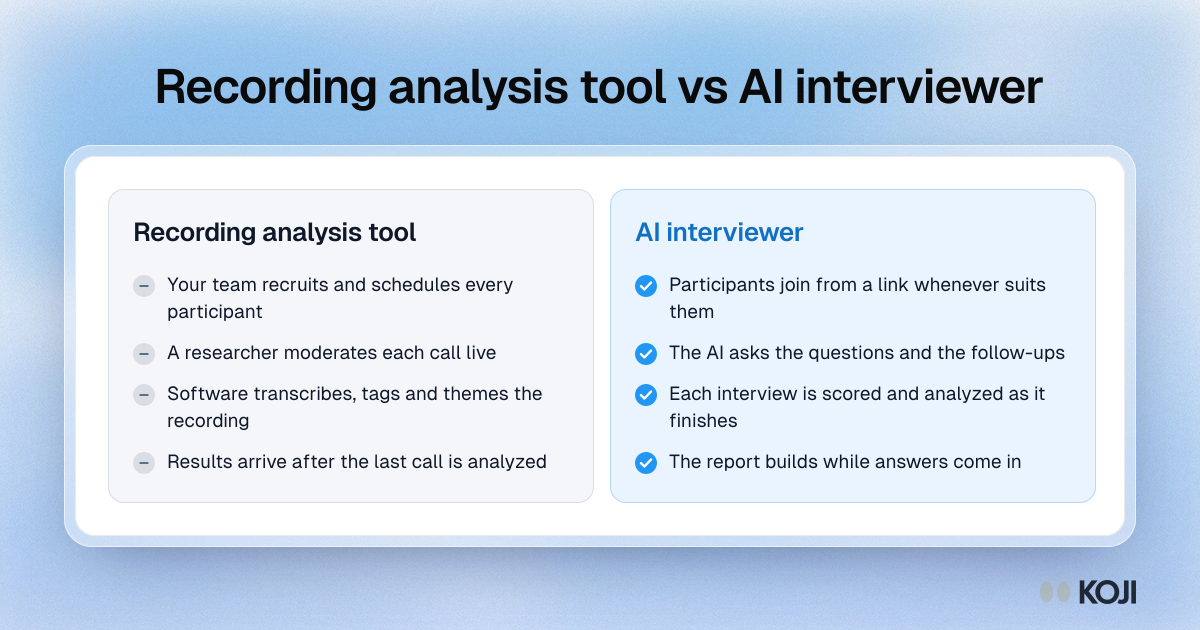
Looppanel puts AI on the analysis side. An AI interviewer like Koji puts it on both sides: it runs the interview and then analyzes it.
How Koji works
With Koji you describe what you want to learn, and Koji drafts a research brief with interview questions. You can preview the interview yourself, then share a link. Participants talk to an AI interviewer by voice or text, in 28 languages, whenever suits them. The interviewer asks follow-up questions based on what each person says, so you get the depth of a moderated call without booking one.
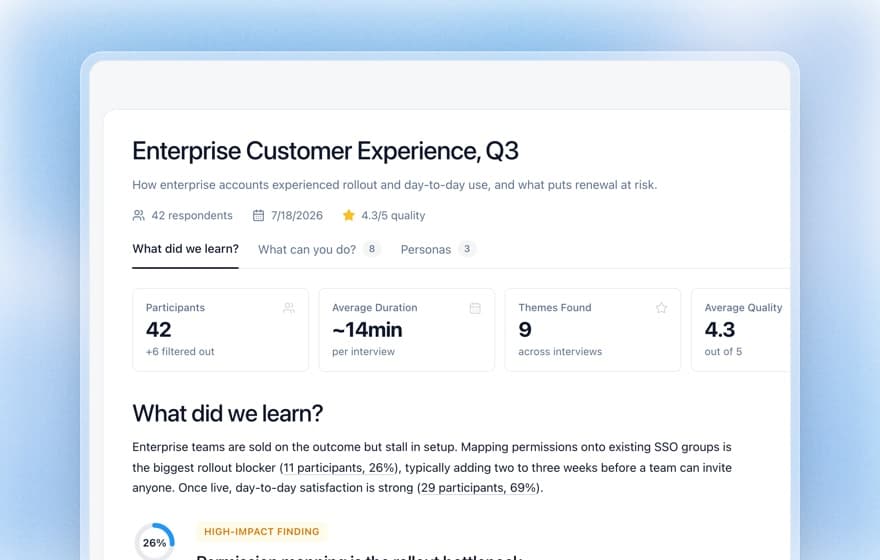
Each interview gets a quality score from 1 to 5, and only interviews scoring 3 or more use credits or go into the report (how the quality gate works). Koji then writes the report: themes, findings backed by supporting quotes, personas and a summary (generating research reports).
You can bring your own participants with a link or personalized invite links, add screening questions, or recruit from Koji's research panel on paid plans (panel recruitment).
Koji pricing next to Looppanel
| Looppanel Pro | Koji | |
|---|---|---|
| Entry price | $4,200/year | Free to start with 10 credits, no card |
| Paid plans | Pro or custom Enterprise | Insights €29/month (29 credits), Interviews €79/month (79 credits), Enterprise |
| What you pay for | Transcription hours, uploads, editors | Completed interviews: 1 credit for text, 3 for voice, €1 per extra credit |
| Who moderates | Your team | Koji's AI interviewer |
| Recruiting | Not included | Your own list, links, or Koji's panel on paid plans |
| Low-quality sessions | Count toward your hours | Free: only interviews scoring 3+ use credits |
On the Interviews plan, €79 a month covers 79 text interviews or 26 voice interviews, analyzed and reported, with no moderator time.
How to choose
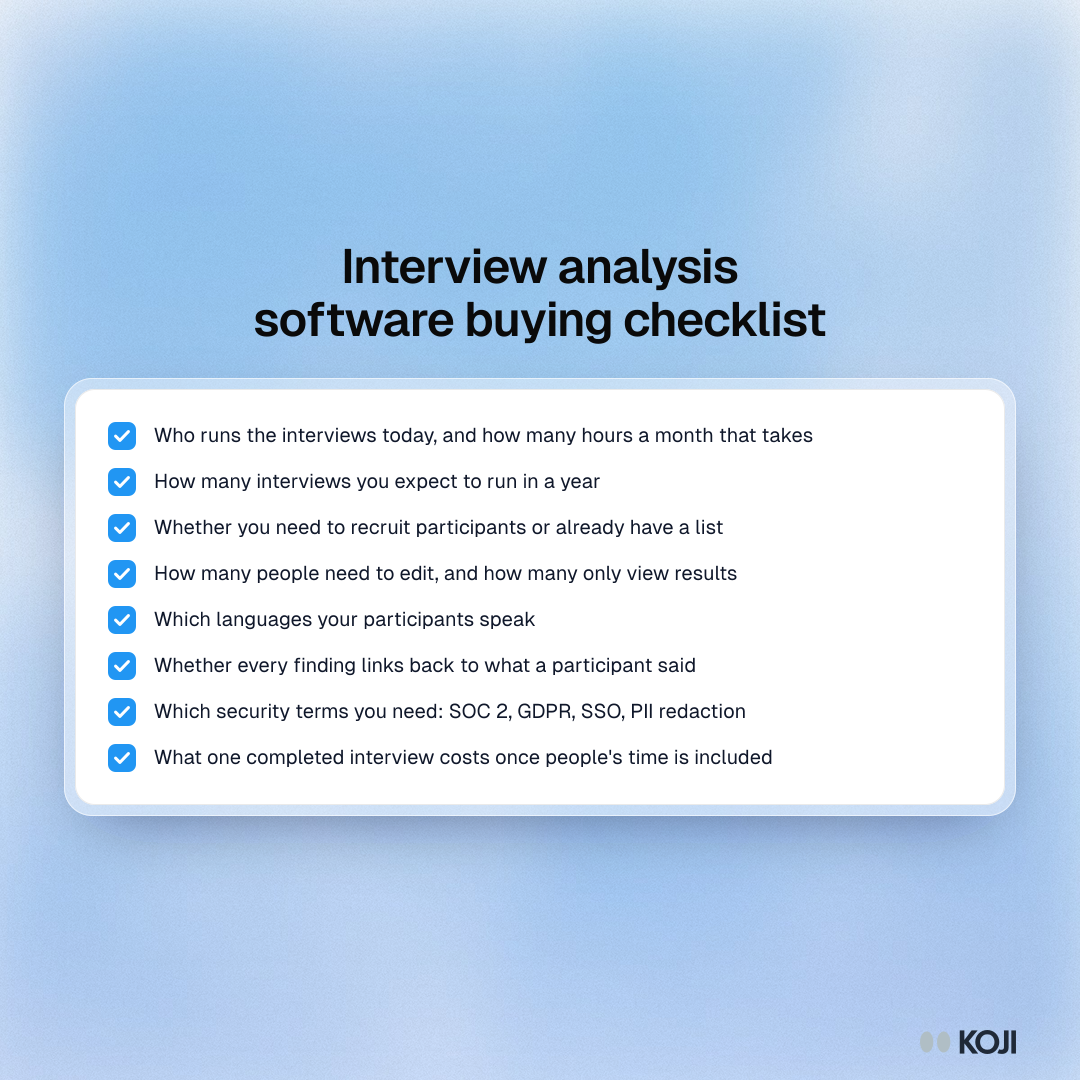
Pick Looppanel if your researchers already run plenty of calls and analysis is where the time goes. Pick an AI interviewer if the calls themselves are the bottleneck, if you need answers in days rather than weeks, or if you want to hear from far more people than your team can schedule. Plenty of teams use both: human-moderated sessions for the hardest conversations, AI interviews for breadth.
Try Koji free
If your problem is too few interviews rather than slow analysis, start a Koji study free with 10 credits and no card. Write one research question, preview the interview, and share the link. Your first report can be ready the same day the answers come in.