

Most customer interviews fail before they begin.
Not because the product idea is bad. Not because the customers are lying. But because the questions are designed — consciously or not — to get validation rather than truth.
Rob Fitzpatrick's book The Mom Test diagnoses this problem with devastating clarity: if you ask your mom whether your business idea is good, she will say yes. She loves you. She does not want to hurt your feelings. And your customers, without even realizing it, do the same thing.
This guide covers the core Mom Test principles, gives you proven question templates, and explains why the hardest part of running good customer interviews is not talking to the right people — it is asking the right questions.
What Is the Mom Test?
The Mom Test is a set of rules for customer interviews developed by entrepreneur and author Rob Fitzpatrick. The core premise: most founders (and product managers) ask customer interview questions in a way that elicits polite encouragement rather than useful data.
The name comes from a simple thought experiment: if you ask your mom "Do you think this app is a good idea?", she will say yes — because she loves you, not because she has evaluated your market opportunity. The same dynamic plays out in most customer conversations. People are socially conditioned to be encouraging, to avoid conflict, and to give the "helpful" answer rather than the honest one.
The Mom Test's rules fix this by making questions about customer reality, not your idea.
The Mom Test is now core curriculum at Harvard, UCL, and EU startup accelerators including Seedcamp and Microsoft Ventures, and has been adopted by product teams at Shopify and hundreds of other companies.
The Three Rules of the Mom Test
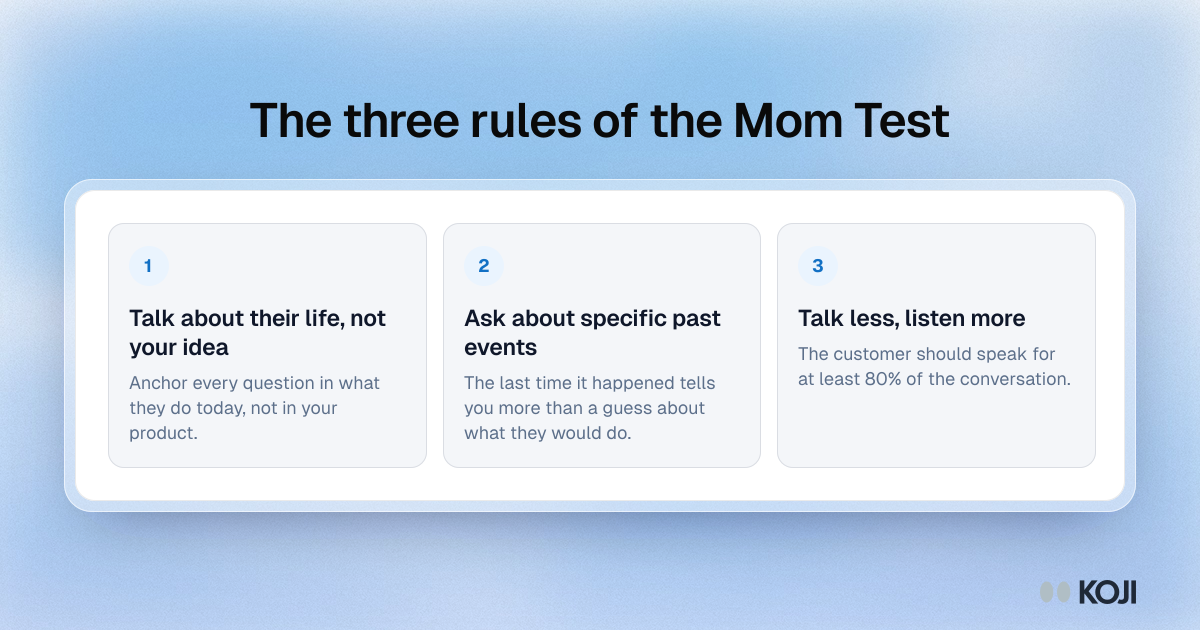
Rule 1: Talk About Their Life, Not Your Idea
Every question should be anchored in the customer's actual experience — what they currently do, what frustrates them, what workarounds they have built. Your idea should not enter the conversation.
This sounds counterintuitive. You have a product. You want to know if it will work. But the moment you describe your idea, the conversation becomes about your feelings. The customer starts optimizing for not hurting you.
When you keep the conversation on their life, you get honest data. You learn whether the problem actually exists, how significant it is, and what they are already doing about it.
Bad: "Do you think an AI interview tool would be useful for your team?" Good: "How do you currently collect customer feedback? Walk me through what that process looks like."
Rule 2: Ask About Specific Past Events, Not Hypotheticals
Hypothetical questions produce hypothetical answers — and hypothetical answers are worthless for product decisions.
"Would you use this?" — "Sure, probably." This tells you nothing. People routinely overestimate their future behavior, especially when they want to be helpful.
"Tell me about the last time you tried to get feedback from customers. What happened?" — Now you are in the territory of real behavior. Past events are factual. The customer cannot embellish their past behavior as easily as they can construct a rosy hypothetical future.
Bad: "Would you pay $50/month for this?" Good: "What are you currently paying for tools in this category? What did the decision-making process look like when you bought the last one?"
Rule 3: Talk Less, Listen More
The third rule is the most difficult because it is about ego.
Founders and PMs tend to over-talk in customer interviews. They describe the product. They explain the vision. They fill silences with enthusiasm. Every word they speak is an opportunity for the customer to say "oh yes, that sounds great" — which is meaningless data.
The job of an interviewer is to ask and listen, not to pitch and persuade. A useful ratio: the customer should speak for at least 80% of the conversation.
When you catch yourself talking more than 20% of the time, you have stopped doing customer research and started doing sales.
Why Good Questions Are So Hard to Write
The core difficulty of customer interviews is that good questions feel uncomfortable to ask.

Photo by Ninthgrid on Unsplash
Bad questions feel comfortable because they are really validation-seeking in disguise:
- "Would you find this useful?" (seeking yes)
- "How much would you pay for this?" (seeking high number)
- "Do you have this problem?" (seeking confirmation)
Good questions feel risky because they might surface negative information:
- "How are you currently solving this? What does that actually cost you?" (might reveal they have a fine solution)
- "What have you tried before? Why did that not work?" (might reveal they gave up because the problem was not worth solving)
- "How much time does this problem cost you in a typical week?" (might reveal it is not a real problem)
The discomfort of potentially hearing bad news is why most customer research is unconsciously designed to avoid it.
The Mom Test Question Framework: Full Template
Here is a complete Mom Test-compliant interview structure covering the key areas of customer research:
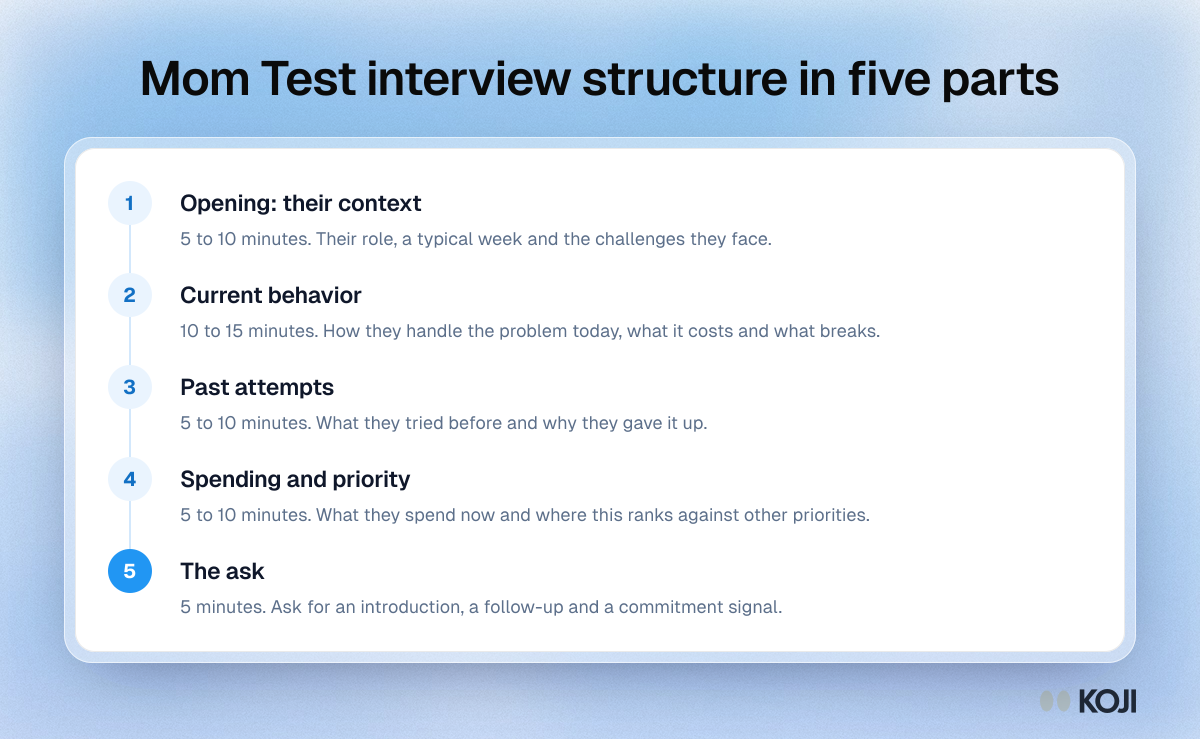
Opening: Establish Their Context (5–10 minutes)
- "Tell me about your role and what a typical week looks like for you."
- "What are the biggest challenges you're trying to solve right now in [problem area]?"
- "How long have you been dealing with this problem?"
What you are learning: Whether the problem space is real and how central it is to their work.
Current Behavior (10–15 minutes)
- "Walk me through exactly how you handle [problem] today. Start from the beginning."
- "What tools or processes are you using? How did you settle on those?"
- "What does that cost you — in time, money, or frustration?"
- "What breaks down in that process?"
- "What workarounds have you built?"
What you are learning: The current solution landscape and its real pain points. Workarounds are gold — they reveal pain that customers have accepted as inevitable.
Past Attempts (5–10 minutes)
- "Have you tried to solve this differently in the past? What happened?"
- "What made you give up on that approach?"
- "Have you looked at other tools? What made you not switch to them?"
What you are learning: The history of failed solutions, which tells you why the problem is hard and what the real barriers to switching are.
Spending and Priority (5–10 minutes)
- "What are you currently spending on [category of solution]?"
- "How does fixing this problem rank against other priorities for you right now?"
- "Has anyone in your team been tasked with solving this specifically?"
What you are learning: Whether the problem is prioritized enough to buy a solution for — and what budget already exists.
The Ask (5 minutes)
At the end of a useful interview, there are three asks you can make:
- Ask for an introduction: "Who else do you know that deals with this problem I should speak to?"
- Ask for a follow-up: "Would you be open to a follow-up conversation once we've built something to show?"
- Ask for a commitment signal: "If we solved this, would you want to be an early tester?"
Commitment signals (time, reputation, money) separate genuine interest from social encouragement. Treat verbal enthusiasm without a commitment signal as noise.
The Four Biggest Mom Test Violations
Violation 1: Describing Your Solution
The moment you describe what you are building, you have contaminated the data. The customer's subsequent responses are reactions to your pitch, not honest assessments of their problem.
Keep your solution out of the conversation until you have finished collecting data. You can mention you are working on something in the space — but do not explain what it does.
Violation 2: Asking for Opinions About the Future
"Do you think this would be useful?" and "Would you use this?" are questions about a hypothetical future. Humans are poor predictors of their own future behavior, especially when being polite.
Always anchor questions in the past: "The last time you dealt with this problem, what did you do?" produces factual data. "What would you do if this product existed?" produces confabulation.
Violation 3: The Compliment Trap
When a customer says "That's a really cool idea," resist the urge to feel good about it. Compliments are social lubricant, not market validation. A compliment is worth nothing unless it is accompanied by a commitment: time, money, reputation, or a referral.
When you hear enthusiasm, probe it: "I'm glad you think so — what would make you actually want to try it?" Then notice whether their answer involves a concrete commitment or another compliment.
Violation 4: Talking to the Wrong People
The Mom Test rules apply to the actual people who will pay for and use your product. Talking to adjacent stakeholders — academics who study the problem, consultants who advise on it, journalists who write about it — produces interesting conversations but not customer data.
Identify who specifically is experiencing the problem, who makes the purchase decision, and who uses the product day-to-day. These may be three different people, and you need to talk to all of them.
How the Mom Test Applies to Scale: AI-Moderated Interviews
The Mom Test was written for founders doing customer discovery — typically 5–20 interviews before building. But the principles apply equally to ongoing product research at any scale.
Here is the challenge: applying Mom Test principles consistently across 50+ customer interviews is operationally difficult. Human interviewers drift — they start seeking validation when they hear discouraging answers, they fill silences with hints about the product, they skip follow-up probes when they are tired.
Koji's AI-moderated interview platform is structurally immune to these failure modes:
No validation-seeking: Koji's AI interviewer does not have an emotional stake in the research outcome. It asks probing follow-up questions ("Tell me more about that," "What happened next?") without pushing toward any particular answer. This is exactly what the Mom Test demands — a neutral interviewer who listens rather than pitches.
Past-event anchoring by design: Koji studies are structured to ask about specific past behavior and current workarounds before introducing any product framing. The 6 question types — open_ended, scale, single_choice, multiple_choice, ranking, and yes_no — are applied in a sequence that matches Mom Test principles: qualitative exploration first, structured benchmarks after.
Consistent probing across all participants: Whether it is the 5th or the 50th interview, Koji applies the same probing depth. It never gets tired, never gets excited, and never lets a "that's a great idea!" go unprobed.
Scale that manual interviews cannot match: The Mom Test recommends 50–100 customer conversations before making major product decisions. That is operationally impossible for most teams using traditional interviews. Koji makes it routine — sending a study link to 100 customers and receiving synthesized analysis within 48 hours.
Mom Test Interview Questions: Ready-to-Use Templates
Here are question templates you can use in a Koji study or a manual interview, organized by Mom Test compliance:
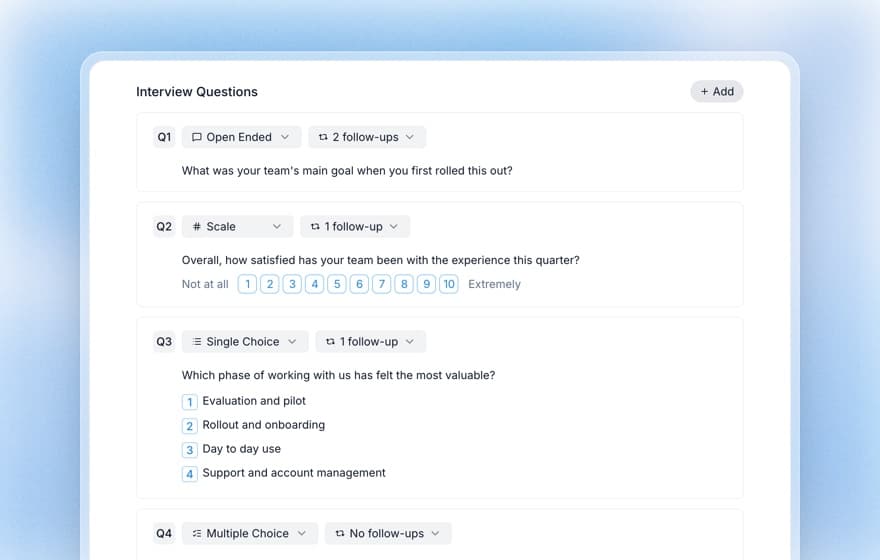
Current situation (open_ended): "Walk me through how your team currently handles [problem area]. Start from the beginning and describe what actually happens."
Pain depth probe (open_ended): "What's the most frustrating part of that process? Tell me about a specific time recently when that frustration really hit you."
Workaround discovery (open_ended): "What have you built or hacked together to make this work? What does that actually cost you in time or money?"
Problem frequency (scale): "How often does this problem come up in your work?" Scale: 1 (Rarely) to 5 (Every day)
Current spending (single_choice): "What's your team currently spending to handle this problem?" Options: [Nothing — we manage manually, Under $100/month, $100–$500/month, $500–$2,000/month, Over $2,000/month]
Priority ranking (ranking): "Please rank these challenges in order of urgency for your team right now:" Options: [Problem A, Problem B, Problem C, Problem D]
Past attempts (open_ended): "What have you tried before to solve this? What made you move away from that approach?"
Solution commitment (yes_no): "Is solving this problem on your team's active roadmap or budget for the next 3 months?"
The Mom Test for Product Teams, Not Just Founders
Most of the Mom Test's coverage focuses on early-stage founders. But the same principles apply to product managers running discovery for existing products:
-
Feature validation failure: "Would you use a dashboard feature that showed X?" produces the same polite yes as "Would you use this app?" Ask instead: "How do you currently track X? What data do you actually look at every week and why?"
-
Roadmap prioritization: Do not ask customers to rank features. Ask them to tell you about recent situations where they were frustrated, and let the patterns tell you what matters.
-
Churn interviews: Mom Test principles are especially important for churn research. "Was our pricing too high?" lets the customer pick a face-saving answer. "Walk me through what happened in the 30 days before you decided to cancel" reveals the real story.
Getting Started: Your First Mom Test Study
The single best way to apply Mom Test principles immediately is to run a structured customer interview study — and the fastest way to do that at meaningful scale is with an AI-moderated platform.
Start your first Mom Test study on Koji — free at koji.so — 10 free credits on signup, no research expertise required. Build a study with open_ended questions anchored in past behavior, add structured benchmarks for quantitative comparison, and have synthesized insights ready in 24 hours.
For related methodology guides, see How to Write User Interview Questions That Get Real Answers and How Founders Validate Product Ideas with Customer Interviews.
Frequently Asked Questions
What is the Mom Test in customer interviews?
The Mom Test is a set of rules for customer interviews developed by Rob Fitzpatrick. It states that all questions should be about the customer's actual life and past behavior (not your idea or their hypothetical opinions), questions should be about specific events (not hypotheticals), and the interviewer should talk less and listen more. The framework is designed to prevent founders and product teams from unconsciously seeking validation instead of truth.
What are the three rules of the Mom Test?
The three rules are: (1) Talk about their life, not your idea — keep questions anchored in their real experience. (2) Ask about specifics in the past, not hypotheticals about the future. (3) Talk less and listen more — the customer should speak at least 80% of the time.
What kinds of questions violate the Mom Test?
Any question that seeks validation violates the Mom Test: "Do you think this is a good idea?", "Would you use this?", "How much would you pay?" Instead, ask about past behavior: "How do you currently handle this?", "What did you pay for the last tool in this category?", "Walk me through what happened the last time you dealt with this problem."
How many customer interviews do you need for the Mom Test?
Rob Fitzpatrick recommends dozens of conversations — typically 50–100 across your customer segments — before making major product decisions. Most founders and PMs stop at 5–10, which is not enough to identify real patterns. AI-moderated platforms like Koji make it operationally feasible to run 50+ well-structured interviews in the same time it would take to manually schedule 5.
Can AI conduct Mom Test-compliant interviews?
Yes. AI-moderated interview platforms like Koji are structurally better suited to Mom Test principles than human interviewers in some ways: they have no emotional stake in the outcome, never seek validation, apply consistent probing across all participants, and never fill silences with product pitches. Koji's open_ended questions with AI follow-up probing replicate exactly what the Mom Test demands — deep listening with neutral follow-up questions.
Who is Rob Fitzpatrick and what is The Mom Test book?
Rob Fitzpatrick is a British entrepreneur and the author of The Mom Test: How to Talk to Customers and Learn If Your Business Is a Good Idea When Everyone Is Lying to You (2013). The book is a practical guide to customer discovery interviews and is now core curriculum at Harvard, UCL, and leading startup accelerators including Seedcamp. It is widely considered the most useful short book on customer research for founders and product managers.


