Updated November 2026 for 2027: rechecked every platform and price on the vendors' own sites, added Great Question, noted UserTesting's purchase of User Interviews and Askable's move away from credits, corrected Prolific's fee, credited every statistic to its source, and moved Koji out of the ranking into its own section.
Short answer: for consumer studies with quick turnaround, use Prolific or User Interviews. For hard-to-reach professionals, Respondent or User Interviews' B2B pool. For strict participant verification, Askable. To recruit your own users from your website or app, Ethnio. For a participant CRM next to the rest of your research, Great Question. If you already run surveys in Qualtrics, Qualtrics panels. If you already have the people, you don't need a panel at all, only a way to reach and interview them.
Recruitment is the part of research that stalls most often. In User Interviews' 2024 State of User Research survey, the top recruiting problem was finding enough participants who match the criteria (62% of respondents), and 61% called the time it takes to recruit a major issue (User Interviews, State of User Research 2024). It also costs real money: in User Interviews' 2025 Research Budget Report, headcount, tools and participant recruitment took 71% of research budgets.
Why recruitment is getting harder

Photo by Daoud Abismail on Unsplash
More research is being asked for. In Maze's Future of User Research Report 2026, a survey of nearly 500 researchers, designers and product professionals, 66% saw demand for research rise, up from 55% the year before, and the share of organisations where research is essential at every level of business strategy grew from 8% to 22% (Maze, 2026). More studies means more participants.
Quality is the other half. In the same 2024 User Interviews survey, 57% of researchers named participant quality and reliability as a recruiting challenge. Fraud rises with incentives, so every platform below now checks identity or behaviour in some way.
Niche audiences stay hard. A general consumer panel fills a study about grocery shopping in a day. Security buyers at mid-size banks, or clinicians who prescribe one drug, take days and cost several times more.
The market is consolidating. UserTesting bought User Interviews in January 2026; User Interviews keeps running as its own product and says customers don't have to move (UserTesting press release).
How we chose
We compared platforms that supply research participants for interviews, tests and surveys, checked on each vendor's own site in November 2026, on:
- Audience: consumers, professionals (B2B) or your own users
- Verification: identity, LinkedIn, voice or behaviour checks
- Pricing model: platform fee on incentives, per session, per seat, or quote
- Incentives: included in the price or paid on top
- Who it suits: UX teams, academics, market researchers, agencies
Koji publishes this page and has its own panel, so it is not in the ranking. It has its own section after the list.
The 7 best participant recruitment platforms for 2027
1. Prolific: best for consumer and academic studies with verified participants
Best for: academic and behavioural research, consumer surveys and unmoderated tests where data quality matters most. Pricing: pay as you go. You pay each participant (at least £6 or $8 an hour; Prolific recommends £9 or $12) plus a platform fee of 43%, or 33% for academics and non-profits. No subscription (Prolific).
Prolific is known for identity checks, attention checks and a large pool you can filter with detailed screeners.
Watch out for: the platform fee sits on top of every incentive, so long or well-paid sessions get expensive.
2. User Interviews: best for fast UX and B2B interview recruitment
Best for: UX and product teams who recruit for interviews and tests every month. Pricing: pay as you go at $49 a completed session for consumers and $98 for professionals, with advanced B2B targeting extra. Incentives are paid on top, with a 3% processing fee if User Interviews pays them for you. Subscriptions are available (User Interviews pricing).
User Interviews reports a network of more than 6 million participants and handles screening, scheduling and incentives. It also lets you manage your own participants in its research hub.
Watch out for: session fees and incentives add up fast for B2B audiences.
3. Respondent: best for niche professional audiences
Best for: B2B research with specific job titles, industries or company sizes. Pricing: a fee per completed session plus the incentive you set. Current researcher fees were not public on the pages we checked. Its incentive calculator suggests $35 for a 30-minute US consumer session (Respondent).
Respondent focuses on professionals and lets you set screeners, review applicants and pay incentives through the platform.
Watch out for: confirm the session fee before you budget, and set incentives high enough for senior people.
4. Askable: best for strict participant verification
Best for: teams running high-stakes research where participant authenticity matters. Pricing: an annual plan with participant incentives included, which replaced Askable's credits from June 2026. Prices are on request (Askable).
Askable checks participants with AI fraud detection, voice clips and LinkedIn, and lets you hand-pick or auto-match them.
Watch out for: an annual plan suits steady research programs more than a single study.
5. Ethnio: best for recruiting your own users
Best for: product teams with enough traffic to recruit visitors from their own website or app. Pricing: seat-based plans; the pricing page lists Individual from $12 a seat a month and Pro from $82 a seat a month, billed annually. Web intercepts need a paid plan and native app intercepts are Enterprise only (Ethnio pricing).
Ethnio shows a screener to real visitors, qualifies them in real time and books them in.
Watch out for: it only reaches people already using your product.
6. Great Question: best for a participant CRM next to your research
Best for: teams that recruit mostly from their own customers and want consent, history and incentives in one place. Pricing: self-serve $129 a seat a month, up to 5 seats. Recruiting from external panels is paid in credits as you go (Great Question pricing).
Watch out for: per-seat pricing, so count who will run studies.
7. Qualtrics panels: best if you already run Qualtrics
Best for: enterprise teams running large surveys in Qualtrics. Pricing: quote only.
Qualtrics sources sample from panel partners for studies you build in its survey platform, so recruitment, fieldwork and analysis stay in one contract.
Watch out for: built for quantitative surveys more than one-to-one interviews.
Which platform for which job
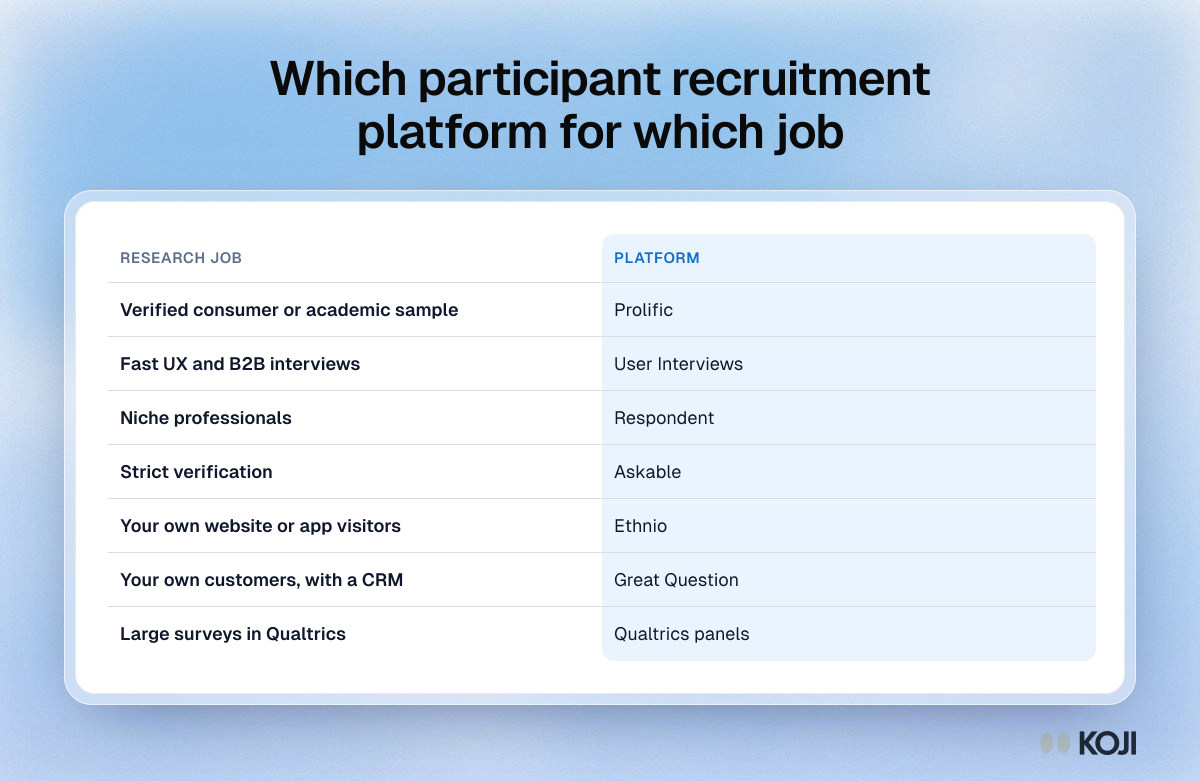
| Job | Platform | How it charges |
|---|---|---|
| Verified consumer or academic sample | Prolific | Participant pay plus 43% fee (33% academic) |
| Fast UX and B2B interviews | User Interviews | $49 consumer, $98 professional per session, plus incentives |
| Niche professionals | Respondent | Session fee plus incentive |
| Strict verification | Askable | Annual plan, incentives included |
| Your own website or app visitors | Ethnio | Per seat, from $12 a month billed annually |
| Your own customers, with a CRM | Great Question | $129 a seat a month |
| Large surveys in Qualtrics | Qualtrics panels | Quote |
Checked November 2026 on each vendor's own site. Prices change often, so confirm before you buy.
DIY or a platform?
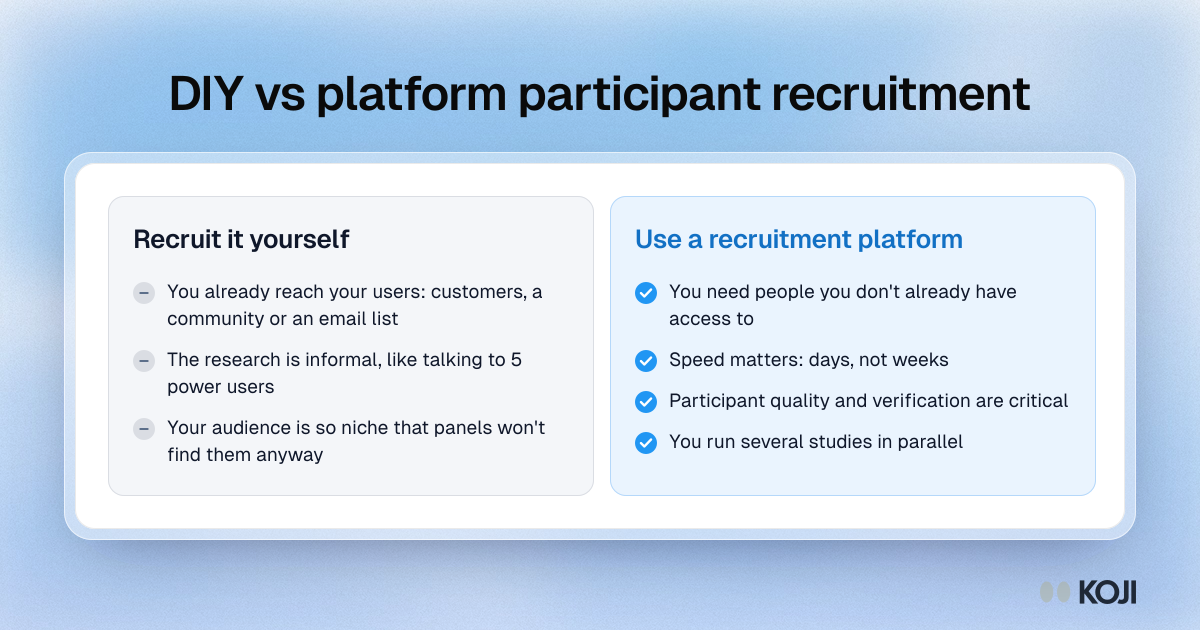
Recruit it yourself when:
- You already reach your users: customers, a community or an email list
- The research is informal, like talking to 5 power users
- Your audience is so niche that panels won't find them anyway
Use a recruitment platform when:
- You need people you don't already have access to
- Speed matters: days, not weeks
- Participant quality and verification are critical
- You run several studies in parallel
If you recruit yourself, budget the incentive anyway. The research incentives guide has typical amounts, and the screener questions guide shows how to keep the wrong people out. For market research teams, the ESOMAR 37 questions are the standard checklist for judging any sample provider.
Where Koji fits (our product)
Koji publishes this page, so here is plainly what it does for recruitment and what it doesn't.
What it does. Koji runs AI-moderated interviews by voice, text or phone, and gives you several ways to fill a study:
- Koji's research panel, on paid plans. Describe the audience in plain words, see the price per interview before you launch, and choose text, voice or both. A soft launch fields about 10% of the goal first so you can check quality before releasing the rest.
- Your own people, on paid plans. Import a list or email an audience from Participants, with reminders. Personal invite links, on the Interviews plan, let you see who answered.
- Find people, on paid plans: search professional profiles by job title, seniority, company size and industry to build a B2B list.
- Incentives from €10 to €500 per participant, paid through Koji on paid plans.
Every route lands in the same study and report. Each interview gets a quality score from 1 to 5, and only interviews scoring 3 or more use credits or enter the report. In-house market research and insights teams can see how this fits their work on the Koji for researchers page.
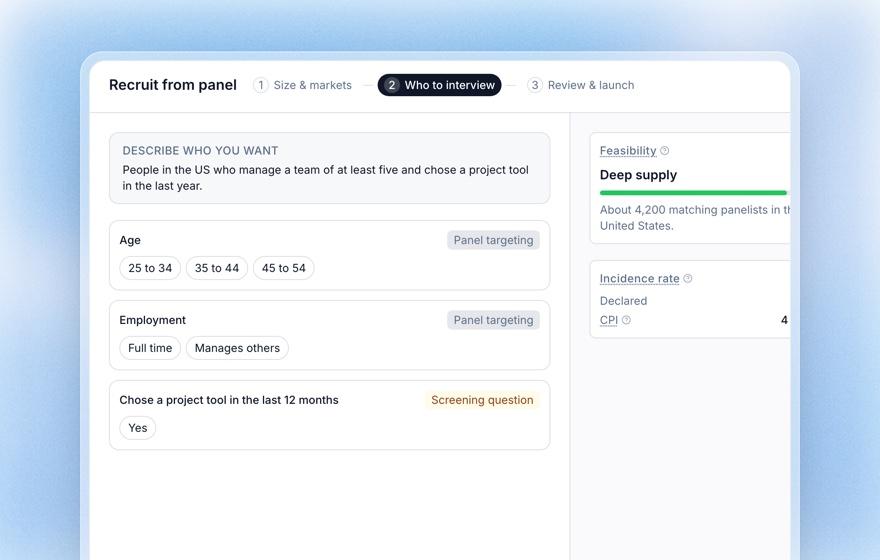
What it costs. A free account comes with 10 credits, no card, and lets you build a panel audience and see its price. Launching a panel recruitment needs a paid plan, from €29 a month. A text interview uses 1 credit and a voice interview 3; panel participants are priced per interview on top, shown before you launch. See the pricing page for current plans.
When it's the wrong choice. If you need participants for live moderated sessions on your own video calls, in-person focus groups, diary studies or long academic surveys, use one of the platforms above. Koji recruits for interviews that Koji runs.
Read the panel recruitment guide for the setup, or start a study free.
See also: How to recruit user research participants · River sampling vs panels · Survey sample cost, CPI and incidence rate