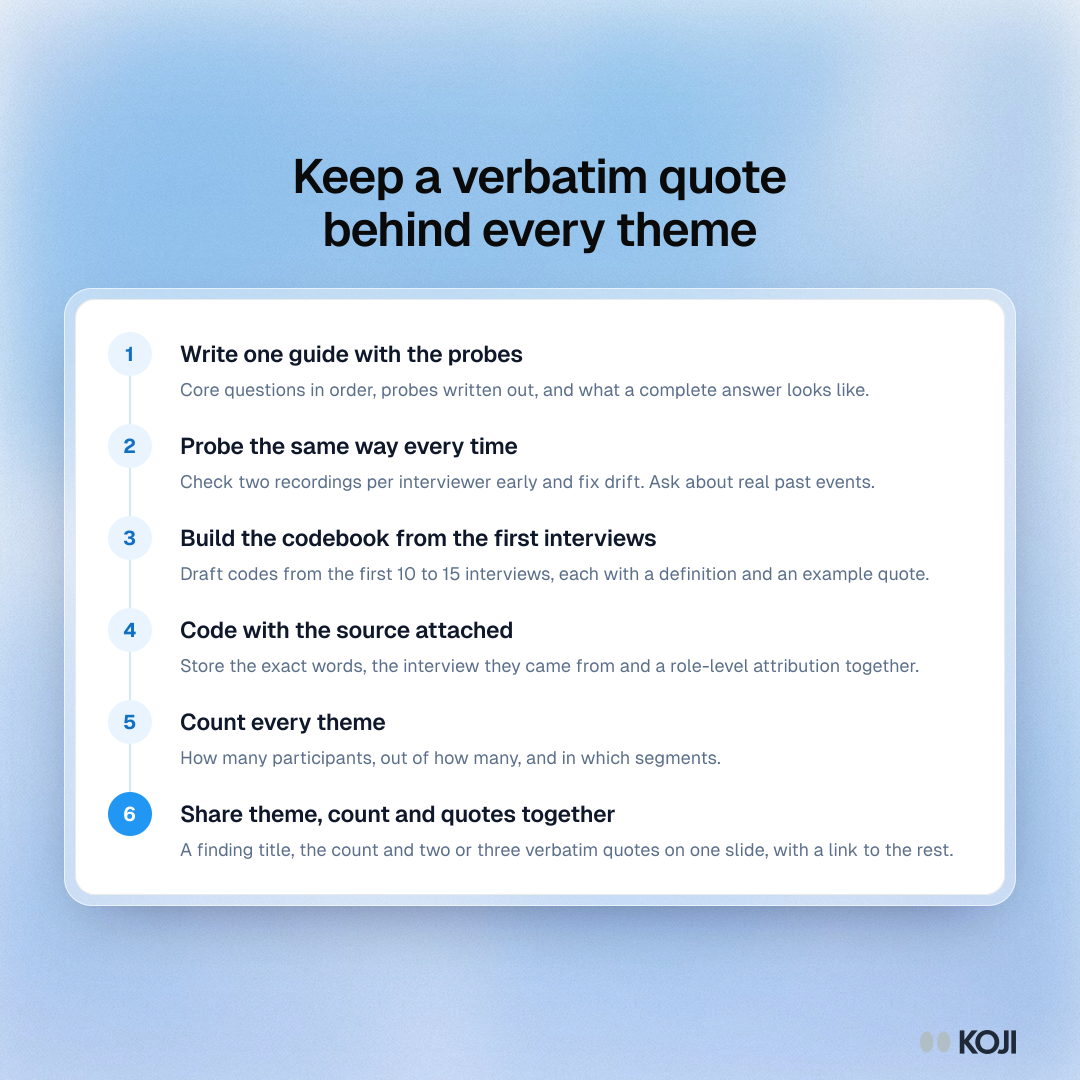
To run qualitative interviews at scale and still have a verbatim quote behind every theme, decide how you'll link quotes to themes before fieldwork starts, not after. Use one discussion guide with written probes, a codebook you build from the first interviews, and a rule that no theme reaches a stakeholder without a count and at least two exact quotes that link back to the transcript they came from.
That's the whole method. The rest of this guide is how to do each step when you have 50, 200 or 500 interviews instead of 12, and what to look for in a tool so the link between a theme and its quotes never breaks.
It's written for market research and insights teams, agencies and consultancies who have to defend findings in front of clients and leadership. Koji publishes it, and explains where its own product fits near the end.
Why quotes get lost at scale
With 12 interviews, the researcher remembers who said what. With 200, nobody does. Three things usually go wrong:
- Themes get written from memory. Someone drafts the findings deck from their notes, then goes hunting for quotes to fit. The quotes found that way support the story, not the data.
- Quotes get cleaned up. A participant's words get shortened, merged with another participant's or "lightly edited" for the slide. Once that happens, nobody can check it.
- The link breaks. The quote sits in a deck, the transcript sits in a folder, and the theme sits in a spreadsheet. When a stakeholder asks "how many people said that?", the answer takes a day.
AI makes the first and second problems easier to fall into, not harder. In User Interviews' State of User Research 2025, 80% of 485 research professionals said they use AI in their work, and 91% said they were concerned about the accuracy of its output. Greenbook's 2025 GRIT report found 67% of research suppliers now put generative AI directly into client deliverables. If AI is writing the summary, the evidence trail is the only thing that lets a reader trust it.
Step 1: Write one guide, with the probes written down
Consistency is what makes 200 interviews comparable. Write a single discussion guide with:
- The core questions, in the order you want them asked.
- The probes for each question, written out: "What happened just before that?", "Can you give me an example from the last month?", "What did you do instead?"
- What counts as a complete answer for each question, so the interviewer knows when to move on.
If different moderators or different markets are involved, this is what keeps one interviewer from probing for ten minutes while another accepts a one-line answer. Keep the guide short enough to finish in the time you promised participants.
Step 2: Probe the same way every time
At scale, the risk is drift: interviewer five asks leading follow-ups, interviewer nine skips them. Brief every moderator on the probes, listen to two recordings from each early in fieldwork, and fix drift before it spreads. Ask for specific past events, not opinions about the future. A quote about what someone did last Tuesday is evidence; a quote about what they'd probably do is a guess.
Step 3: Build the codebook from the first interviews
Don't wait until fieldwork closes to start coding. Read the first 10 to 15 interviews closely and draft a codebook: each code with a name, a one-line definition, when to use it, when not to, and one example quote. That example quote is the first link in your evidence trail.
The research on saturation says this is the right moment. Hennink and Kaiser's 2022 systematic review of empirical saturation studies found most reached saturation within 9 to 17 interviews, especially with fairly similar participants and a narrow objective. Hennink's earlier work found that 9 interviews were enough to find the range of issues (code saturation), but 16 to 24 were needed to understand them well (meaning saturation). So the codes will mostly be visible by interview 15; what the next 185 interviews add is how often each one happens, in which segments, and the detail that explains it.
For the full method, see how to build a qualitative research codebook.
Step 4: Link every theme to quotes when you code, not after
This is the step that keeps the trail intact. Each time you apply a code, store three things together:
- The exact words, copied from the transcript, with nothing changed. If you trim, mark it with an ellipsis.
- Where it came from: the interview and the point in it.
- Who said it, at the level you can share: role, segment, market. Never a name in a client deliverable.
Then count. A theme backed by 11 of 42 participants is a different finding from one backed by 2, and stakeholders should see which is which. Our guide on why a tagged quote isn't evidence on its own covers why the link back to context matters as much as the quote.
Step 5: Show the theme, the count and the quotes together
Stakeholders read findings fast and believe what they can check. For every theme in the deck, put on one slide:

Photo by Campaign Creators on Unsplash
- A title that states the finding, not the topic: "Permission setup is what slows rollouts", not "Onboarding".
- The count: how many participants, out of how many, and in which segments.
- Two or three verbatim quotes, from different participants, each with its role-level attribution.
- A link or reference to the full set of supporting quotes for anyone who wants to look.
Pick quotes that show the range, including one that complicates the theme. A finding with a dissenting quote next to it reads as honest; a finding with three identical quotes reads as cherry-picked.
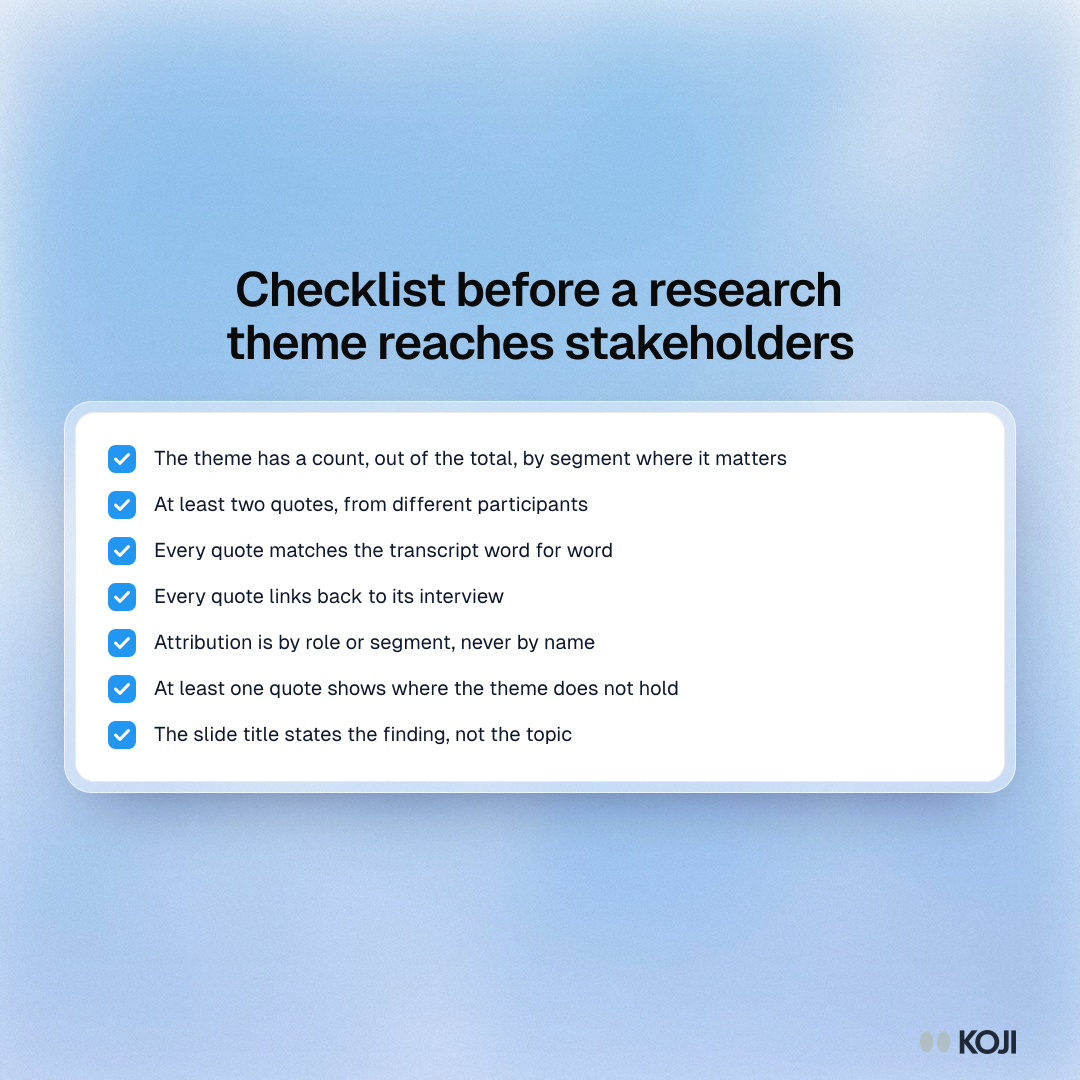
Checklist before a theme reaches stakeholders
Run every theme through this before it goes in a deck:
- The theme has a count, out of the total, by segment where it matters.
- At least two quotes, from different participants.
- Every quote matches the transcript word for word.
- Every quote links back to its interview.
- Attribution is by role or segment, never by name.
- At least one quote shows where the theme doesn't hold.
- The slide title states the finding, not the topic.
What to look for in a tool
Whatever you use for analysis, check how it handles the trail:
- Does every theme link to its quotes, and every quote to its transcript? One click, not a search.
- Can it show you the count behind a theme? Out of how many, and by segment.
- What happens when AI writes a summary? Can you see which quotes each sentence rests on, and does the tool check that those quotes exist in the transcripts?
- Can you share it without names? Removing personal details before quotes leave the team matters for consent and GDPR.
- Does it work across languages? For multi-market studies, you want the quote in the original language and a translation, linked to the same transcript.
Repository and analysis tools such as Dovetail, Condens, NVivo and ATLAS.ti let you highlight a passage in a transcript you've already collected and tag it to a code. They're strong when you run the interviews elsewhere and want a home for the analysis.
Where Koji fits (our product)
Koji publishes this guide. Koji runs the interviews and the analysis in one place, so the link between a theme and its quotes is made when the interview is analysed rather than added later.
You write the guide (or have the research assistant draft it), set how deep follow-ups should go, and an AI interviewer runs each interview by voice or text, asking the same probes of everyone, in more than 30 languages. Each interview gets a quality score, and only interviews that score 3 or more out of 5 go into the report. The report groups what people said into themes and findings, shows how many participants back each one, and links each to the supporting quotes and interviews.
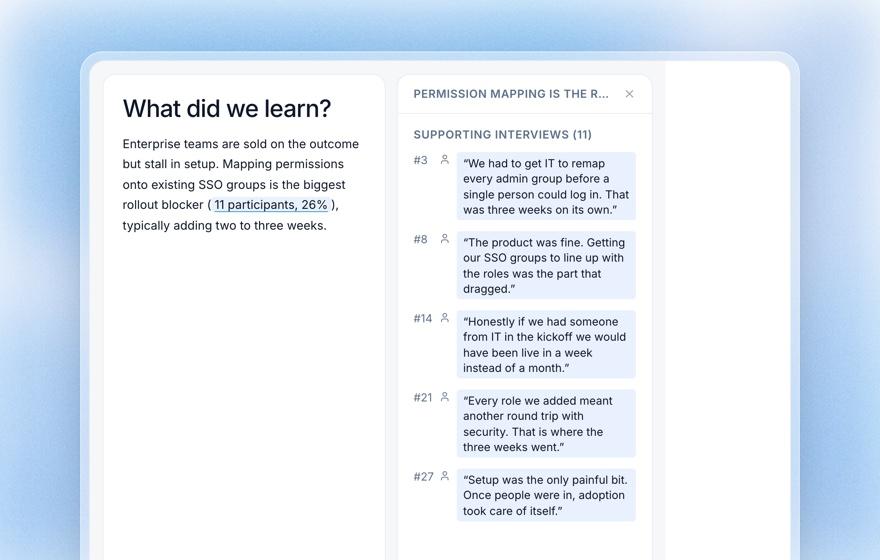
The part that matters for this guide: Koji checks every quote it shows against what the participant actually said in the transcript. If a quote can't be found there, Koji doesn't show it. You can turn on removing personal details per study, so names, emails and employers come out of transcripts before anyone shares them, and download the report as an editable slide deck or a PDF.
When Koji is the wrong choice: if your interviews are already done and recorded elsewhere, a repository or QDA tool is the better home for coding them. Koji works on the interviews it runs.
Agencies and consultancies can see how this fits client work on the page for agencies; in-house insights teams, on the page for researchers. The thematic analysis guide and the guide to extracting and using customer quotes cover the method in more depth.
The next step
Take the study you're planning next and write the codebook template and the four-part slide format above before fieldwork starts. If you want to see the evidence trail built for you, run the guide in Koji with ten participants and open the first finding: the quotes behind it are one click away.