Short answer: Sprig has a free plan, a paid Starter plan and a custom-quoted Enterprise plan, and the price is driven mainly by how many monthly tracked users (MTUs) your product has, not by how many surveys you send. Third-party reviews in 2026 most often put Starter at about $175 a month, billed annually, which is about $2,100 a year. Enterprise is quote-only. Sprig does not show a full price list without a conversation with sales, so treat every figure here as reported, not confirmed. If what you need is the reasons behind the numbers, Koji runs AI-moderated interviews with published per-interview prices: 1 credit per qualified text interview, 3 per voice interview, €1 per credit.
This guide covers what each Sprig plan includes, how MTU pricing works, the questions to ask before you sign, and when an interview tool fits better than an in-product survey.
What Sprig does
Sprig, formerly called UserLeap, started as an in-product survey tool and has grown into a wider research platform. Today it covers:
- In-product surveys triggered by an event, a page or a user attribute, on web and mobile.
- Session replays, including short clips captured around a survey response, so you can see what the person did before they answered.
- Heatmaps of where people click and scroll.
- AI analysis that groups open-text answers into themes, plus AI recommendations on what to act on. Sprig describes design, fielding and synthesis agents that help build a study and summarise results.
- Link surveys and broader studies such as concept tests and experience measurement.
Its strength is timing. A question shown at the moment someone finishes onboarding or abandons a flow gets a fresher answer than an email a week later.
Sprig plans and prices in 2026
Sprig's plans are consistent across sources. The limits and prices are not, so here is the range:
| Plan | Reported price | Reported limits | What it suits |
|---|---|---|---|
| Free | $0 | One survey or replay study a month and a small MTU cap in one report; about 250 responses a month and 1 user in another | Trying the product |
| Starter | About $175 a month, billed annually. One directory lists a $5,000 a year flat rate instead | Two in-product surveys or replays and up to 25,000 MTUs, per one review | Small product teams |
| Enterprise | Custom quote | Custom MTU and study limits, API access, SSO, dedicated support, more AI features | Larger teams with many products or regions |
Three things to take from the table:
- The free plan is a trial in practice. One study a month is enough to learn the tool, not to run a research program.
- Starter is priced per year. At about $175 a month billed annually, you commit roughly $2,100 up front.
- Enterprise is where most scaling teams land, because MTU caps and study limits rise with the size of your product, and that tier has no public price.
How MTU pricing works
An MTU is a monthly tracked user: someone your Sprig SDK sees in your product during the month. MTU pricing ties the bill to the size of your user base, so:
- A growing product raises your bill even if you run the same number of surveys.
- A large free tier is expensive to track. Consumer apps with many casual users reach MTU limits fast.
- Response volume matters less than reach. You pay to be able to ask everyone, whether or not they answer.
That is a fair model for a tool whose value is reaching every user at the right moment. It is a poor fit if you only want to hear from 30 people about one decision.
Before you accept a quote, ask Sprig, or any tool priced by tracked users, for these answers in writing:
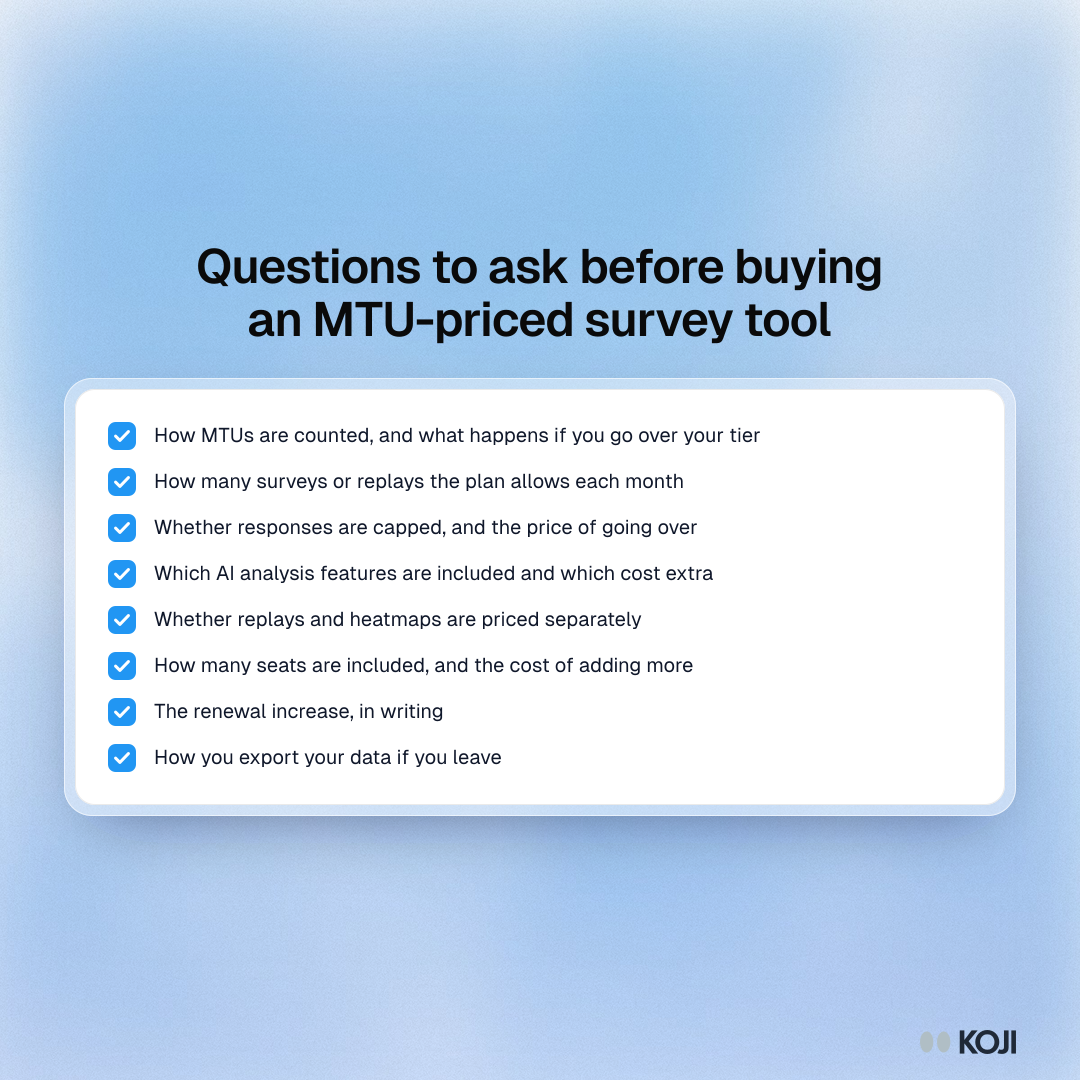
- How MTUs are counted, and what happens if you go over your tier.
- How many surveys or replays the plan allows each month.
- Whether responses are capped, and the price of going over.
- Which AI analysis features are included and which cost extra.
- Whether replays and heatmaps are priced separately.
- How many seats are included, and the cost of adding more.
- The renewal increase, in writing.
- How you export your data if you leave.
Why in-product surveys are worth paying for
The case for Sprig rests on response rates. Refiner's analysis of 1,382 in-app surveys found an average response rate of 27.52% on web and 36.14% on mobile. SurveyMonkey's 2025 platform data gives a more balanced view: in-app surveys averaged 34%, while email surveys sent to people who know the sender averaged 49%. So in-product surveys are not always the highest-response channel, but they reach people at the moment of use, which no email can.

Photo by Vitaly Gariev on Unsplash
Research teams are also leaning harder on AI to make sense of all that text. In the 2026 State of User Research report from User Interviews, 80% of researchers said they use AI, up 24 points in a year. Sprig's AI theming is a direct answer to that demand.
Where Sprig stops
An in-product survey can only ask the people who are in your product, and it can only ask briefly. That leaves three gaps:
- People who left. Churned customers, lost trials and prospects who never signed up are not in your product to be surveyed.
- The reason behind the score. A two-question survey tells you that onboarding scored 6 out of 10. It cannot ask "what happened right before you gave up?" and then follow the answer.
- Depth per person. Short surveys get short answers. Themes built from one-line comments are thin.
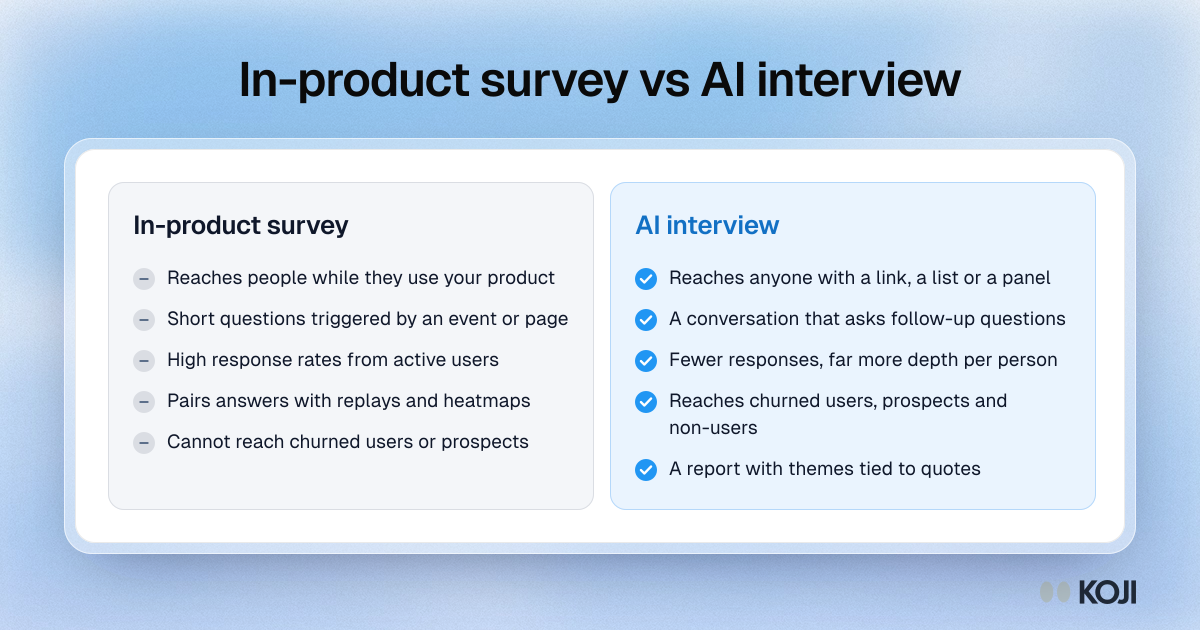
Here is how the two methods compare:
| In-product survey | AI interview |
|---|---|
| Reaches people while they use your product | Reaches anyone with a link, a list or a panel |
| Short questions triggered by an event or page | A conversation that asks follow-up questions |
| High response rates from active users | Fewer responses, far more depth per person |
| Pairs answers with replays and heatmaps | Reaches churned users, prospects and non-users |
| Cannot reach churned users or prospects | A report with themes tied to quotes |
Many teams use both: a survey to spot where something is wrong, then interviews to learn why.
The interview alternative: Koji
Koji runs AI-moderated interviews, by voice or text, with anyone you can send a link to. It does not replace replays and heatmaps. It answers the question those tools raise.
- Published, per-interview pricing. A qualified text interview uses 1 credit, a voice interview 3. Credits cost €1. Thirty text interviews about one onboarding problem use about 30 credits.
- Pay only for useful interviews. Each interview gets a quality score from 1 to 5, and only those scoring 3 or more use credits or enter the report.
- No user-based pricing. The size of your user base never changes the price. You pay for interviews that happen.
- Free to start. 10 free credits at signup with no card. Then buy credit packs, or choose Insights at €29 a month (29 credits) or Interviews at €79 a month (79 credits). Credits stay valid for 12 months.
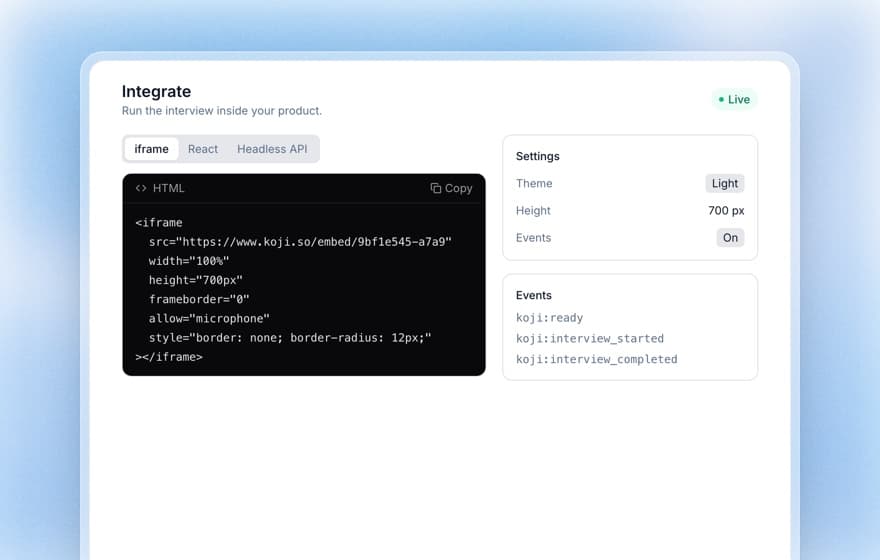
- Inside your product too. You can embed an interview in your app or site with an iframe or React component, so you catch people in the moment and still get a full conversation.
- Surveys and interviews in one study. Six question types (open ended, scale, single choice, multiple choice, ranking and yes/no), each with AI follow-up questions, and a report with thematic analysis and quotes.
- Reach people outside your product. Send personal invite links from a CSV to churned customers, or on a paid plan use panel recruitment to reach people who have never used you.
Where Sprig is ahead: replays, heatmaps and event-triggered micro-surveys across your whole user base. If you need behaviour data and a steady pulse from active users, Sprig does that well and Koji does not.
Sprig vs Koji at a glance
| Sprig | Koji | |
|---|---|---|
| Pricing model | Plans tied to monthly tracked users | Credits per qualified interview |
| Published prices | Partly, most figures are reported | Yes |
| Entry paid price | About $175 a month billed annually (reported) | €29 a month, or pay as you go |
| Free option | Free plan with tight limits | 10 free credits, no card |
| Method | In-product surveys, replays, heatmaps | AI voice and text interviews with follow-ups |
| Who you can reach | Active users of your product | Anyone: users, churned customers, prospects, panel |
| AI analysis | Theming and recommendations | Themes, findings with quotes, personas |
More reading: Koji vs Sprig, Sprig alternatives, Sprig vs Hotjar and the best in-app survey tools.
Find out why, this week
If your Sprig dashboard shows where users struggle but not why, pick the one flow that worries you most. Write the question in Koji, preview the interview for free, and send it to 20 people who dropped out of that flow. You will have their reasons, in their own words, in a few days.
Start free with Koji. 10 credits, no card, and you only pay for interviews that pass the quality bar.
Sources: Sprig website and blog; third-party reviews and software directories (G2, Capterra, TrustRadius and others) for reported pricing, 2026; Refiner, in-app survey response rate analysis (2025); SurveyMonkey platform response rate data (2025); User Interviews, State of User Research 2026. Sprig prices are reported estimates. Ask Sprig for a current quote.