Short answer: Sprig and Maze answer different questions. Sprig is built to ask people questions inside your live product: targeted in-product surveys, session replays and heatmaps, with AI that groups the answers into themes. Maze is built to test designs before they ship: prototype tests, usability tests, card sorting and tree testing, plus newer AI-moderated interviews. Pick Sprig if you want feedback from real users at the moment they act. Pick Maze if you want to know whether a design works before engineering builds it. Neither publishes a full price list: Sprig's Starter plan is widely reported at about $175 a month billed annually, and Vendr puts the median Maze contract at $29,000 a year. If what you actually need is the reason behind a behavior, Koji runs AI-moderated interviews that ask follow-up questions, at a published price per interview.
This guide compares the two on what they do, what they cost, where each one stops, and which teams should pick which.
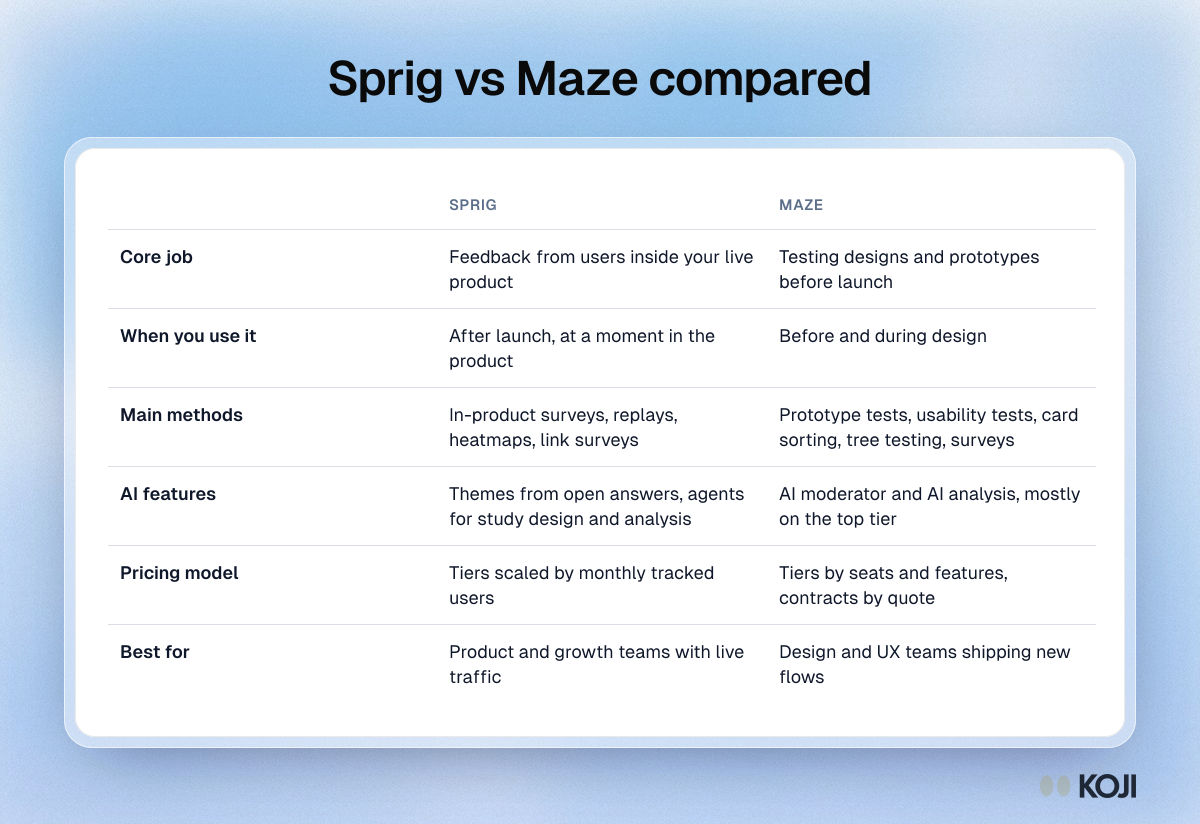
Sprig vs Maze at a glance
| Sprig | Maze | |
|---|---|---|
| Core job | Feedback from users inside your live product | Testing designs and prototypes before launch |
| When you use it | After launch, at a moment in the product | Before and during design |
| Main methods | In-product surveys, replays, heatmaps, link surveys | Prototype tests, usability tests, card sorting, tree testing, surveys |
| AI features | Themes from open answers, agents for study design and analysis | AI moderator and AI analysis, mostly on the top tier |
| Pricing model | Tiers scaled by monthly tracked users | Tiers by seats and features, contracts by quote |
| Best for | Product and growth teams with live traffic | Design and UX teams shipping new flows |
What Sprig does
Sprig, which started out as UserLeap, is an in-product research platform. You install its SDK on your web or mobile app, and it shows short surveys to the right people at the right moment: after someone finishes onboarding, abandons checkout or uses a new feature for the first time.
Around that core it now offers:
- In-product surveys on web and mobile, targeted by event, page or user attribute.
- Long-form and link surveys for studies outside the product.
- Session replays and heatmaps, so you can see what someone did before they answered. Sprig says its AI groups replay clips into product themes (G2 listing).
- AI research agents. A September 2026 directory listing describes a Design agent that builds studies from a brief, a Field agent that adapts surveys while they run, and a Synthesize agent for reporting (GetApp).
Why timing matters: a question asked in the product, seconds after the moment you care about, gets a fresher and more frequent answer than an email a week later. One analysis of 1,382 in-app surveys found an average response rate of 27.5% (Refiner), against the 5% to 20% the same source gives for email surveys.
What it costs: Sprig shows a free plan, a Starter plan and a custom Enterprise plan. Third-party reviews most often put Starter at about $175 a month, billed annually, with limits on studies and monthly tracked users, and Enterprise on quote (Toolradar). Because the bill grows with your monthly tracked users, a fast-growing product pays more for the same number of surveys. Our Sprig pricing guide covers the plans in detail.
Where it stops: a survey can only ask what you thought to ask. When someone picks "too complicated" from a list, Sprig tells you how many people said it, not what was complicated or what they expected instead. Replays show the clicks, not the reasoning.
What Maze does
Maze is a testing platform for designers and researchers. You connect a prototype, usually from Figma, set tasks, and send the test to participants from Maze's panel or your own users. Maze reports success rates, misclicks, time on task and paths taken, and turns them into a shareable report.

Its methods cover most of the design cycle:
- Prototype and usability tests, with task success and heatmaps on each screen.
- Card sorting and tree testing, to check navigation and information architecture.
- Surveys and live website tests.
- Interview studies and an AI moderator. Maze has been expanding its AI moderator to run conversations at scale (Maze). A June 2026 comparison reports it is sold as an add-on to Enterprise plans and takes up to five images as stimuli per study (Hubble).
What it costs: Maze's pricing page compares features but does not show prices for its paid tiers. Vendr's data across 33 purchases puts the median annual contract at $29,000, with a range from about $12,000 to $62,682 (Vendr). The free plan is reported as one study a month. Interview studies, Maze AI and mobile testing sit on Enterprise on Maze's own comparison table. See our Maze pricing guide.
Where it stops: Maze tells you that people failed a task and where. Unless you run interview studies on Enterprise, it does not ask them why, and testing a prototype says little about how the shipped product fits into someone's week.
Sprig vs Maze: the differences that decide it
1. Live product or design file
This is the real dividing line. Sprig needs a live product with traffic; it has nothing to show until real users reach the moment you target. Maze works best before launch, when changing a design still costs an afternoon rather than a sprint. Teams that ship often end up wanting both: Maze to test the new flow, Sprig to see how it lands.
2. Who you hear from
Sprig hears only from your current users, which keeps answers grounded but leaves out the people who never signed up or already left. Maze can recruit from its panel, so you can test with people who have never seen your product, which suits new concepts and first-impression tests.
3. How deep the answers go
Both tools lean on structured answers: survey choices and short text in Sprig, task metrics in Maze. Both have added AI to summarize. Neither, at its core price, holds a conversation that follows up on a vague answer. That gap matters more as research grows: Maze's own 2026 survey of close to 500 product and research professionals reports that demand for user insights is up 20% and that research influence at board level has nearly tripled (Maze, Future of User Research 2026). More decisions now rest on the reason behind a number, not just the number.
4. How you pay
Sprig scales with your tracked users. Maze scales with seats, studies and the Enterprise features you need. Both are annual for most teams, and both push AI features toward the top tier. Ask either vendor for a written quote that names the limits, the AI features included and the renewal increase before you sign.
Which should you choose?
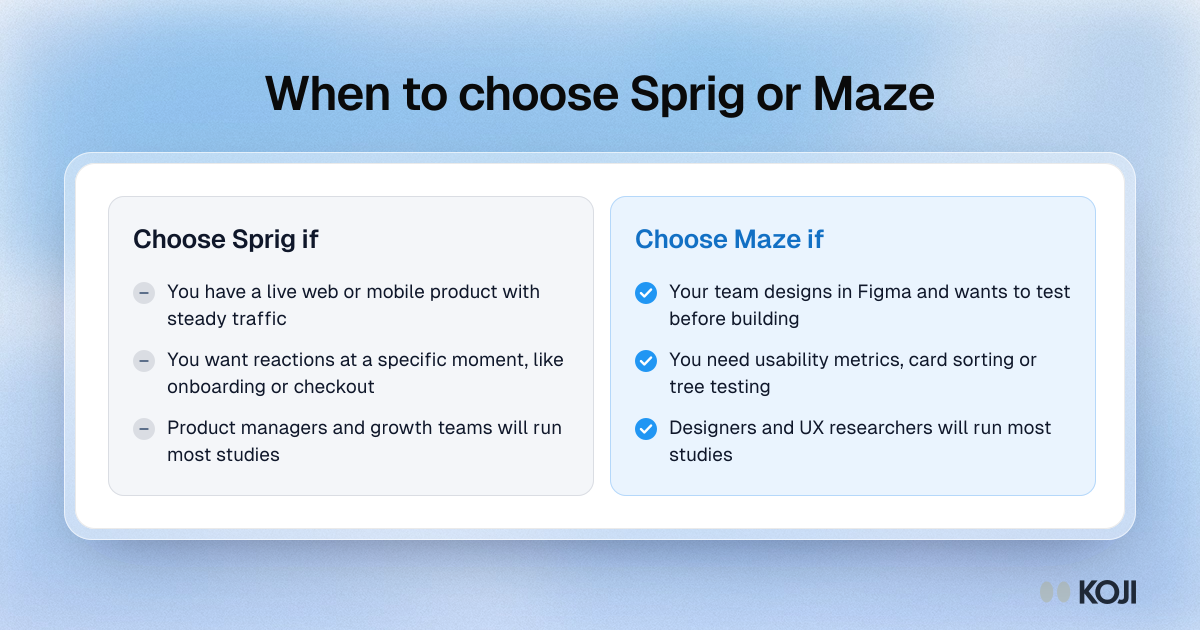
Choose Sprig if:
- You have a live web or mobile product with steady traffic.
- You want reactions at a specific moment, like onboarding or checkout.
- Product managers and growth teams will run most studies.
Choose Maze if:
- Your team designs in Figma and wants to test before building.
- You need usability metrics, card sorting or tree testing.
- Designers and UX researchers will run most studies.
Choose neither, or add an interview tool, if your open question is why: why people churn, why a feature is ignored, why a plan feels too expensive. Those questions need follow-ups, and a survey or a task metric cannot ask them.
Where Koji fits
Koji is not a prototype tester or a replay tool. It is an AI interviewer. You write a research question, Koji drafts the interview, and each participant talks to it by text or voice. When someone says "it was confusing", the interviewer asks what was confusing and what they expected instead, the follow-up a survey cannot make.
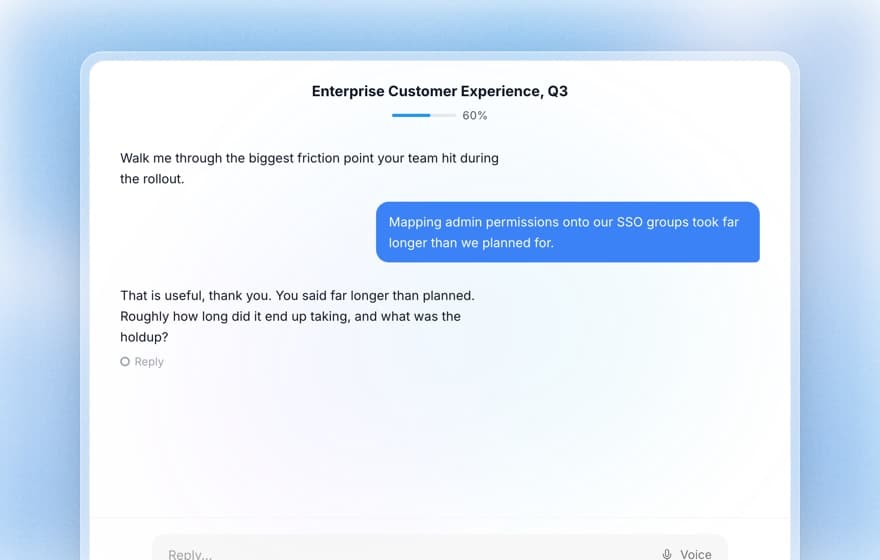
It works alongside either tool:
- After a Sprig survey: invite the people who chose "too complicated" to a five-minute interview. Use personal invite links from a CSV, or put the interview inside your product with the embed widget, available on every plan.
- After a Maze test: interview the participants who failed a task about what they were trying to do, by voice in their own words.
- When you have no list: recruit from Koji's research panel (panel recruitment) and add screening questions so only the right people get through.
Each interview gets a quality score, and only interviews scoring 3 or more out of 5 use credits or go into the report. The report groups themes and links every finding to the quotes behind it. A text interview costs 1 credit and a voice interview 3, at €1 a credit, and new accounts start with 10 free credits.
Try it on your next question
Take the question your last Sprig survey or Maze test could not answer. Write it into Koji, preview the interview yourself for free, and send it to ten users. You will have transcripts and a themed report the same day.
More reading: Koji vs Sprig, Koji vs Maze, Sprig alternatives and Maze alternatives.
Sources: Sprig documentation and G2 listing; GetApp listing for Sprig, September 2026; Toolradar Sprig pricing; Refiner, in-app vs email surveys; Maze blog, "Maze's AI moderator, expanded"; Hubble, AI-moderated tools comparison, June 2026; Vendr Maze pricing data; Maze, Future of User Research Report 2026. Prices change often; check each vendor's current terms.