Framework
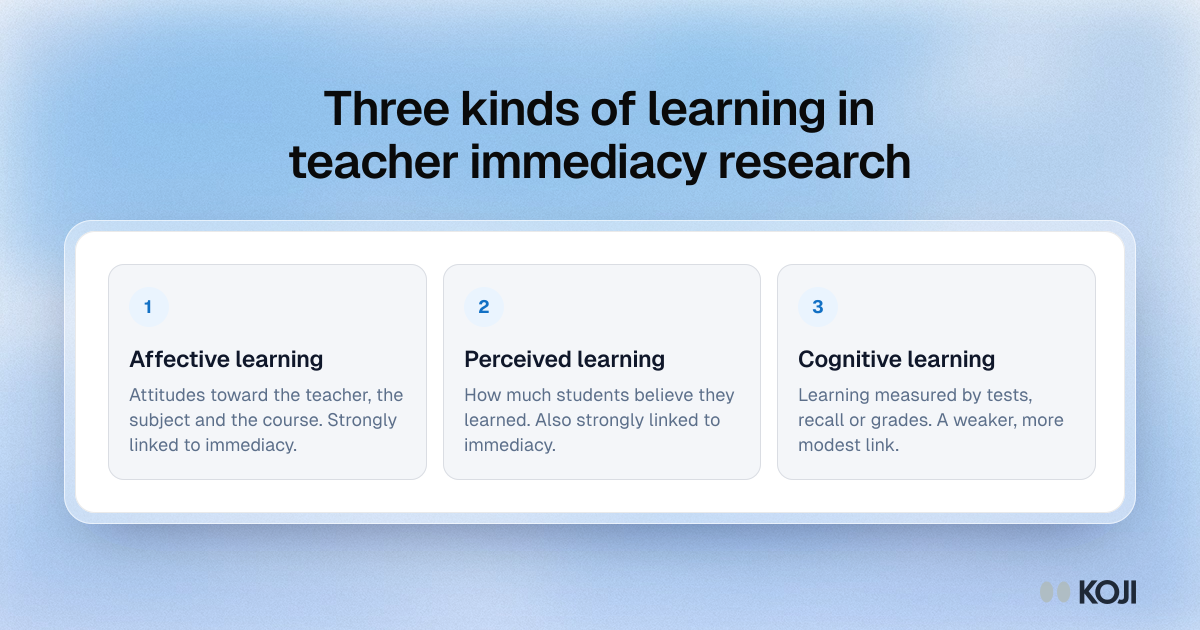
Three kinds of learning in teacher immediacy research
How strongly teacher immediacy relates to what students feel, believe and can show
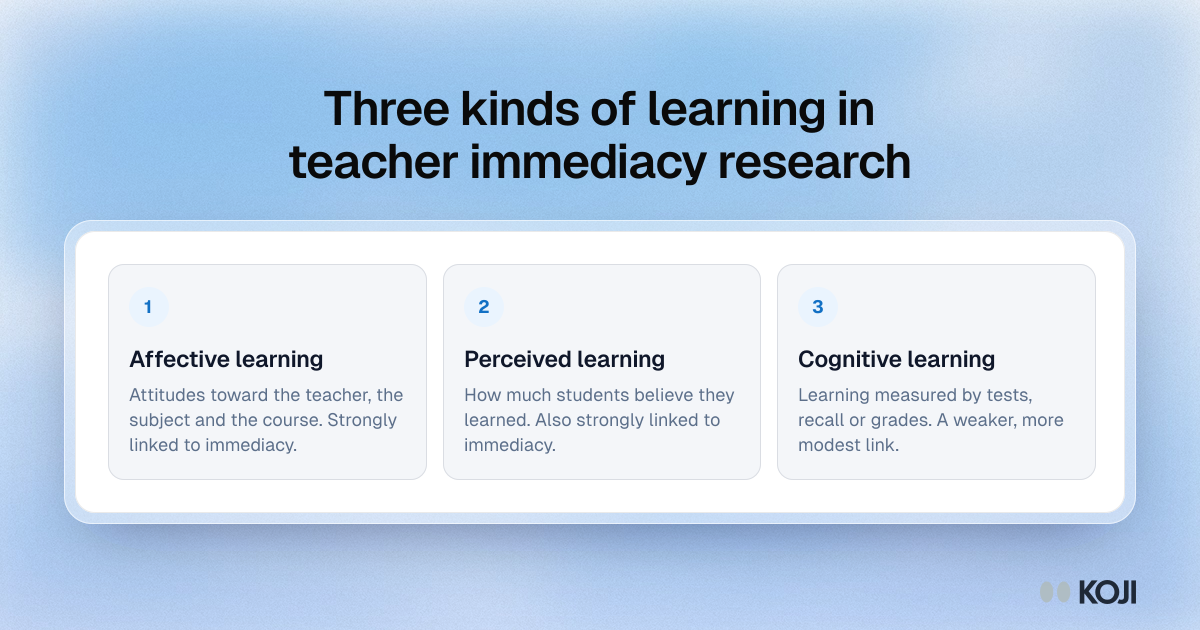
A framework for anyone who reads student evaluations of teaching. A 2004 meta-analysis of 81 studies found that teacher immediacy, the eye contact, names, humour and openness that make a lecturer feel close, relates strongly to students' attitudes and self-reported learning, and less strongly to measured learning. Use it to explain why a high rating can reflect a warm climate, real learning or both. Koji asks students what helped them learn, so committees can see which.
What's in this framework
- Affective learning: Attitudes toward the teacher, the subject and the course. Strongly linked to immediacy.
- Perceived learning: How much students believe they learned. Also strongly linked to immediacy.
- Cognitive learning: Learning measured by tests, recall or grades. A weaker, more modest link.
Use this image
Free to use in your docs, decks and posts under CC BY 4.0, as long as you credit Koji with a link to this page. To embed it, paste this into your page:
html
<a href="https://www.koji.so/visuals/affective-perceived-cognitive-learning-immediacy"><img src="https://www.koji.so/visuals/affective-perceived-cognitive-learning-immediacy/affective-perceived-cognitive-learning-immediacy.png" alt="Framework showing three kinds of learning in immediacy research: affective, perceived and cognitive learning, and how strongly immediacy relates to each." width="1200" height="630" /></a>
<p>Source: <a href="https://www.koji.so/visuals/affective-perceived-cognitive-learning-immediacy">Three kinds of learning in teacher immediacy research</a>, Koji</p>