Reference table
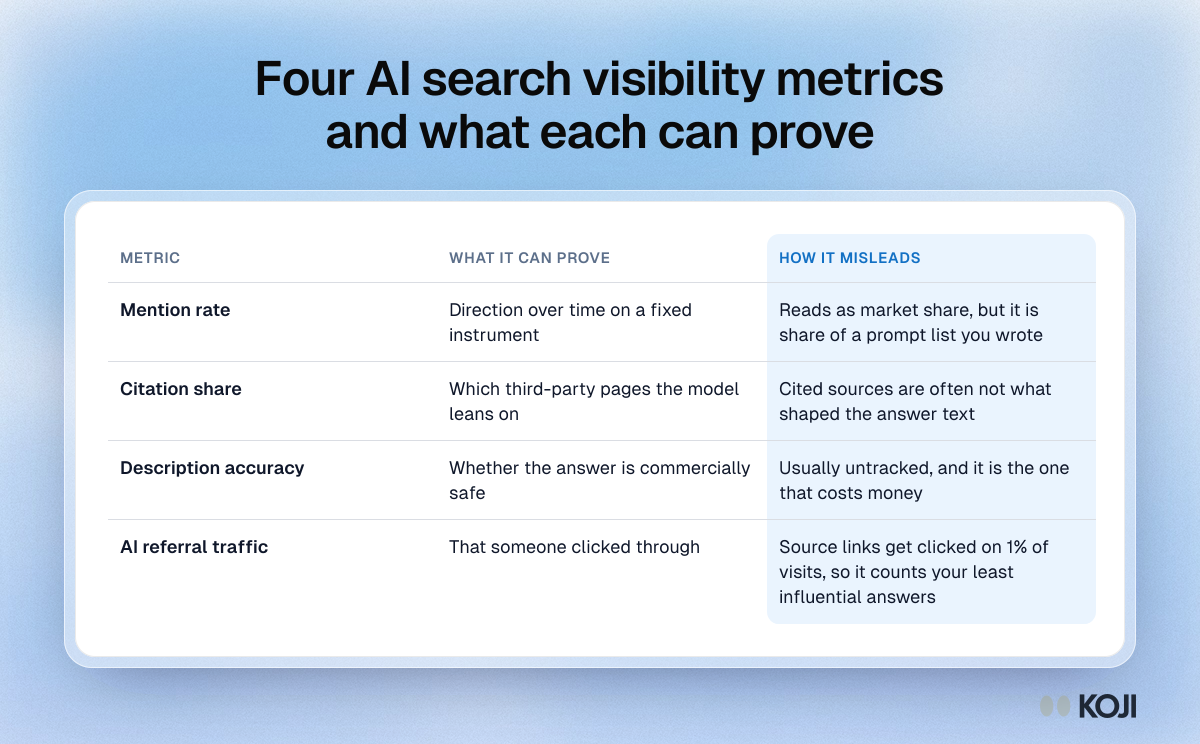
Four AI search visibility metrics and what each can prove
Mention rate, citation share, description accuracy and AI referral traffic
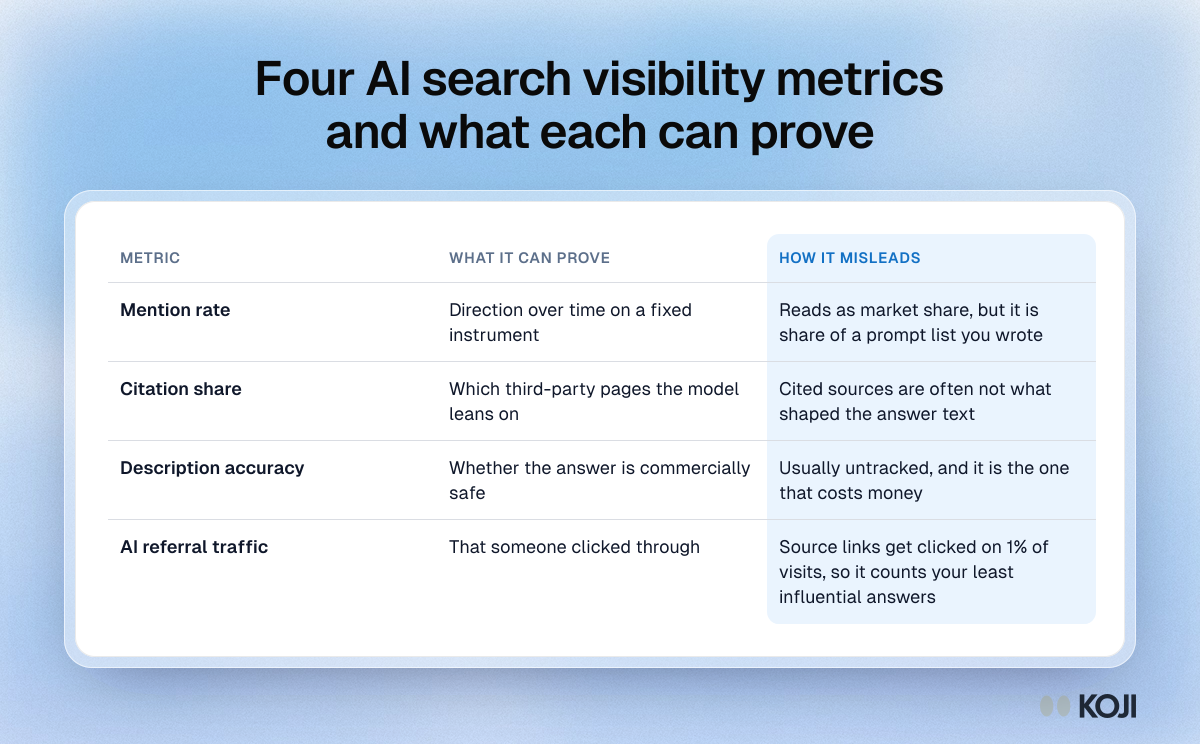
A table of the four numbers worth tracking for AI search visibility: mention rate, citation share, description accuracy and AI referral traffic. For each it sets out what the metric can legitimately prove and how it misleads when reported on its own. Use it to design an AI visibility report a board can trust. Description accuracy needs buyer interviews, which Koji runs as AI-moderated voice or text conversations.
Where this appears
What's in this reference table
| Metric | What it can prove | How it misleads |
|---|---|---|
| Mention rate | Direction over time on a fixed instrument | Reads as market share, but it is share of a prompt list you wrote |
| Citation share | Which third-party pages the model leans on | Cited sources are often not what shaped the answer text |
| Description accuracy | Whether the answer is commercially safe | Usually untracked, and it is the one that costs money |
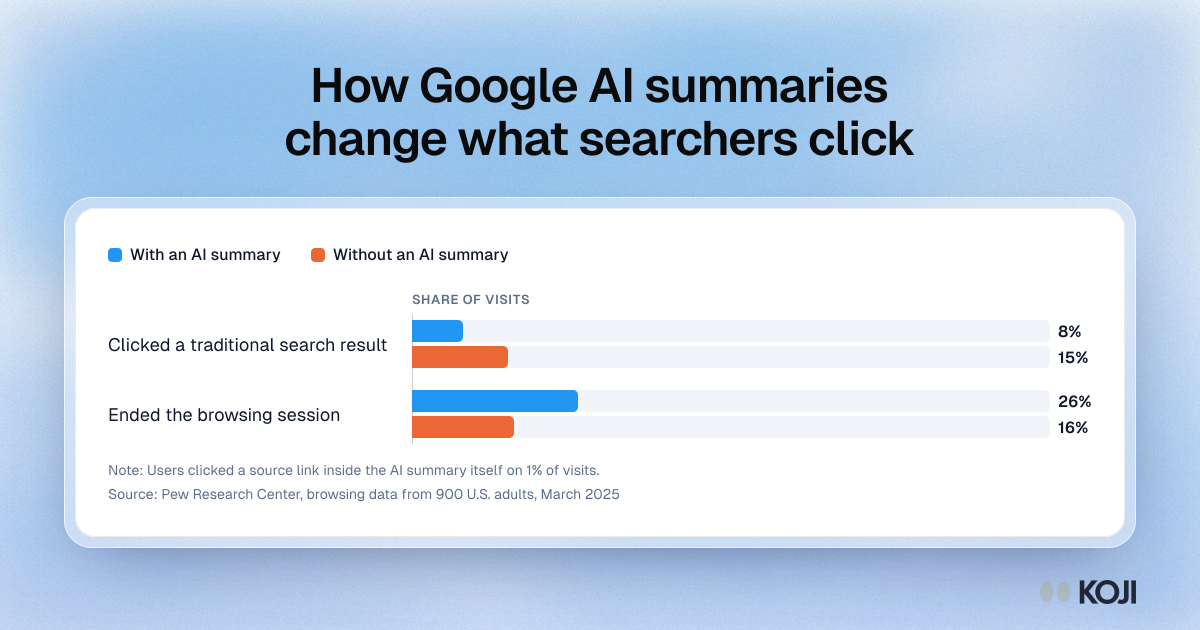
| AI referral traffic | That someone clicked through | Source links get clicked on 1% of visits, so it counts your least influential answers |
Use this image
Free to use in your docs, decks and posts under CC BY 4.0, as long as you credit Koji with a link to this page. To embed it, paste this into your page:
html
<a href="https://www.koji.so/visuals/ai-search-visibility-metrics-what-they-prove"><img src="https://www.koji.so/visuals/ai-search-visibility-metrics-what-they-prove/ai-search-visibility-metrics-what-they-prove.png" alt="Table of four AI search visibility metrics: mention rate, citation share, description accuracy and AI referral traffic, with what each proves and hides." width="1200" height="744" /></a>
<p>Source: <a href="https://www.koji.so/visuals/ai-search-visibility-metrics-what-they-prove">Four AI search visibility metrics and what each can prove</a>, Koji</p>