Reference table
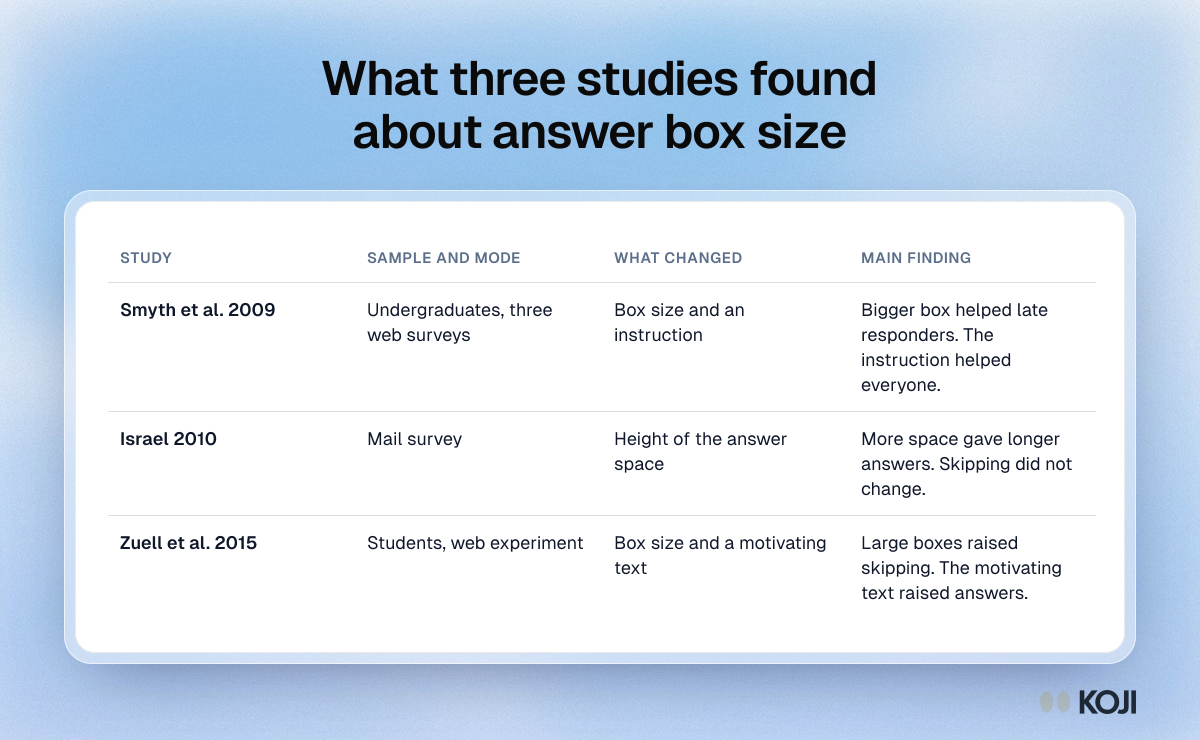
What three studies found about answer box size
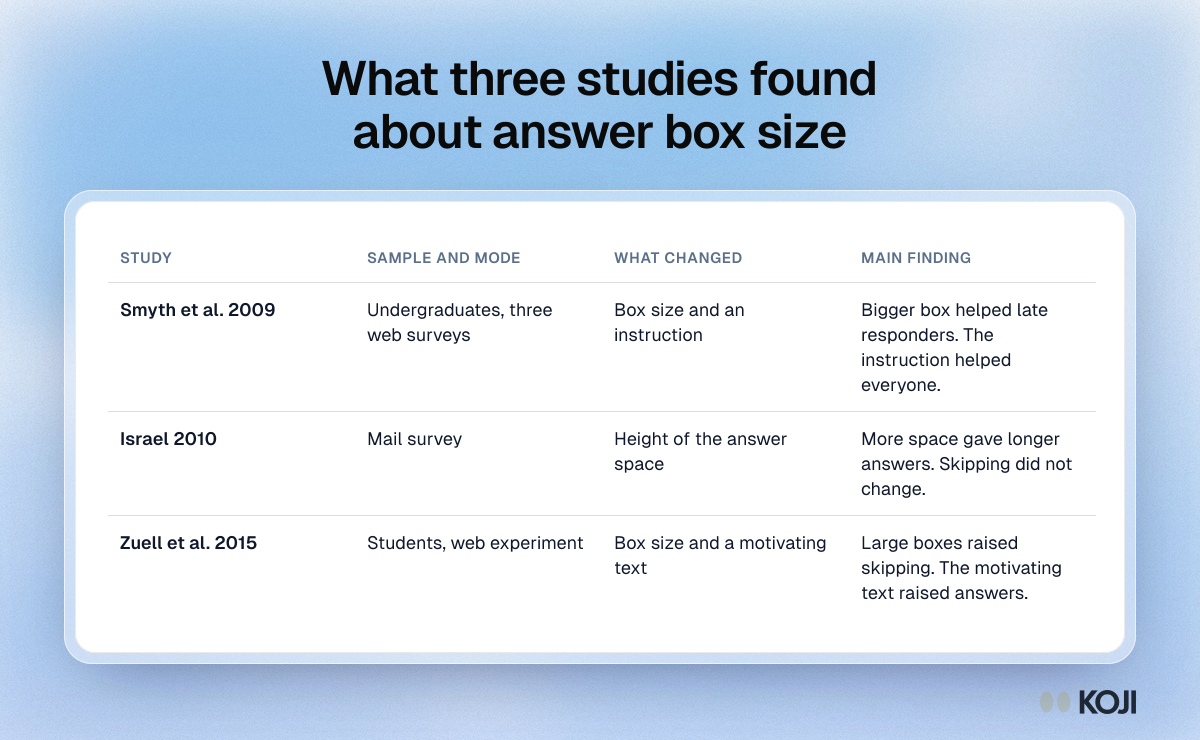
A summary of three survey experiments on how the size of an open-ended answer box affects what people write. Smyth and colleagues found larger boxes helped late responders, Israel found more space gave longer answers on paper, and Zuell and colleagues found very large boxes raised skipping. It is for anyone designing the comment questions in a course evaluation. Koji replaces the fixed box with follow-up questions in a short interview.
What's in this reference table
| Study | Sample and mode | What changed | Main finding |
|---|---|---|---|
| Smyth et al. 2009 | Undergraduates, three web surveys | Box size and an instruction | Bigger box helped late responders. The instruction helped everyone. |
| Israel 2010 | Mail survey | Height of the answer space | More space gave longer answers. Skipping did not change. |
| Zuell et al. 2015 | Students, web experiment | Box size and a motivating text | Large boxes raised skipping. The motivating text raised answers. |
Use this image
Free to use in your docs, decks and posts under CC BY 4.0, as long as you credit Koji with a link to this page. To embed it, paste this into your page:
html
<a href="https://www.koji.so/visuals/answer-box-size-open-ended-questions-three-studies"><img src="https://www.koji.so/visuals/answer-box-size-open-ended-questions-three-studies/answer-box-size-open-ended-questions-three-studies.png" alt="Table comparing three experiments on answer box size by sample, what changed and main finding: Smyth et al. 2009, Israel 2010 and Zuell et al. 2015." width="1200" height="740" /></a>
<p>Source: <a href="https://www.koji.so/visuals/answer-box-size-open-ended-questions-three-studies">What three studies found about answer box size</a>, Koji</p>