Reference table
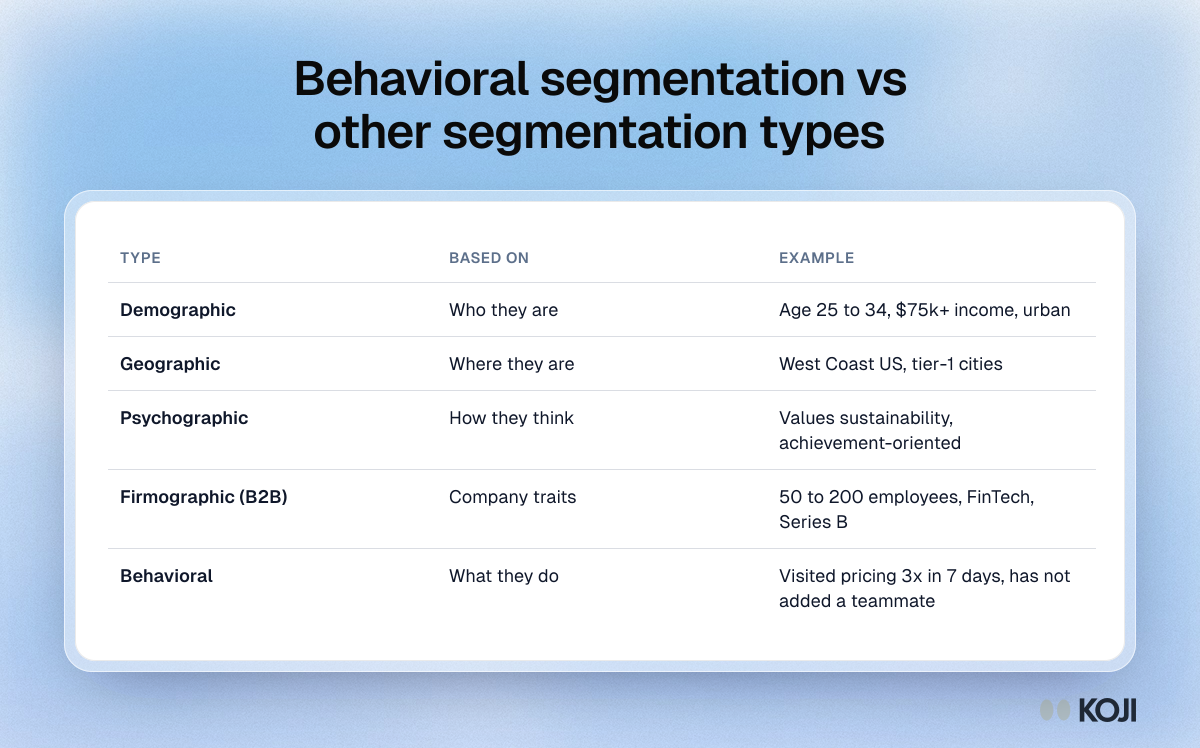
Behavioral segmentation vs other segmentation types
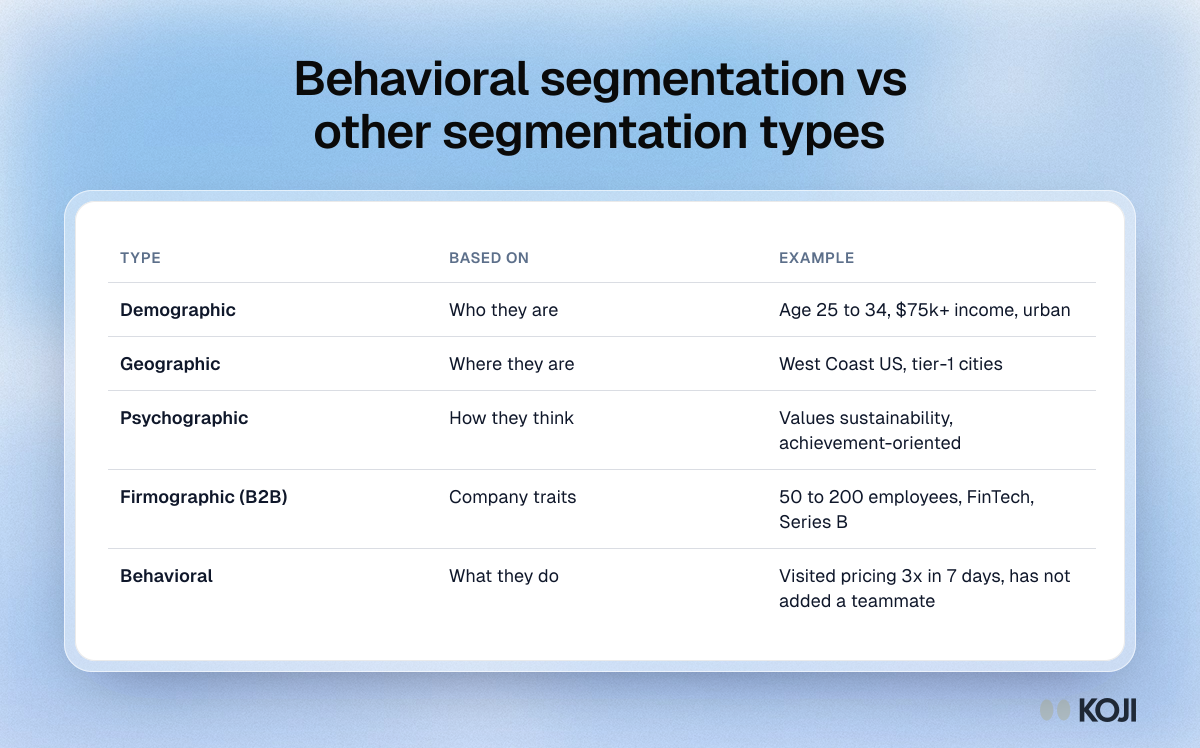
A comparison of the five common ways to segment customers: demographic (who they are), geographic (where they are), psychographic (how they think), firmographic for B2B (company traits) and behavioral (what they do), each with an example segment. Use it to explain to a team why behavioral segments predict action better than personas built on demographics, and which lens to add on top.
Where this appears
What's in this reference table
| Type | Based on | Example |
|---|---|---|
| Demographic | Who they are | Age 25 to 34, $75k+ income, urban |
| Geographic | Where they are | West Coast US, tier-1 cities |
| Psychographic | How they think | Values sustainability, achievement-oriented |
| Firmographic (B2B) | Company traits | 50 to 200 employees, FinTech, Series B |
| Behavioral | What they do | Visited pricing 3x in 7 days, has not added a teammate |
Use this image
Free to use in your docs, decks and posts under CC BY 4.0, as long as you credit Koji with a link to this page. To embed it, paste this into your page:
html
<a href="https://www.koji.so/visuals/behavioral-vs-demographic-psychographic-segmentation"><img src="https://www.koji.so/visuals/behavioral-vs-demographic-psychographic-segmentation/behavioral-vs-demographic-psychographic-segmentation.png" alt="Table comparing five segmentation types by what each is based on, with examples: demographic, geographic, psychographic, firmographic and behavioral." width="1200" height="748" /></a>
<p>Source: <a href="https://www.koji.so/visuals/behavioral-vs-demographic-psychographic-segmentation">Behavioral segmentation vs other segmentation types</a>, Koji</p>