Reference table
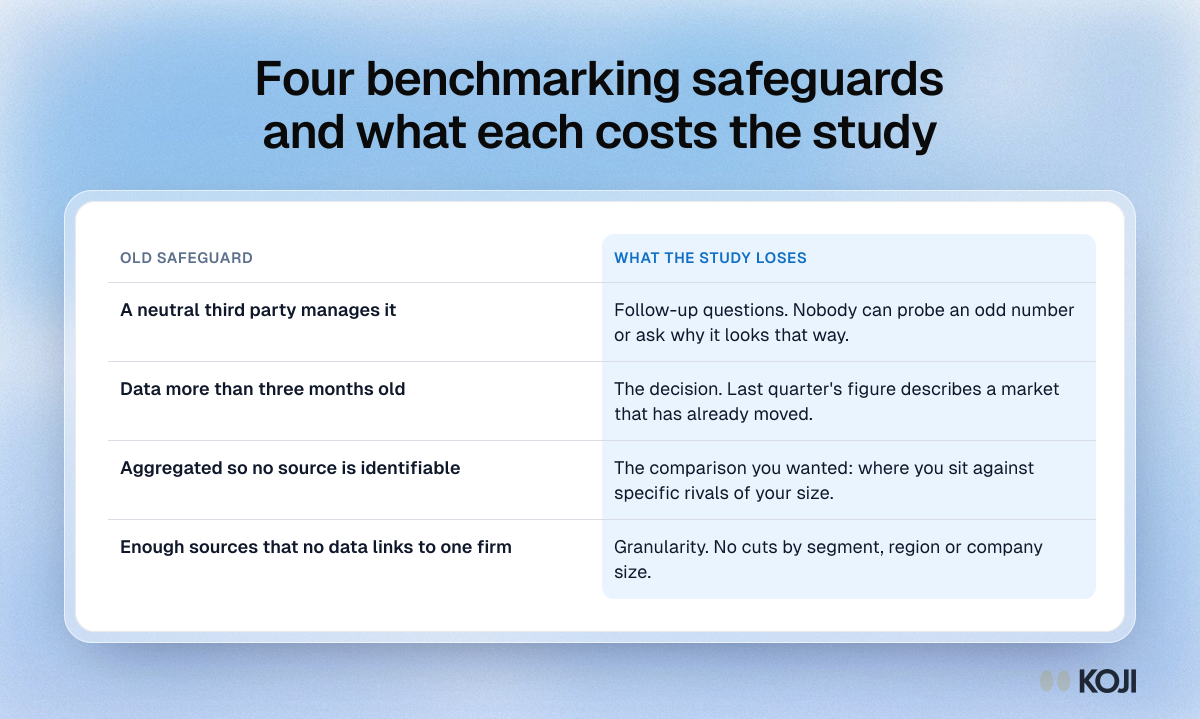
Four benchmarking safeguards and what each costs the study
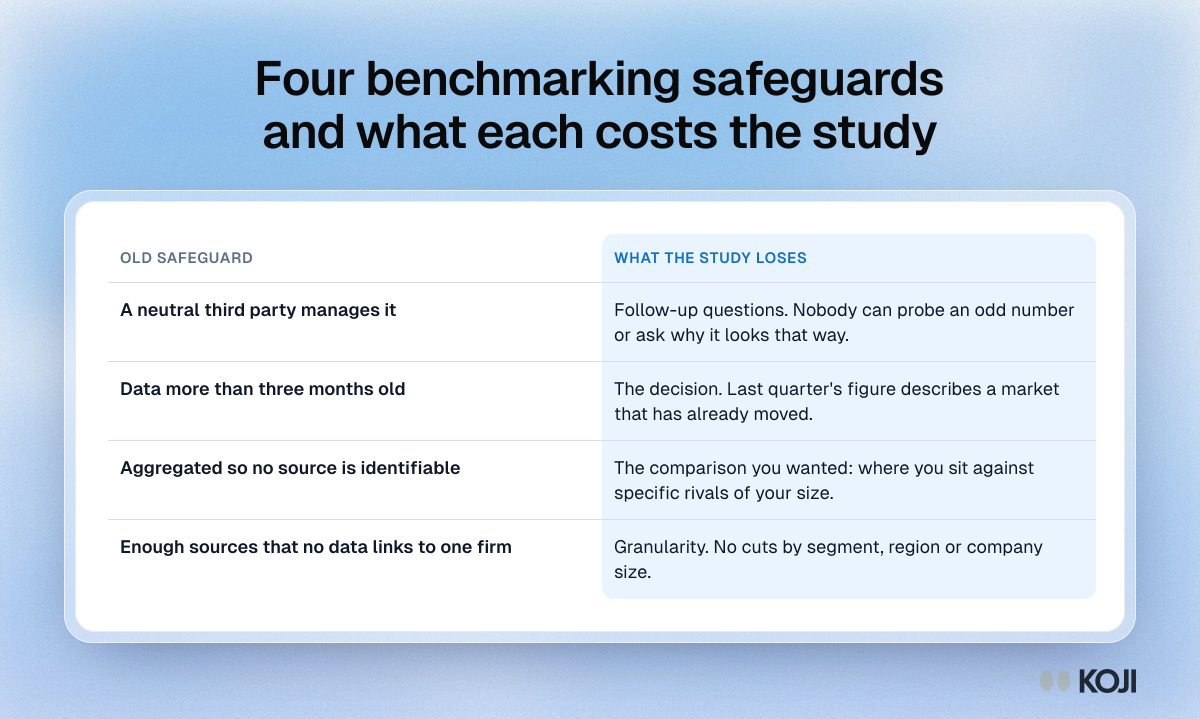
A table pairing the four classic safeguards for competitor benchmarking surveys (third-party management, data at least three months old, aggregation and a minimum number of sources) with what each one takes away from the research. Use it when deciding whether a competitor-fed benchmark can answer your question, or whether internal benchmarks and buyer interviews would serve you better.
Where this appears
What's in this reference table
| Old safeguard | What the study loses |
|---|---|
| A neutral third party manages it | Follow-up questions. Nobody can probe an odd number or ask why it looks that way. |
| Data more than three months old | The decision. Last quarter's figure describes a market that has already moved. |
| Aggregated so no source is identifiable | The comparison you wanted: where you sit against specific rivals of your size. |
| Enough sources that no data links to one firm | Granularity. No cuts by segment, region or company size. |
Use this image
Free to use in your docs, decks and posts under CC BY 4.0, as long as you credit Koji with a link to this page. To embed it, paste this into your page:
html
<a href="https://www.koji.so/visuals/benchmarking-safeguards-what-each-costs-the-study"><img src="https://www.koji.so/visuals/benchmarking-safeguards-what-each-costs-the-study/benchmarking-safeguards-what-each-costs-the-study.png" alt="Table of four antitrust safeguards for benchmarking surveys and what each costs: follow-ups, current data, named comparisons and segment cuts." width="1200" height="719" /></a>
<p>Source: <a href="https://www.koji.so/visuals/benchmarking-safeguards-what-each-costs-the-study">Four benchmarking safeguards and what each costs the study</a>, Koji</p>