Framework
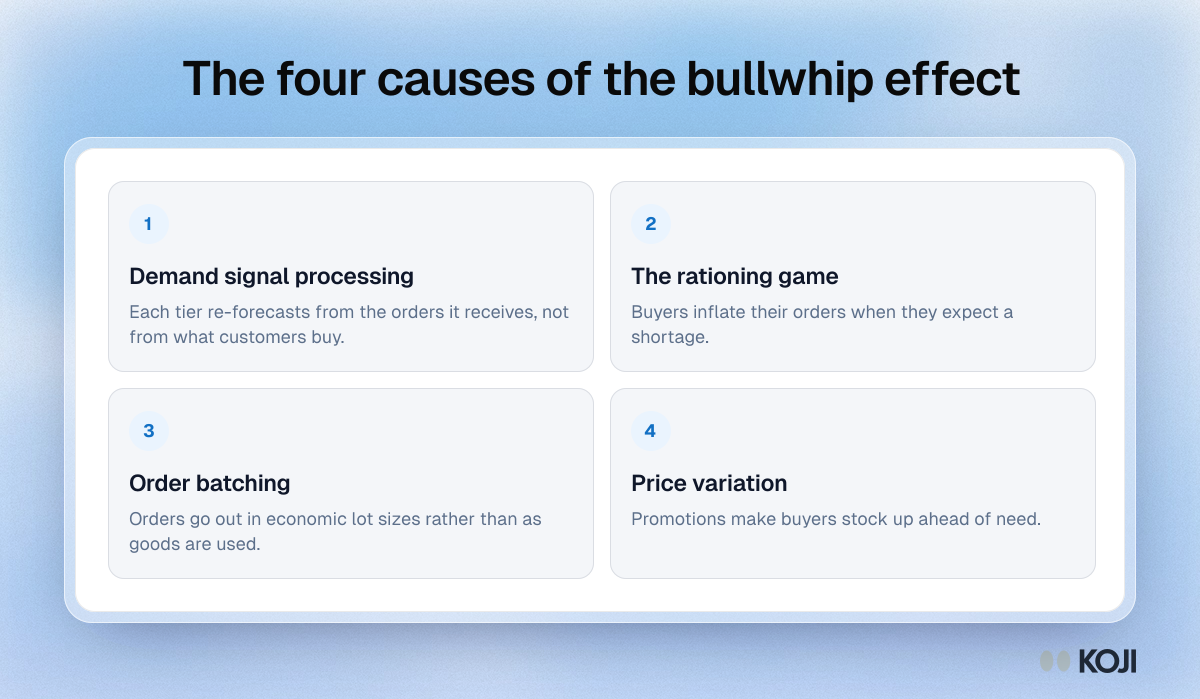
The four causes of the bullwhip effect
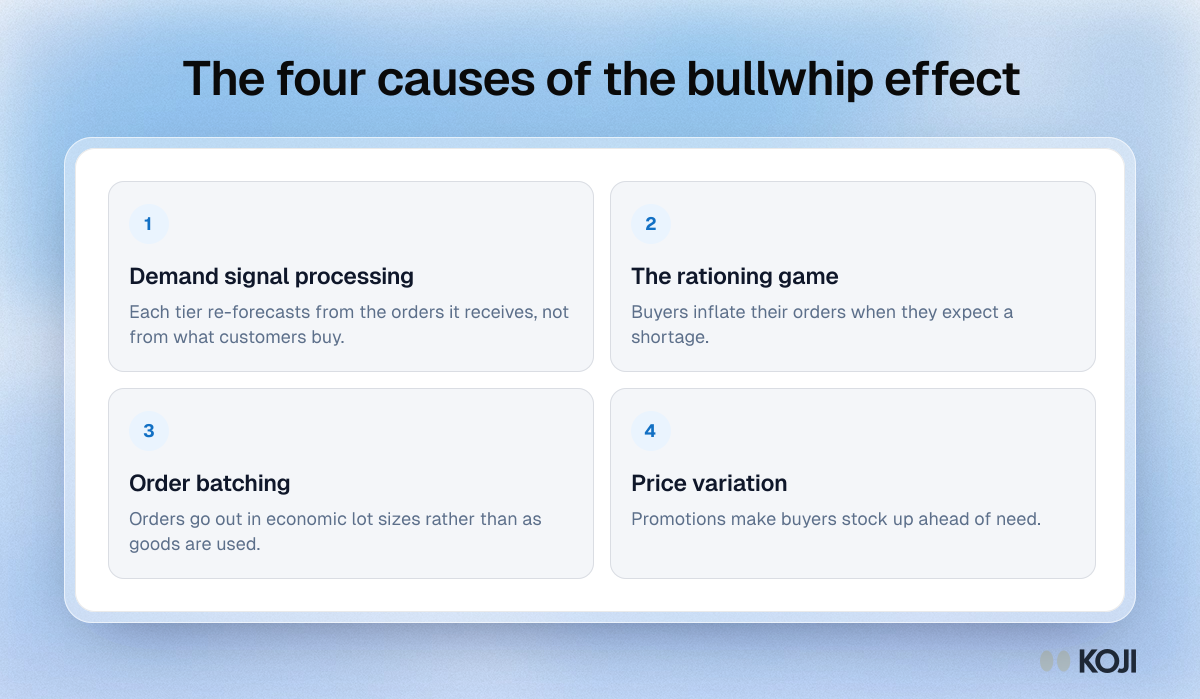
A framework of the four causes of the bullwhip effect identified by Hau Lee, V. Padmanabhan and Seungjin Whang in 1997: demand signal processing, the rationing game, order batching and price variation. Each one makes order variability grow as it moves up a supply chain, so channel order data can swing hard while end-customer demand stays steady. Use it to question a spike or drop in distributor orders before you read it as a change in what customers want, and ask end customers directly, which Koji does with AI-moderated interviews.
Where this appears
What's in this framework
- Demand signal processing: Each tier re-forecasts from the orders it receives, not from what customers buy.
- The rationing game: Buyers inflate their orders when they expect a shortage.
- Order batching: Orders go out in economic lot sizes rather than as goods are used.
- Price variation: Promotions make buyers stock up ahead of need.
Use this image
Free to use in your docs, decks and posts under CC BY 4.0, as long as you credit Koji with a link to this page. To embed it, paste this into your page:
html
<a href="https://www.koji.so/visuals/bullwhip-effect-four-causes-framework"><img src="https://www.koji.so/visuals/bullwhip-effect-four-causes-framework/bullwhip-effect-four-causes-framework.png" alt="Framework of the four causes of the bullwhip effect: demand signal processing, the rationing game, order batching and price variation." width="1200" height="699" /></a>
<p>Source: <a href="https://www.koji.so/visuals/bullwhip-effect-four-causes-framework">The four causes of the bullwhip effect</a>, Koji</p>