Reference table
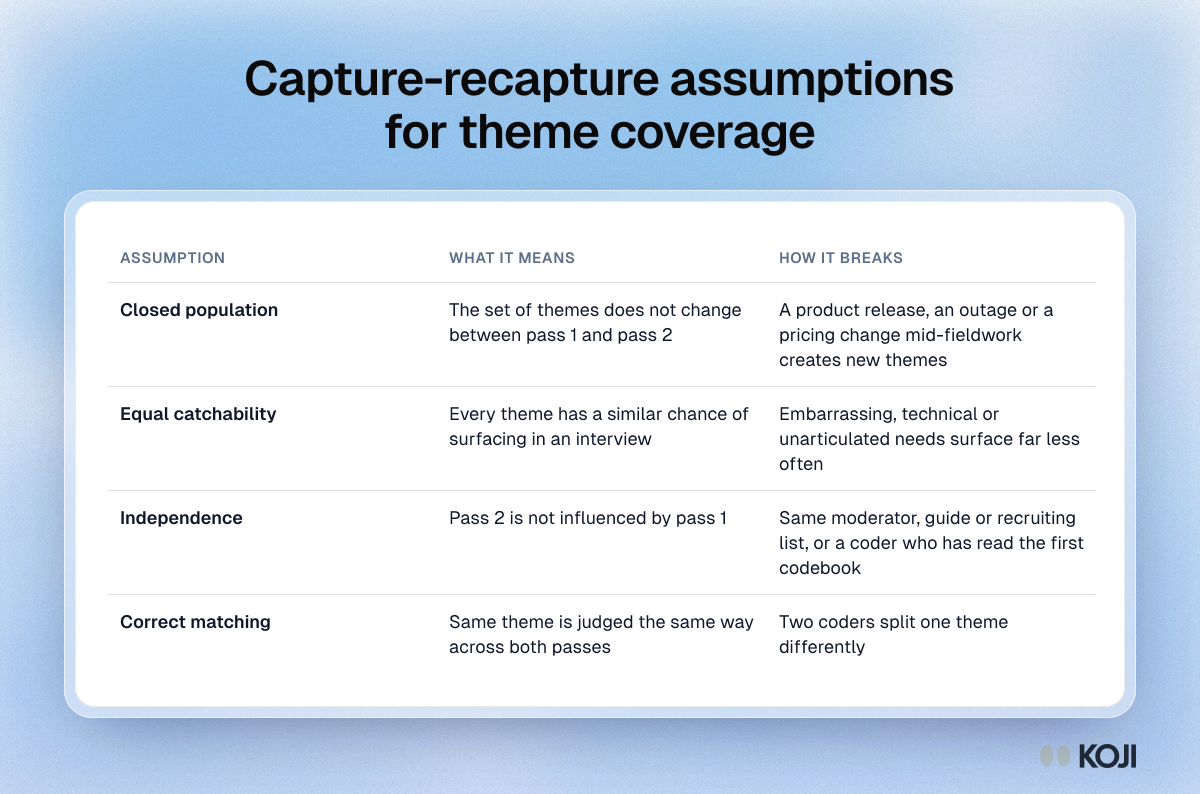
Capture-recapture assumptions for theme coverage
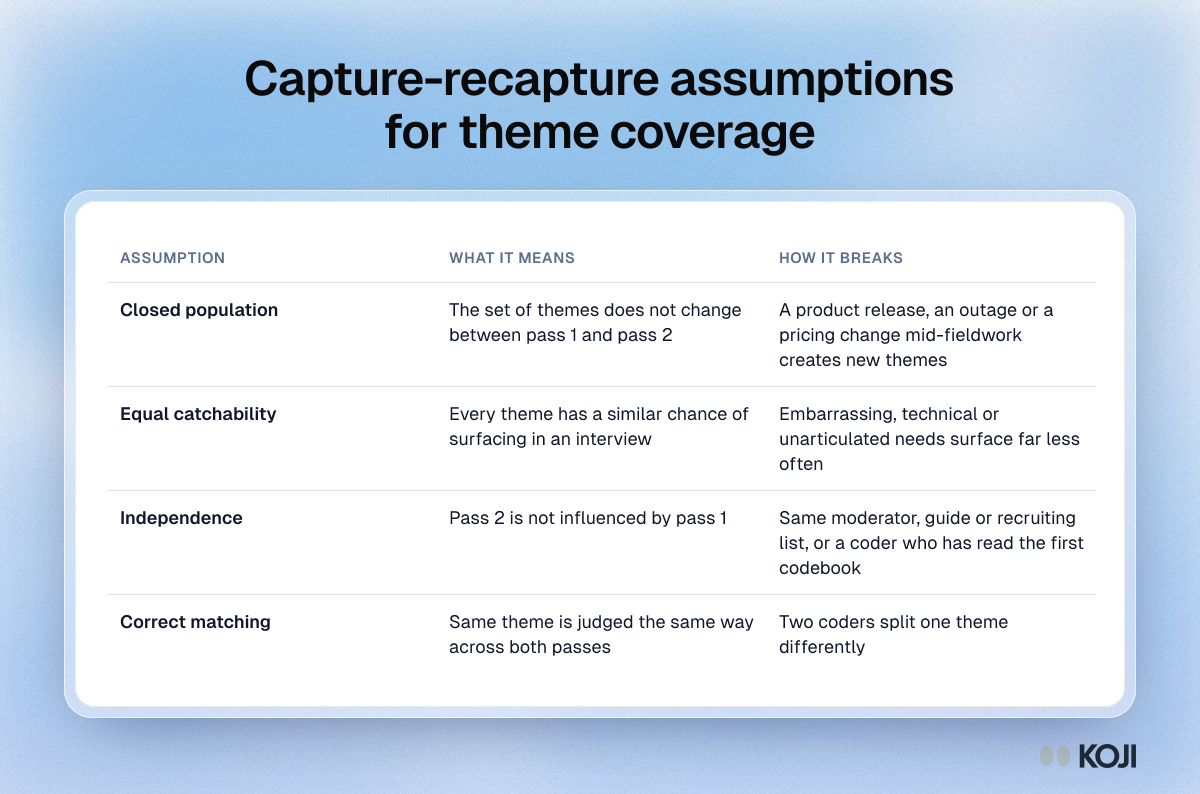
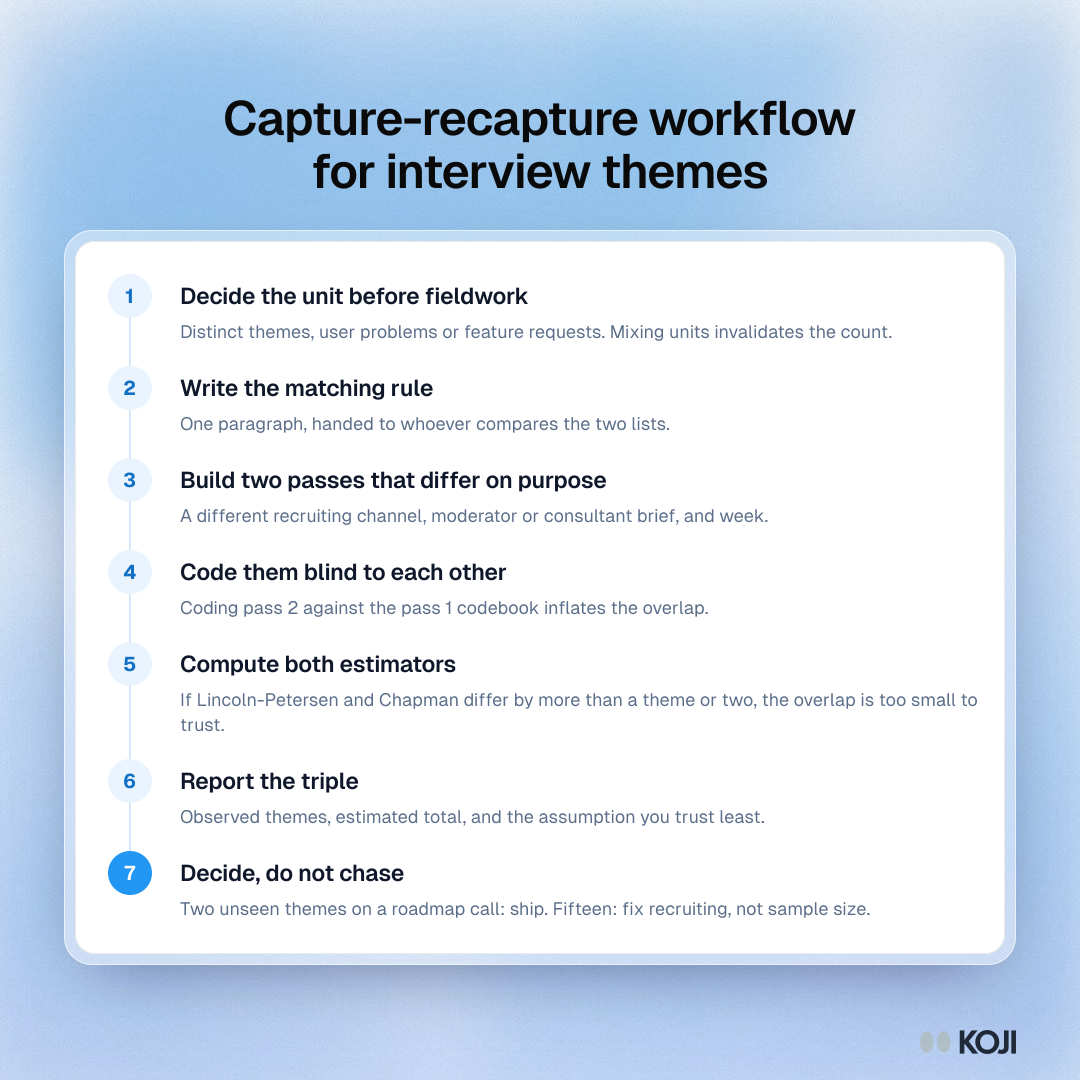
A reference table for researchers using capture-recapture to estimate how many interview themes a study has missed. It lists the four assumptions the estimator needs, what each means for a qualitative study, and the everyday ways each one breaks. Check it before you trust a coverage number. Koji's automatic thematic analysis gives you a second, independent coding pass to compare with a human one.
Where this appears
What's in this reference table
| Assumption | What it means | How it breaks |
|---|---|---|
| Closed population | The set of themes does not change between pass 1 and pass 2 | A product release, an outage or a pricing change mid-fieldwork creates new themes |
| Equal catchability | Every theme has a similar chance of surfacing in an interview | Embarrassing, technical or unarticulated needs surface far less often |
| Independence | Pass 2 is not influenced by pass 1 | Same moderator, guide or recruiting list, or a coder who has read the first codebook |
| Correct matching | Same theme is judged the same way across both passes | Two coders split one theme differently |
Use this image
Free to use in your docs, decks and posts under CC BY 4.0, as long as you credit Koji with a link to this page. To embed it, paste this into your page:
html
<a href="https://www.koji.so/visuals/capture-recapture-assumptions-qualitative-research"><img src="https://www.koji.so/visuals/capture-recapture-assumptions-qualitative-research/capture-recapture-assumptions-qualitative-research.png" alt="Table of four capture-recapture assumptions for interview themes: closed population, equal catchability, independence and matching, and how each breaks." width="1200" height="794" /></a>
<p>Source: <a href="https://www.koji.so/visuals/capture-recapture-assumptions-qualitative-research">Capture-recapture assumptions for theme coverage</a>, Koji</p>