Guide
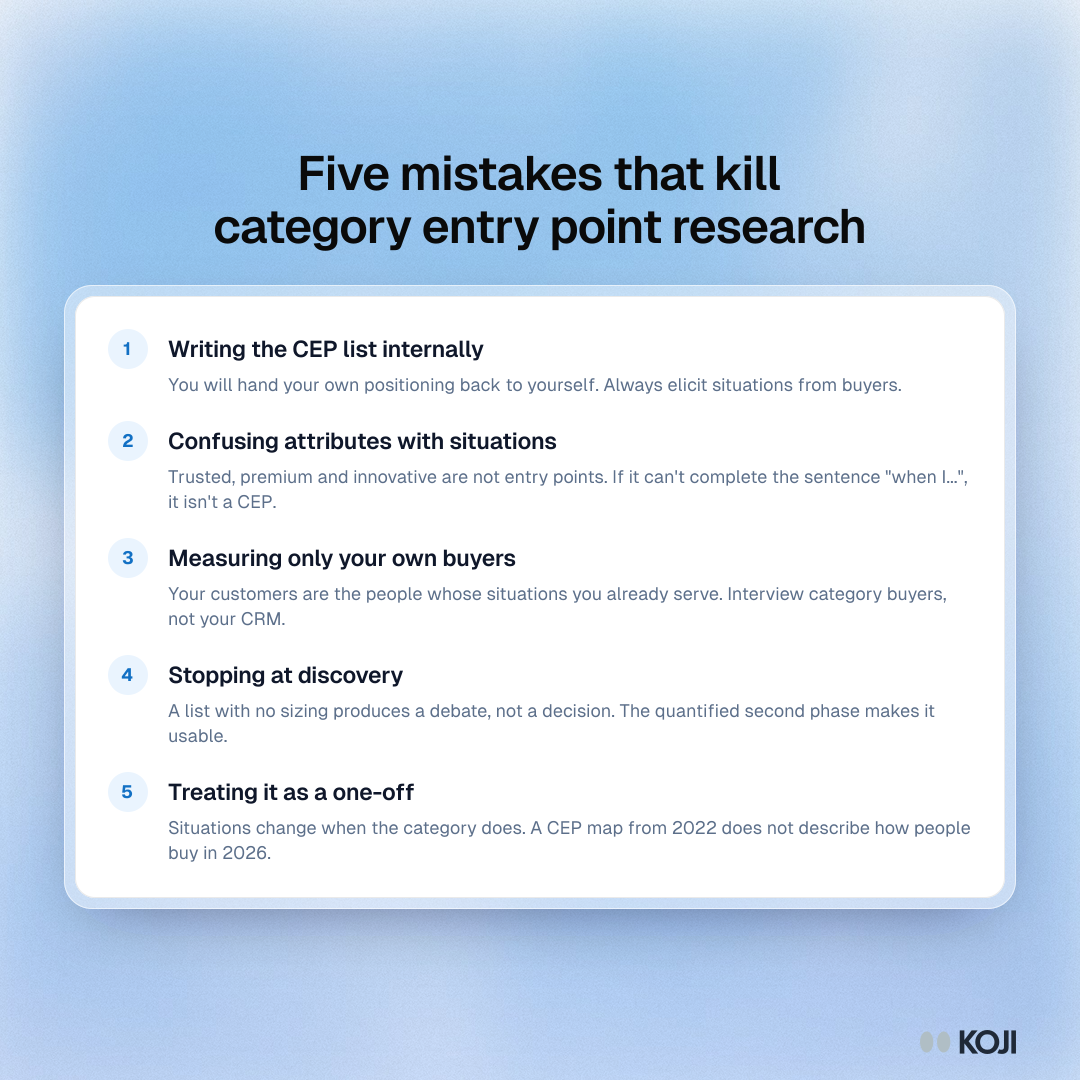
Five mistakes that kill category entry point research
What goes wrong in CEP projects and how to avoid it
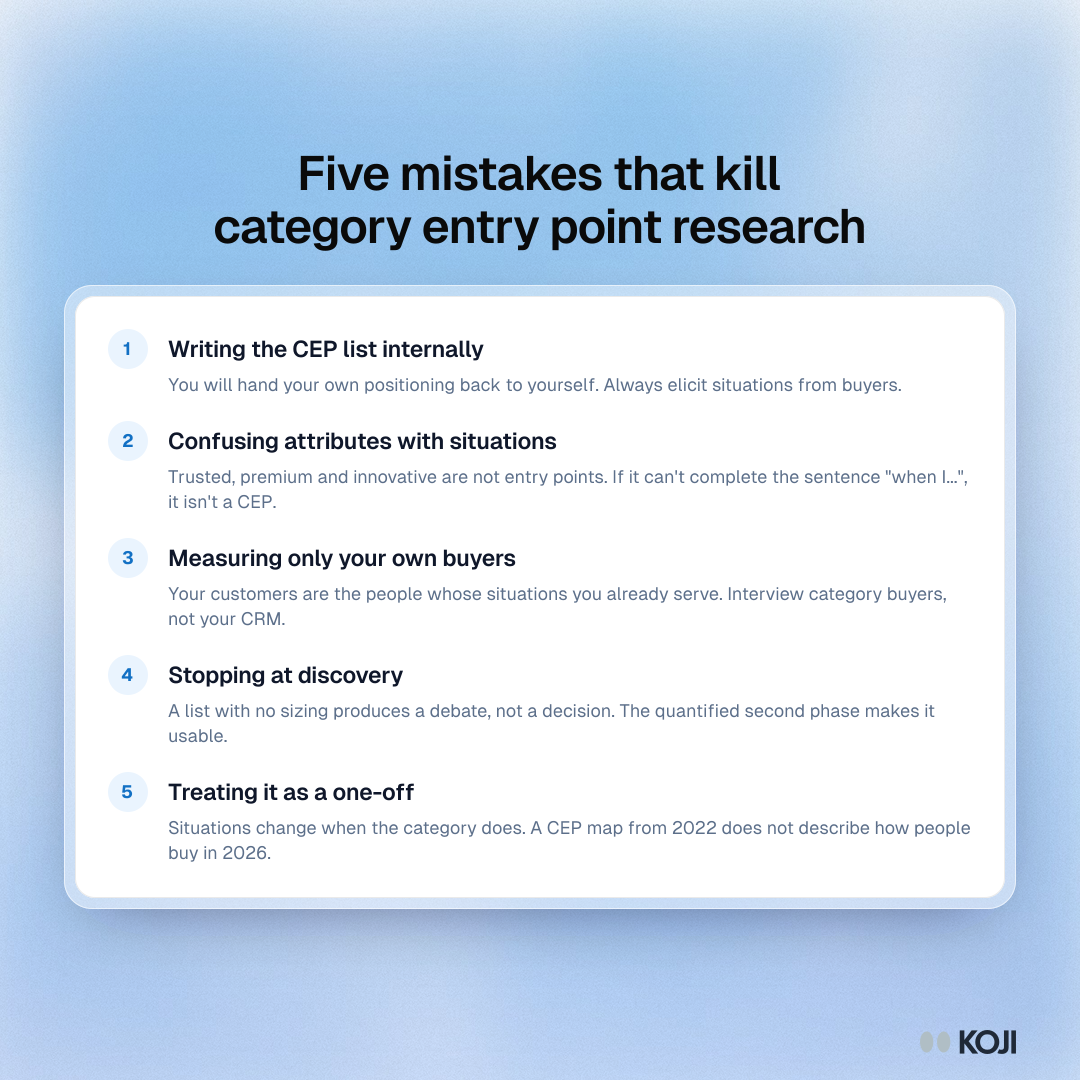
Five common mistakes in category entry point research, the work of finding the buying situations that bring a category to mind. Lists written in a workshop, attributes passed off as situations and samples drawn only from existing customers all hide the situations a brand is losing. Stopping after discovery leaves no sizing to act on, and a map goes stale as the category changes. Koji can run occasion-based interviews with category buyers to fix the first three.
Where this appears
What's in this guide
- Writing the CEP list internally: You will hand your own positioning back to yourself. Always elicit situations from buyers.
- Confusing attributes with situations: Trusted, premium and innovative are not entry points. If it can't complete the sentence "when I...", it isn't a CEP.
- Measuring only your own buyers: Your customers are the people whose situations you already serve. Interview category buyers, not your CRM.
- Stopping at discovery: A list with no sizing produces a debate, not a decision. The quantified second phase makes it usable.
- Treating it as a one-off: Situations change when the category does. A CEP map from 2022 does not describe how people buy in 2026.
Use this image
Free to use in your docs, decks and posts under CC BY 4.0, as long as you credit Koji with a link to this page. To embed it, paste this into your page:
html
<a href="https://www.koji.so/visuals/category-entry-point-research-mistakes"><img src="https://www.koji.so/visuals/category-entry-point-research-mistakes/category-entry-point-research-mistakes.png" alt="List of five category entry point research mistakes: an internal CEP list, attributes for situations, only own buyers, stopping at discovery, a one-off map" width="1080" height="1080" /></a>
<p>Source: <a href="https://www.koji.so/visuals/category-entry-point-research-mistakes">Five mistakes that kill category entry point research</a>, Koji</p>