Reference table
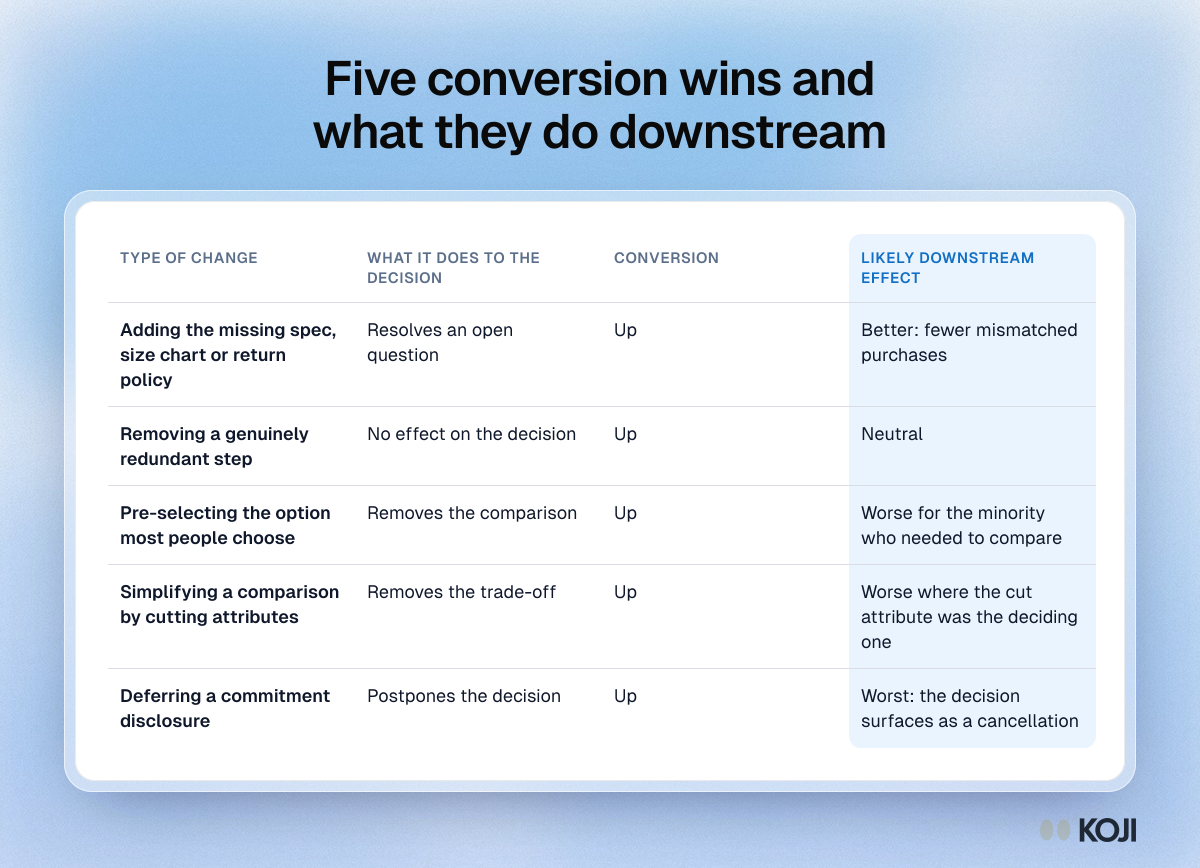
Five conversion wins and what they do downstream
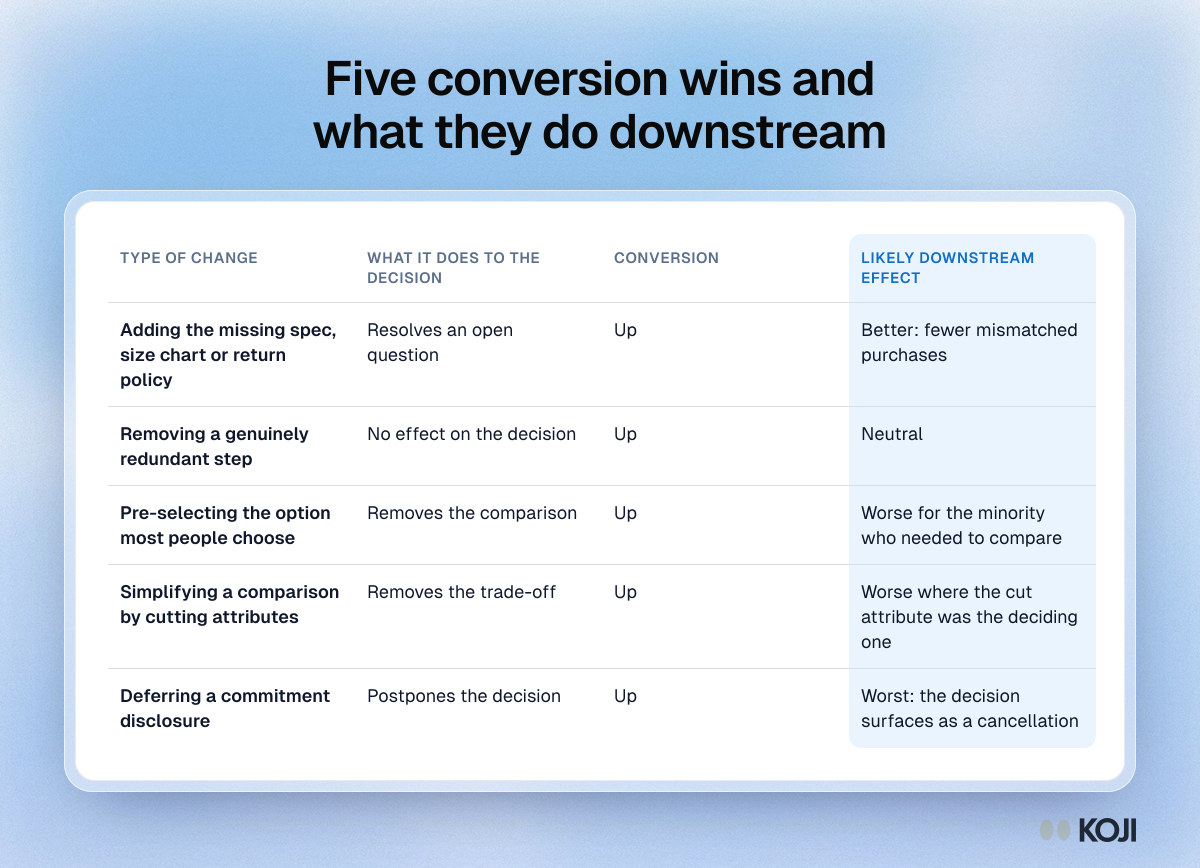
Five common conversion changes compared by what they do to the shopper's decision. Answering an open question improves what happens after purchase. Pre-selecting, cutting attributes and deferring commitments raise conversion by removing the decision, and the cost shows up later as returns or cancellations. Use it to sort your past test wins before you trust them.
Where this appears
What's in this reference table
| Type of change | What it does to the decision | Conversion | Likely downstream effect |
|---|---|---|---|
| Adding the missing spec, size chart or return policy | Resolves an open question | Up | Better: fewer mismatched purchases |
| Removing a genuinely redundant step | No effect on the decision | Up | Neutral |
| Pre-selecting the option most people choose | Removes the comparison | Up | Worse for the minority who needed to compare |
| Simplifying a comparison by cutting attributes | Removes the trade-off | Up | Worse where the cut attribute was the deciding one |
| Deferring a commitment disclosure | Postpones the decision | Up | Worst: the decision surfaces as a cancellation |
Use this image
Free to use in your docs, decks and posts under CC BY 4.0, as long as you credit Koji with a link to this page. To embed it, paste this into your page:
html
<a href="https://www.koji.so/visuals/conversion-changes-downstream-effect-table"><img src="https://www.koji.so/visuals/conversion-changes-downstream-effect-table/conversion-changes-downstream-effect-table.png" alt="Table of five design changes that all raise conversion, from adding a missing spec to deferring a commitment disclosure, and their downstream effect." width="1200" height="868" /></a>
<p>Source: <a href="https://www.koji.so/visuals/conversion-changes-downstream-effect-table">Five conversion wins and what they do downstream</a>, Koji</p>