Comparison
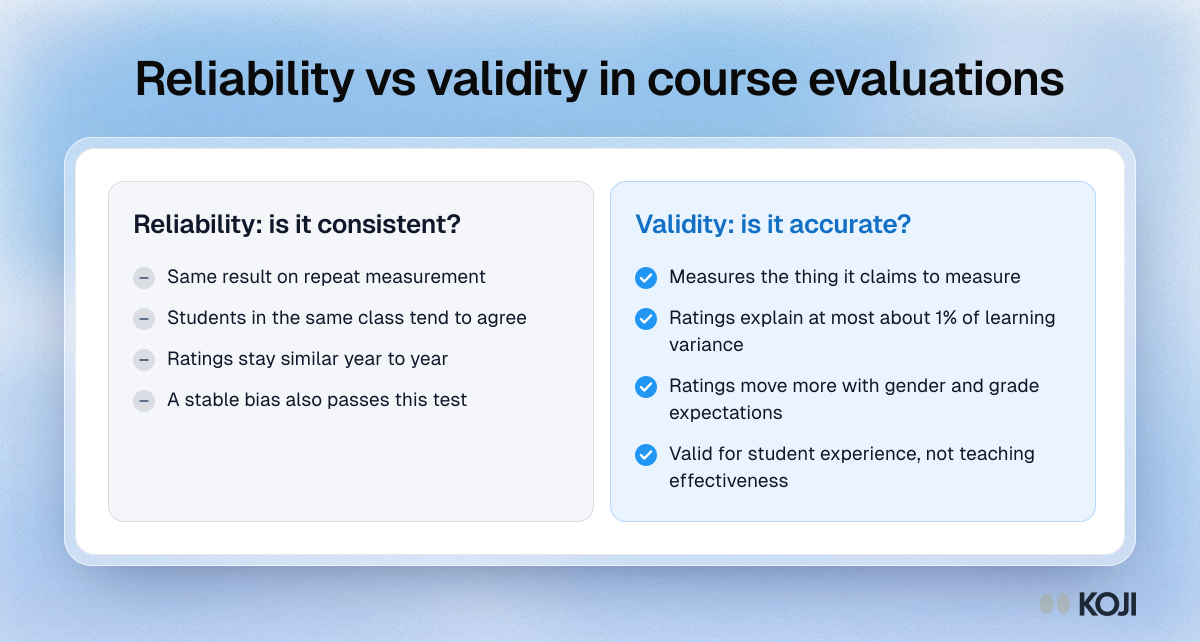
Reliability vs validity in course evaluations
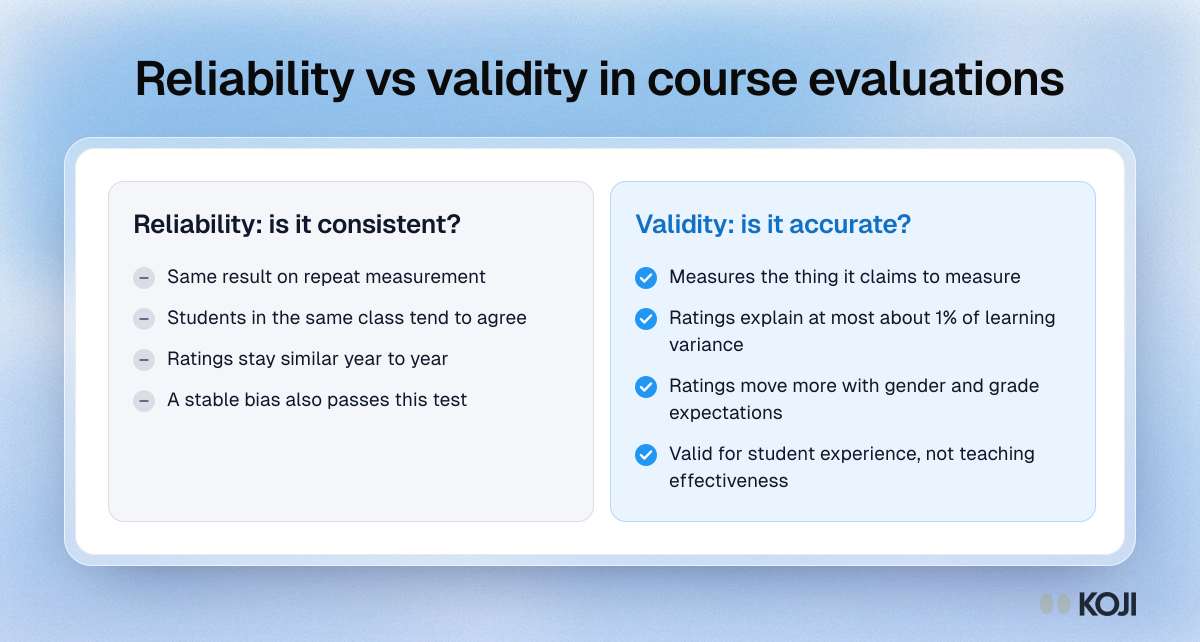
A side-by-side comparison of reliability and validity as they apply to student evaluations of teaching (SET). Reliability asks whether ratings are consistent, and SET mostly are. Validity asks whether they measure teaching effectiveness, and the strongest meta-analytic evidence says they barely track learning while responding to instructor gender and grade expectations. Use it to explain to committees why a stable score can still be the wrong evidence. Koji for Education uses conversational interviews to capture the student experience that SET can validly report.
What's in this comparison
Reliability: is it consistent?
- Same result on repeat measurement
- Students in the same class tend to agree
- Ratings stay similar year to year
- A stable bias also passes this test
Validity: is it accurate?
- Measures the thing it claims to measure
- Ratings explain at most about 1% of learning variance
- Ratings move more with gender and grade expectations
- Valid for student experience, not teaching effectiveness
Use this image
Free to use in your docs, decks and posts under CC BY 4.0, as long as you credit Koji with a link to this page. To embed it, paste this into your page:
html
<a href="https://www.koji.so/visuals/course-evaluation-reliability-vs-validity-comparison"><img src="https://www.koji.so/visuals/course-evaluation-reliability-vs-validity-comparison/course-evaluation-reliability-vs-validity-comparison.png" alt="Comparison of reliability and validity in student evaluations of teaching: ratings are consistent, but barely track learning and respond to bias." width="1200" height="642" /></a>
<p>Source: <a href="https://www.koji.so/visuals/course-evaluation-reliability-vs-validity-comparison">Reliability vs validity in course evaluations</a>, Koji</p>