Comparison
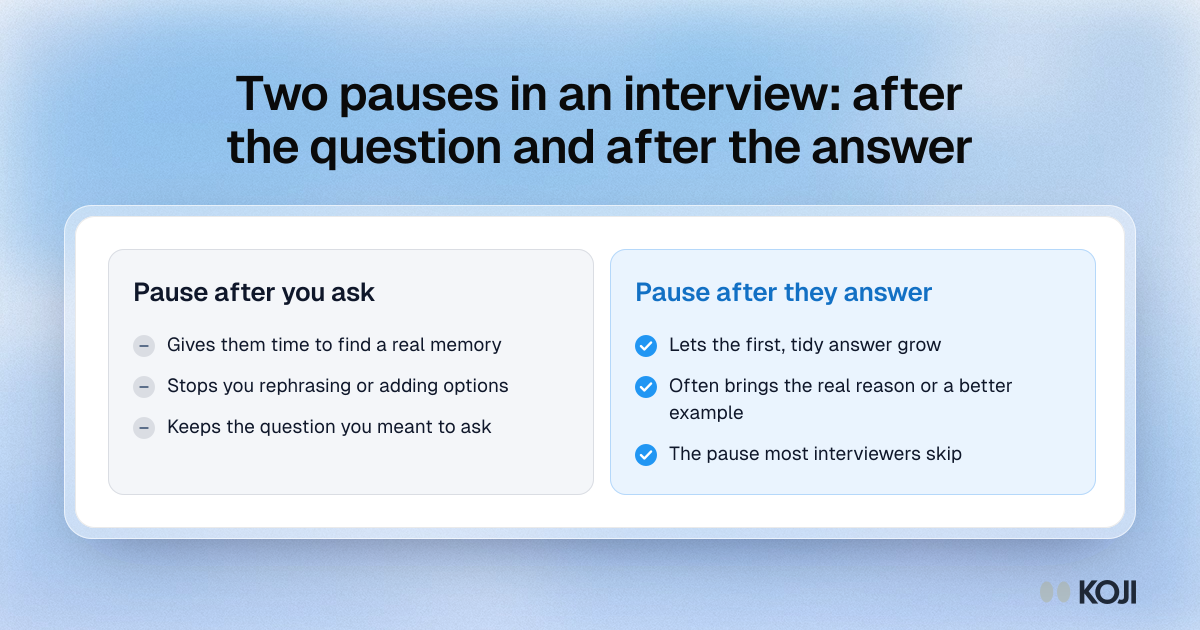
Two pauses in an interview: after the question and after the answer
Where to use silence in a research interview
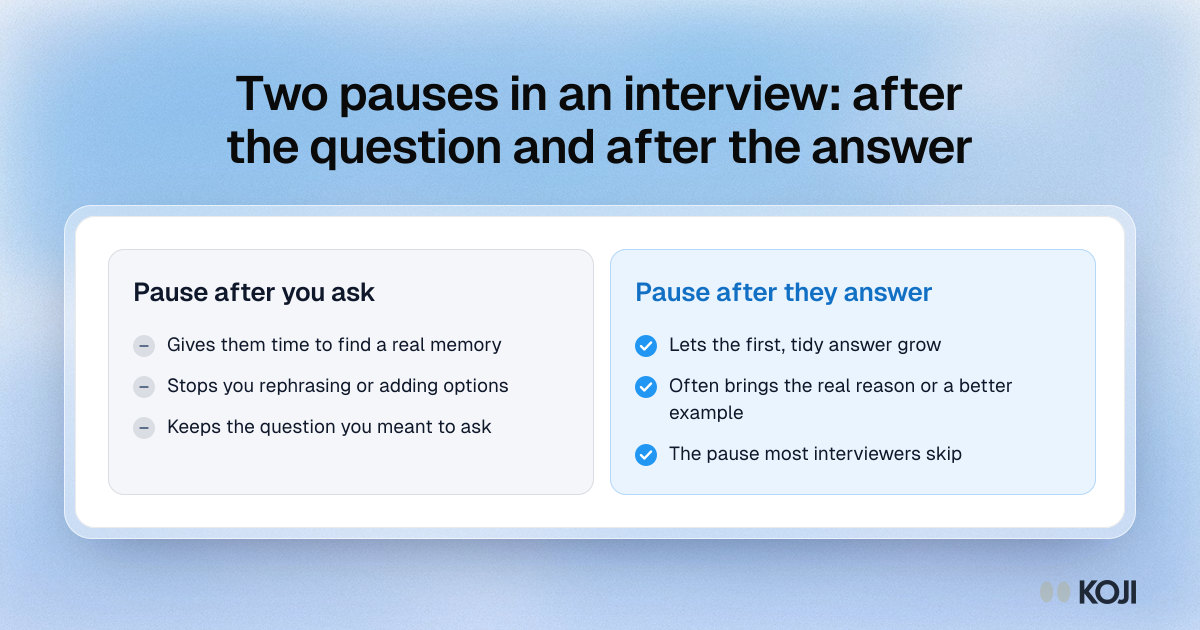
A comparison of the two places an interviewer can use silence. Pausing after the question gives the participant time to recall a real experience and stops the interviewer from rephrasing or leading. Pausing after the answer lets the participant add the qualifier or real reason they had not said yet. The two pauses follow Mary Budd Rowe's distinction between wait time after a question and after an answer, applied here to user interviews.
Where this appears
What's in this comparison
Pause after you ask
- Gives them time to find a real memory
- Stops you rephrasing or adding options
- Keeps the question you meant to ask
Pause after they answer
- Lets the first, tidy answer grow
- Often brings the real reason or a better example
- The pause most interviewers skip
Use this image
Free to use in your docs, decks and posts under CC BY 4.0, as long as you credit Koji with a link to this page. To embed it, paste this into your page:
html
<a href="https://www.koji.so/visuals/interview-pause-after-question-vs-after-answer"><img src="https://www.koji.so/visuals/interview-pause-after-question-vs-after-answer/interview-pause-after-question-vs-after-answer.png" alt="Comparison of the pause after asking a question with the pause after the participant answers, and what each one gets you in a research interview." width="1200" height="630" /></a>
<p>Source: <a href="https://www.koji.so/visuals/interview-pause-after-question-vs-after-answer">Two pauses in an interview: after the question and after the answer</a>, Koji</p>