Using Silence in User Interviews: How Pauses Get Better Answers
Waiting a few seconds before you speak often gets you the part of the answer the participant hadn't said yet. Why silence works, where to pause, how long to wait and when not to.
Silence is one of the most useful tools an interviewer has, and one of the hardest to use. When a participant finishes an answer, waiting a few seconds before you speak often gets you the part they hadn't said yet: the qualifier, the real reason, the example that changes your reading of everything before it. It works because ordinary conversation leaves almost no gaps, so a pause feels like an invitation to keep going. The skill is knowing which pauses to hold, how long to hold them, and when silence stops helping and starts to feel like pressure.
This guide covers why silence works, the research behind it, the two places to pause, how long to wait, when not to use it, and how it works in remote and AI-moderated interviews.
Why silence works
Everyday conversation is fast. In a 2009 study in PNAS, Tanya Stivers and colleagues compared turn-taking across 10 languages from around the world and found the same pattern in all of them: speakers avoid talking over each other and keep the silence between turns to a minimum. The average gap between turns differed from language to language, but only within about 250 milliseconds of the cross-language average. Across cultures, people answer each other within a fraction of a second.
Against that background, even a short silence carries meaning. Conversation analysts have long noted this. Gail Jefferson's well-known paper on the subject describes a "standard maximum" silence of about one second, beyond which people start to treat the gap as a problem to be fixed.
Studies of how listeners read gaps show the same thing. Felicia Roberts, Alexander Francis and Melanie Morgan (2006) played people recordings of requests and assessments with a silence of 0, 600 or 1,200 milliseconds before the reply. With each step up in pause length, listeners heard the reply as less willing to comply with the request and less in agreement with the assessment. Kobin Kendrick and Francisco Torreira (2015) found the pattern in real phone calls: across 195 responses, only once the gap reached 700 milliseconds or more did refusals and other dispreferred answers clearly outnumber preferred ones.
Put those findings together and the interviewer's opportunity is clear. People expect a reply within a second. When it doesn't come, they feel the gap and fill it, often with the thing that was harder to say. As Erika Hall puts it in Just Enough Research: "The great myth is that you need to be a good talker. But conducting a good interview is actually about shutting up."
The two places to pause
The most useful research on deliberate pausing comes from classrooms. Mary Budd Rowe studied how long teachers waited after asking a question and after a student answered. In her 1986 review in the Journal of Teacher Education, she reported that when those pauses reached three seconds or more, there were pronounced changes in how students used language and logic: longer answers, more reasoning, more students willing to answer at all.

Photo by Vitaly Gariev on Unsplash
Rowe separated two kinds of wait time, and the distinction maps directly onto interviewing.
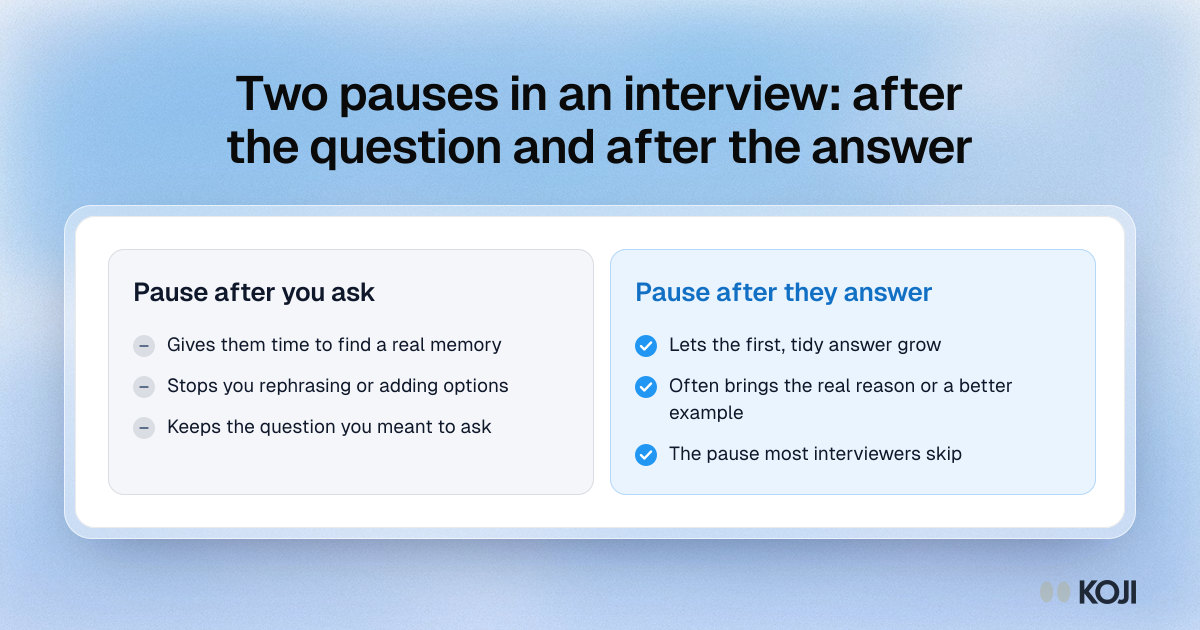
After you ask. The participant needs time to find a memory and decide how to describe it. If you fill the gap by rephrasing, adding examples or offering options, you've changed the question and often led the answer. Ask once, then wait.
After they answer. This is the pause most interviewers skip, and the one that pays off most. The participant has given you the first, tidy version of their answer. Wait, and they will often add the second version: "Actually, the real reason was..." If you jump straight to the next question, you never hear it.
How to use a strategic pause
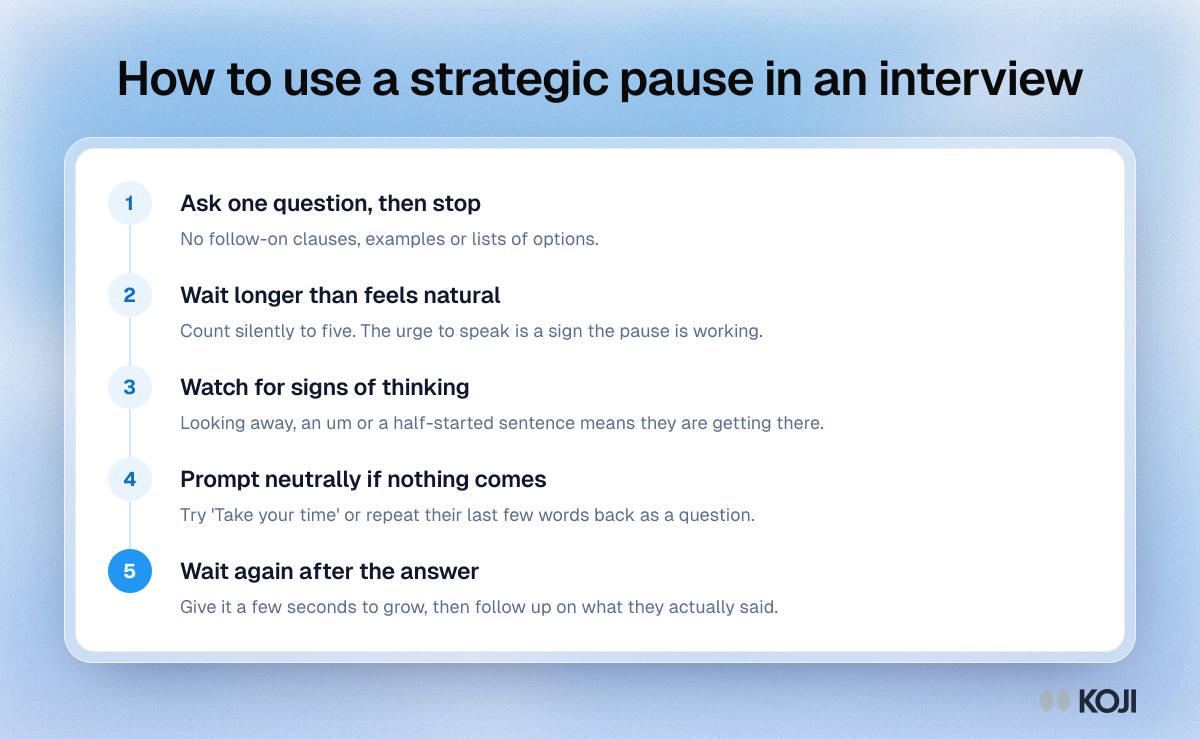
- Ask one question, then stop talking. No follow-on clauses, no examples, no "or maybe...". Double questions are the most common way interviewers fill a silence they should have left alone.
- Wait longer than feels natural. Many practitioners count silently to five. You'll feel the urge to speak at about two. That urge is your signal that the pause is working, not that it has failed.
- Watch for signs of thinking. Looking away, an "um", a slow breath, starting a sentence and stopping. These mean "I'm getting there". Don't interrupt them.
- If nothing comes, prompt neutrally. "Take your time." "What comes to mind?" Or repeat their last few words back to them as a question. A neutral prompt keeps the floor with the participant without steering them.
- When they finish, wait again. Give the answer a few seconds to grow before you move on. Then follow up on what they actually said, not on what you planned to ask next. More on this in probing questions.
Mistakes that kill a useful silence
- Filling it with a multiple-choice menu. "Was it the price, or the setup, or something else?" turns an open question into a closed one and hands the participant an easy answer.
- Nodding along too fast. Quick "mm-hm"s and "right"s signal that you're ready for the next question. A few are fine; a constant stream ends the participant's turn for them. See backchannels and continuers.
- Using silence as a pressure tactic. A pause should feel like room, not a test. Keep your expression open and relaxed; silence with a frown reads as disapproval.
- Reading a long pause as a no. The research above shows that longer gaps often come before a harder answer. That makes the pause worth waiting through, not something to rescue the participant from. It also means a slow "yes" deserves a gentle follow-up. See response timing.
When not to hold the silence
Silence is a tool for drawing out more detail. It's the wrong tool when the participant is struggling for reasons that have nothing to do with the question.
- Distress. If someone is upset, holding a long pause can feel cold. Acknowledge what they've said, offer to move on or take a break, and let them set the pace. See trauma-informed user research.
- Confusion. If the participant clearly didn't understand the question, waiting won't help. Rephrase it, simply.
- Language and culture. People speaking in a second language often need longer pauses to find words, so give them more time, not less. And because comfortable gap lengths vary between languages, as the Stivers study found, don't assume your own sense of an awkward pause is theirs.
- Accessibility. Some participants process questions differently or need more time to respond. Build that into the interview length rather than rushing. See including neurodivergent participants.
Silence in remote interviews
Video and phone calls make silence harder to read. Audio delays mean a pause can be a lag rather than a thought, and without full body language you can't always see someone thinking. Two habits help. Tell participants at the start that you'll sometimes pause to give them time to think, so the silence doesn't feel like a dropped connection. And wait a beat longer before speaking than you would in person, so a delay doesn't make you talk over the end of their answer. For more, see remote interview best practices.
How Koji helps
In an AI-moderated interview, the timing is set by the interviewer's design rather than a person's nerve, so Koji approaches the job silence does from a few directions.
Text interviews let people think in their own time. In a text interview there is no awkward gap to fill. Participants can stop, think and come back to their answer without anyone waiting on the other end, which suits questions that need a memory dug out or a careful answer.
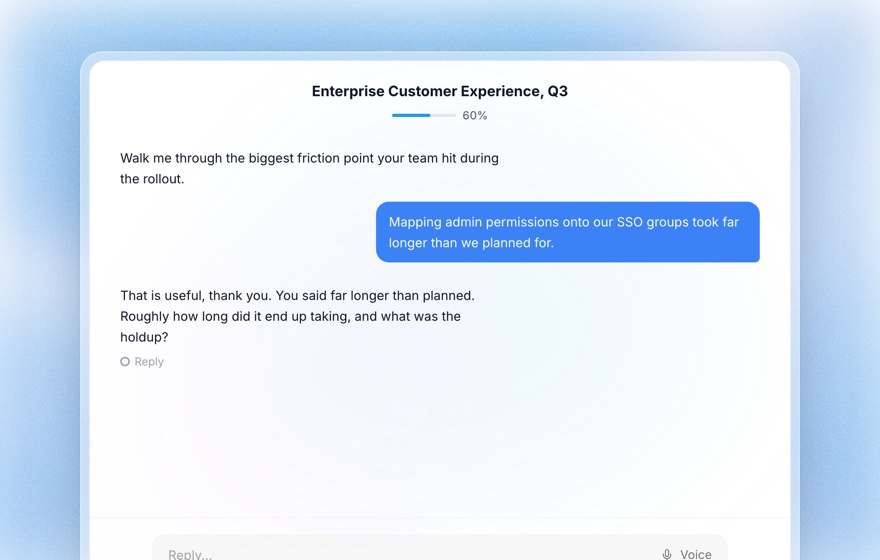
Follow-ups do the work of the second pause. The point of waiting after an answer is to get the second, truer version. In Koji you set, per question, how many follow-ups the AI interviewer may ask, from none up to three, and what to probe for. The interviewer then asks about the participant's own words rather than moving straight to the next topic.
Phone interviews are set up not to rush. In Koji's outbound and call-back phone interviews, the interviewer is designed not to talk over people and not to jump in during a short pause after a substantial question, while still checking in if a long silence suggests the line has dropped.
Hear the pacing before anyone else does. The Preview tab lets you take your own interview by voice or text, exactly as a participant would. Previews are free and never count as responses, so you can check how the conversation feels before you launch.
Related Resources
- Active listening techniques
- Probing questions for user interviews
- Backchannels and continuers
- What response timing tells you
- How to moderate user interviews
- Structured questions guide
Sources
- Hall, E. (2013). Just Enough Research. A Book Apart.
- Jefferson, G. (1989). Preliminary notes on a possible metric which provides for a "standard maximum" silence of approximately one second in conversation. In D. Roger & P. Bull (Eds.), Conversation: An Interdisciplinary Perspective (pp. 166–196). Multilingual Matters.
- Kendrick, K. H., & Torreira, F. (2015). The timing and construction of preference: A quantitative study. Discourse Processes, 52(4), 255–289.
- Roberts, F., Francis, A. L., & Morgan, M. (2006). The interaction of inter-turn silence with prosodic cues in listener perceptions of "trouble" in conversation. Speech Communication, 48(9), 1079–1093.
- Rowe, M. B. (1986). Wait time: Slowing down may be a way of speeding up! Journal of Teacher Education, 37(1), 43–50.
- Stivers, T., Enfield, N. J., Brown, P., et al. (2009). Universals and cultural variation in turn-taking in conversation. Proceedings of the National Academy of Sciences, 106(26), 10587–10592.
Related Articles
Active Listening Techniques for Research Interviews
Learn how to practice active listening during qualitative interviews to uncover deeper participant insights through reflection, paraphrasing, and strategic silence.
Mm Hm, Right, Oh: How Your Listening Noises Change the Answer (2026)
The small sounds an interviewer makes while listening are not interchangeable. Learn what mm hm, right, and oh each do to the next thing a participant says.
A Fast No and a Slow Yes: What Response Timing Really Tells You (2026)
The fastest responses in conversation are blunt rejections and the slowest are hedged acceptances. Below 700 ms, timing does not distinguish a yes from a no at all.
How to Moderate User Interviews: Skills, Probes, and the Question Flow That Surfaces Real Insights
A practical guide to moderating user interviews — rapport building, listening ratios, probing techniques, and how AI-moderated interviews remove the human variability that limits research quality.
Probing Questions for User Interviews: 40+ Examples to Get Deeper Answers
A practical guide to probing questions in user interviews — the six types of probes, 40+ ready-to-use examples, common mistakes, and how Koji's AI interviewer probes every answer automatically and consistently.
Structured Questions in AI Interviews
Mix quantitative data collection — scales, ratings, multiple choice, ranking — with AI-powered conversational follow-up in a single interview.