Customer Discovery vs. Customer Validation: Key Differences & When to Do Each
Customer discovery confirms a real problem; customer validation confirms people will buy your solution. Learn the differences, the order, and when to do each.
Customer discovery and customer validation are the first two stages of Steve Blank's customer development model, and they answer fundamentally different questions. Customer discovery asks "do we understand a real problem that real people have?" — it is about learning, listening, and finding a problem worth solving. Customer validation asks "will people actually buy and use our solution to that problem?" — it is about testing whether you have a repeatable, scalable way to win customers. Discovery comes first and is exploratory; validation comes second and is confirmatory. Confuse the two, or skip discovery to rush into selling, and you risk building something nobody needs.
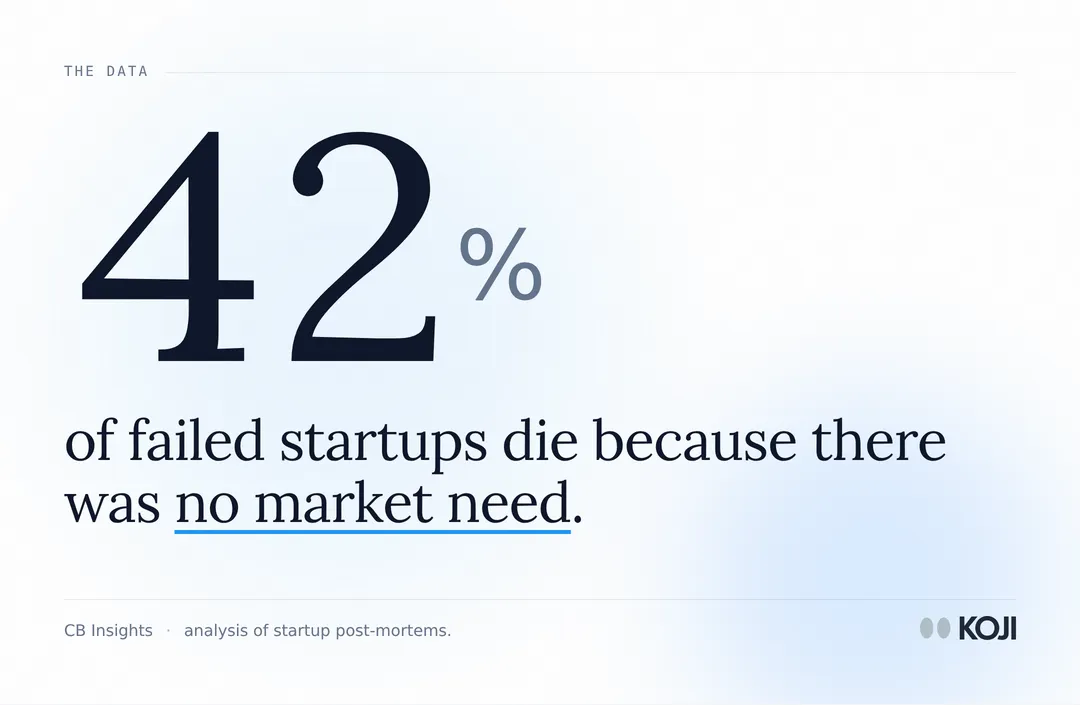
Roughly 42% of failed startups die because there was no market need for what they built, according to CB Insights' analysis of startup post-mortems — making "we never truly validated the problem" the single most common cause of failure. Discovery and validation exist precisely to prevent that outcome. This guide explains what each phase is, how they differ, how to know when you have passed from one to the next, and how AI-native research lets you run both far faster than the traditional interview-by-interview slog.
The customer development model in brief
Steve Blank — the entrepreneur and academic whose work became the foundation of the Lean Startup movement — frames the early life of a company as a search for a business model, not the execution of a known one. His famous rule captures the whole philosophy: "There are no facts inside your building, so get outside." Inside the building you have opinions and assumptions; outside, with customers, you find facts.
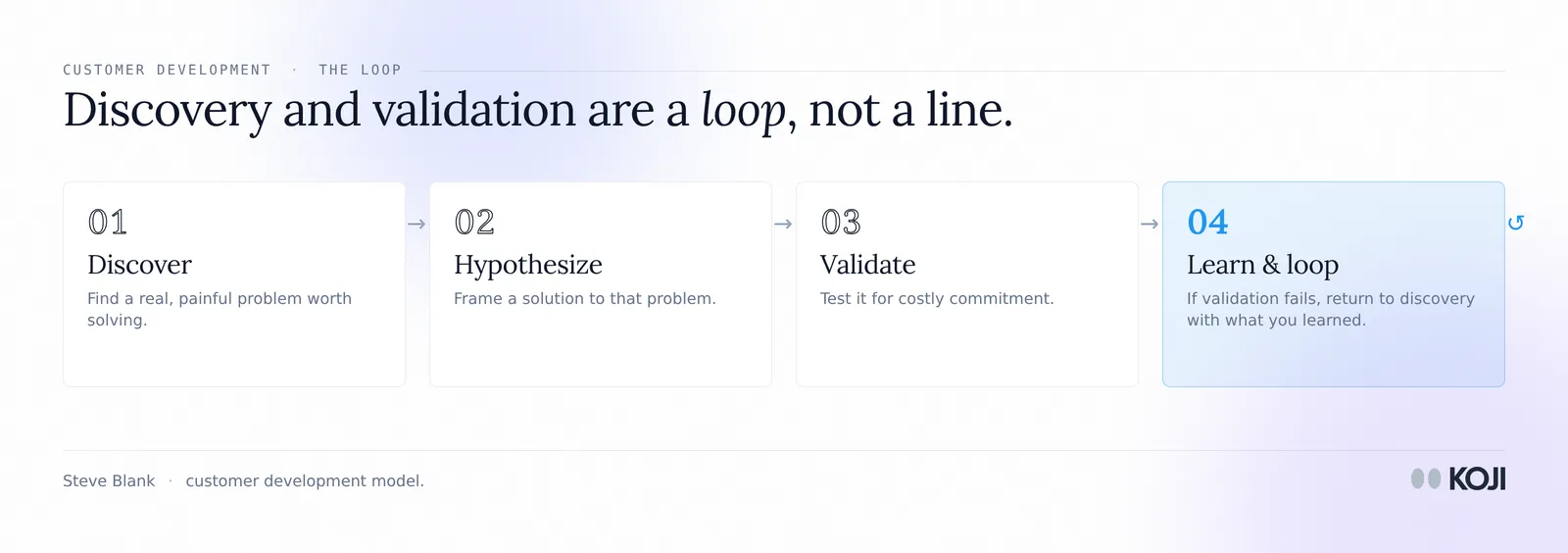
Customer development breaks that search into four stages — discovery, validation, creation, and company-building — but the first two are where research lives and where most of the risk is removed. Discovery and validation form a loop: you discover a problem and a hypothesized solution, you try to validate it, and if validation fails you return to discovery with what you learned. (For the broader frame, see customer development methodology and lean startup methodology.)
What is customer discovery?
Customer discovery is the learning phase. Its goal is to deeply understand a customer's world — their problems, current workarounds, and the jobs they are trying to get done — and to confirm that a problem you care about is real, painful, and widespread enough to be worth solving.
In discovery you are testing problem hypotheses, not pitching a product. The work is mostly open-ended interviews where you talk far more about the customer's life than about your idea. The Mom Test principle applies: ask about specific past behavior, not hypothetical future enthusiasm. Good discovery outputs include:
- A clear, validated statement of the problem and who has it.
- An understanding of how customers solve it today and what that costs them.
- Evidence that the pain is strong enough that people are actively looking for relief.
- A refined view of which customer segment feels the problem most acutely.
If discovery reveals the problem is mild, rare, or already well-served, that is a success — you just saved months of building the wrong thing. (See customer discovery call guide and customer pain points research.)
What is customer validation?
Customer validation is the confirming phase. Now that you believe you understand a real problem, you test whether your specific solution earns real commitment — and whether you have a repeatable, scalable model for finding and converting customers.
In validation you are testing solution and business-model hypotheses. The signal you are hunting for is not a polite "that sounds nice" but costly action: a pre-order, a signed pilot, a deposit, a sustained usage pattern, a willingness to pay. Good validation outputs include:
- Evidence that customers will adopt — and ideally pay for — your solution.
- A repeatable sales or acquisition motion that works more than once.
- Confirmation that the economics (price, cost to acquire) can work.
- Strong enough signal to justify scaling, or clear signal to pivot.
Validation is where you confirm product-market fit is within reach. Crucially, validation can fail even after great discovery — you understood the problem but your solution or pricing missed — and that failure sends you back to discovery, not out of business.
Side-by-side comparison
| Dimension | Customer discovery | Customer validation |
|---|---|---|
| Core question | Is there a real problem worth solving? | Will people buy and use our solution? |
| Stage | First | Second |
| Mindset | Exploratory, learning | Confirmatory, testing |
| What you test | Problem hypotheses | Solution + business-model hypotheses |
| Primary method | Open-ended problem interviews | Pilots, pre-sales, usage, willingness-to-pay |
| Signal of success | Strong, common, urgent pain | Costly commitment (money, time, adoption) |
| A "no" means | Find a different problem or segment | Revisit the solution or return to discovery |
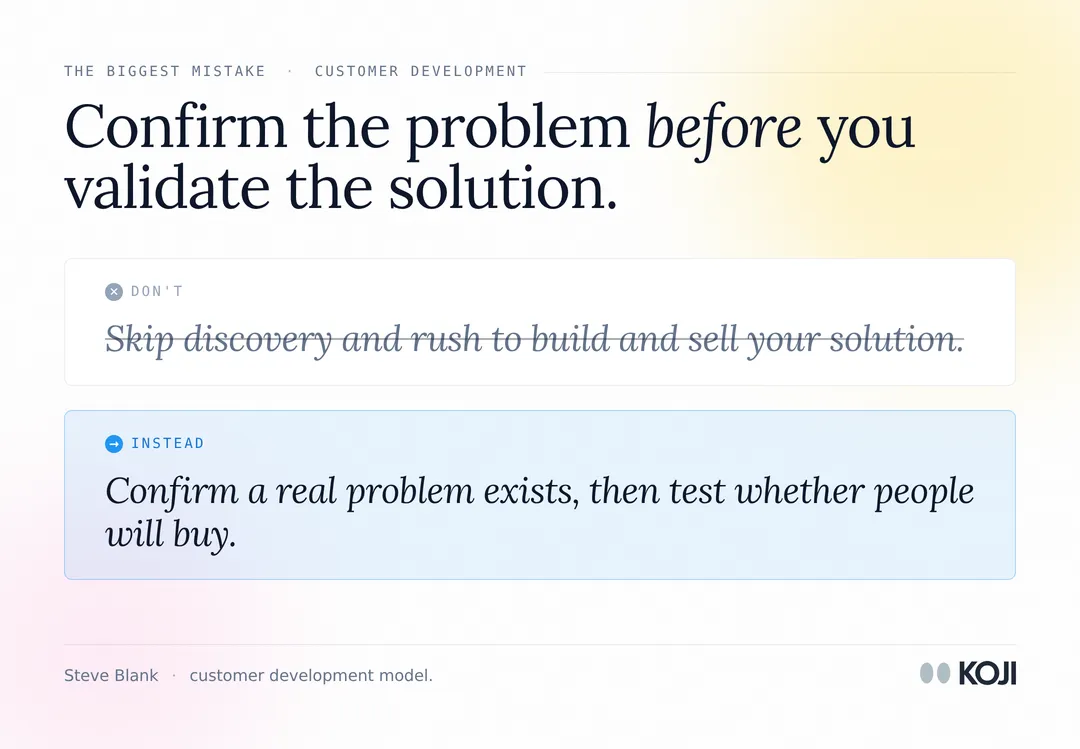
The biggest mistake: skipping discovery to start validating
The most expensive error founders make is jumping straight to validation — building a product and trying to sell it — without ever doing discovery. It feels productive because you are shipping, but you are validating a solution to a problem you never confirmed exists. This is exactly the path to the "no market need" failure that tops the CB Insights list.
A related mistake is confusing the two while interviewing: pitching your solution during what should be a discovery conversation. The moment you start selling, customers shift into polite mode and you lose the unbiased problem signal discovery depends on. Keep the phases — and the conversations — distinct.
How to know you've moved from discovery to validation
You are ready to leave discovery and enter validation when:
- You can state the problem and the most affected segment in one sentence, and customers consistently confirm it unprompted.
- Multiple interviewees describe the same pain and the same inadequate workarounds.
- You have heard enough that new interviews mostly repeat what you already know (you have reached saturation).
- People ask "can I use that when it's ready?" before you pitch anything.
If you are still hearing wildly different problems, or you are the one convincing customers their pain is real, you are still in discovery. Stay there — it is far cheaper than a failed launch.

Map each phase to structured question types
Both phases get sharper when you mix open-ended depth with structured, comparable signal. Koji's six structured question types — open_ended, scale, single_choice, multiple_choice, ranking, and yes_no — map naturally onto each:
- Discovery:
open_endedfor problem stories with AI follow-up probing;scaleto rate how painful a problem is;rankingto order which problems hurt most;multiple_choiceto standardize current workarounds. - Validation:
yes_nofor clean commitment reads ("Would you pay for this?");scalefor purchase intent and willingness to pay;single_choicefor preferred pricing tiers;open_endedto capture objections.
See the structured questions guide for how each type aggregates across many respondents — turning a pile of interviews into a defensible, quantified case.
How Koji accelerates both phases
The classic constraint on customer development is throughput: discovery and validation each need dozens of conversations, and scheduling them one at a time stretches a search that should take weeks into a quarter. Koji removes that bottleneck. Its AI interviewer runs problem and solution interviews by voice or text, asynchronously and in parallel, so you can gather discovery signal from dozens of customers in days — and automatically probes for the specific past behavior that separates real pain from politeness. You also do not need an audience of your own to start. If you have a list, a product, or a community, Koji interviews them. If you do not, Koji recruits the right people for you: describe the market, the role, and your screening criteria, and you get a per-respondent quote in credits to approve before anything launches.
When you move to validation, the same engine tests solution reactions, purchase intent, and pricing, while analyzing every transcript automatically — clustering the problems customers actually raised, flagging where they diverge, and aggregating your scale and ranking answers into charts. Instead of a founder's memory of "most people seemed to like it," you get an evidence-grounded readout of whether the problem is real (discovery) and whether the solution earns commitment (validation). That is the difference between guessing and knowing before you scale.
Discovery and validation are a loop, not a line
In practice you rarely move through these phases once. A failed validation — customers agreed the problem was real but would not pay for your solution — sends you back into discovery to learn why, sharpen the segment, or reframe the offer. Even a successful first pass usually loops: you validate with early adopters, then re-enter discovery to understand the mainstream customer whose needs differ. Treat the two as a cycle you spin quickly and cheaply, not a gate you pass through once. The faster and cheaper each loop, the more times you can afford to learn before the money runs out — which is the entire point of doing customer development before scaling.
A quick worked example
Imagine a team building scheduling software for clinics. In discovery, they interview 20 clinic managers and consistently hear that double-booking and no-shows are the real pain — not calendar syncing, which they assumed. That is a problem hypothesis confirmed and an assumption killed. In validation, they offer a paid pilot of a no-show-reduction feature; three of eight clinics sign and pay, and the others object to the price. The problem was validated in discovery; the solution and pricing were only partly validated. The right move is not to scale — it is a short loop back to discovery on pricing sensitivity before committing the roadmap. That disciplined sequencing is what separates teams that find fit from teams that guess.
Related Resources
- Structured Questions Guide — the six question types and how each aggregates
- Customer Development Methodology — the full four-stage model
- Customer Discovery Call Guide — how to run the discovery interview
- Startup Idea Validation Guide — validating before you build
- Product-Market Fit Interviews — confirming fit in the validation phase
- Lean Startup Methodology — the broader build-measure-learn frame
Related Articles
Customer Development: The Complete Guide to Steve Blank's 4-Step Methodology (2026)
Master Steve Blank's Customer Development methodology — Discovery, Validation, Creation, and Company Building. Learn the framework that prevents the #1 reason startups fail and how AI-native research platforms like Koji compress months of customer interviews into days.
Customer Discovery Call: Questions, Structure, and a Template
A customer discovery call is a one-on-one conversation to learn how a customer thinks, works, and struggles — before you pitch or build. Here is the structure, a question script, and how to run discovery calls at scale.
Lean Startup Methodology: The Complete 2026 Guide to Build-Measure-Learn
A practical guide to Lean Startup — Eric Ries's Build-Measure-Learn loop, validated learning, MVPs, pivot vs persevere, and how Koji's AI interviewer accelerates every loop.
How to Validate Product-Market Fit Through Qualitative Interviews
Learn how to design and run customer interviews specifically focused on measuring and moving your product-market fit score.
Startup Idea Validation: How to Test Your Idea with Customer Interviews
A research-backed guide to validating startup ideas through customer interviews — before you write a line of code.
Structured Questions in AI Interviews
Mix quantitative data collection — scales, ratings, multiple choice, ranking — with AI-powered conversational follow-up in a single interview.