Focus Groups: Advantages and Disadvantages (2026)
A clear-eyed breakdown of the advantages and disadvantages of focus groups — group dynamics, groupthink, cost, and bias — plus how AI-moderated 1:1 interviews keep the upside while eliminating the downsides.
A focus group brings 6–10 participants together with a moderator to discuss a product, concept, or experience. Its core advantage is the live, social dynamic — ideas spark off other ideas, and you can read tone and body language in real time. Its core disadvantage is the same social dynamic — dominant voices, groupthink, and social-desirability bias distort what people actually believe, while logistics make it slow and expensive.
Bottom line up front: Focus groups are excellent for generating ideas and exploring reactions, but they are a poor tool for measuring real preferences or behavior. As Nielsen Norman Group's Jakob Nielsen puts it, focus groups are "a rather poor method for evaluating interface usability… to evaluate interaction designs you must closely observe individual users." The modern alternative — AI-moderated one-on-one interviews run in parallel — keeps the depth of a focus group while removing groupthink, scheduling pain, and cost. This guide weighs both sides honestly.
What Is a Focus Group?
A focus group is a moderated, qualitative discussion among a small group of people selected to represent a target audience. A trained moderator guides the conversation through a discussion guide, probing for opinions, reactions, and the reasoning behind them. Focus groups have anchored market research for decades, especially in concept testing, brand perception, and messaging.

Photo by Vitaly Gariev on Unsplash
Advantages of Focus Groups
1. Rich, in-depth qualitative insight
Focus groups produce detailed, nuanced feedback that surveys can't. Participants explain why they feel a certain way, and a skilled moderator can probe on the spot.
2. Group synergy and idea generation
The interaction itself is a feature. One participant's comment triggers another's memory or reaction, surfacing ideas that wouldn't emerge in isolation. This makes focus groups strong for brainstorming and early concept exploration.
3. Non-verbal cues
Moderators observe tone, hesitation, facial expressions, and energy — signals that are invisible in a written survey.
4. Real-time follow-up
Unlike a static questionnaire, a moderator can ask an unscripted follow-up the moment something interesting comes up.
5. Faster than many 1:1 methods (per session)
You hear from 6–10 people in a single 90-minute session rather than scheduling that many separate interviews.
Disadvantages of Focus Groups
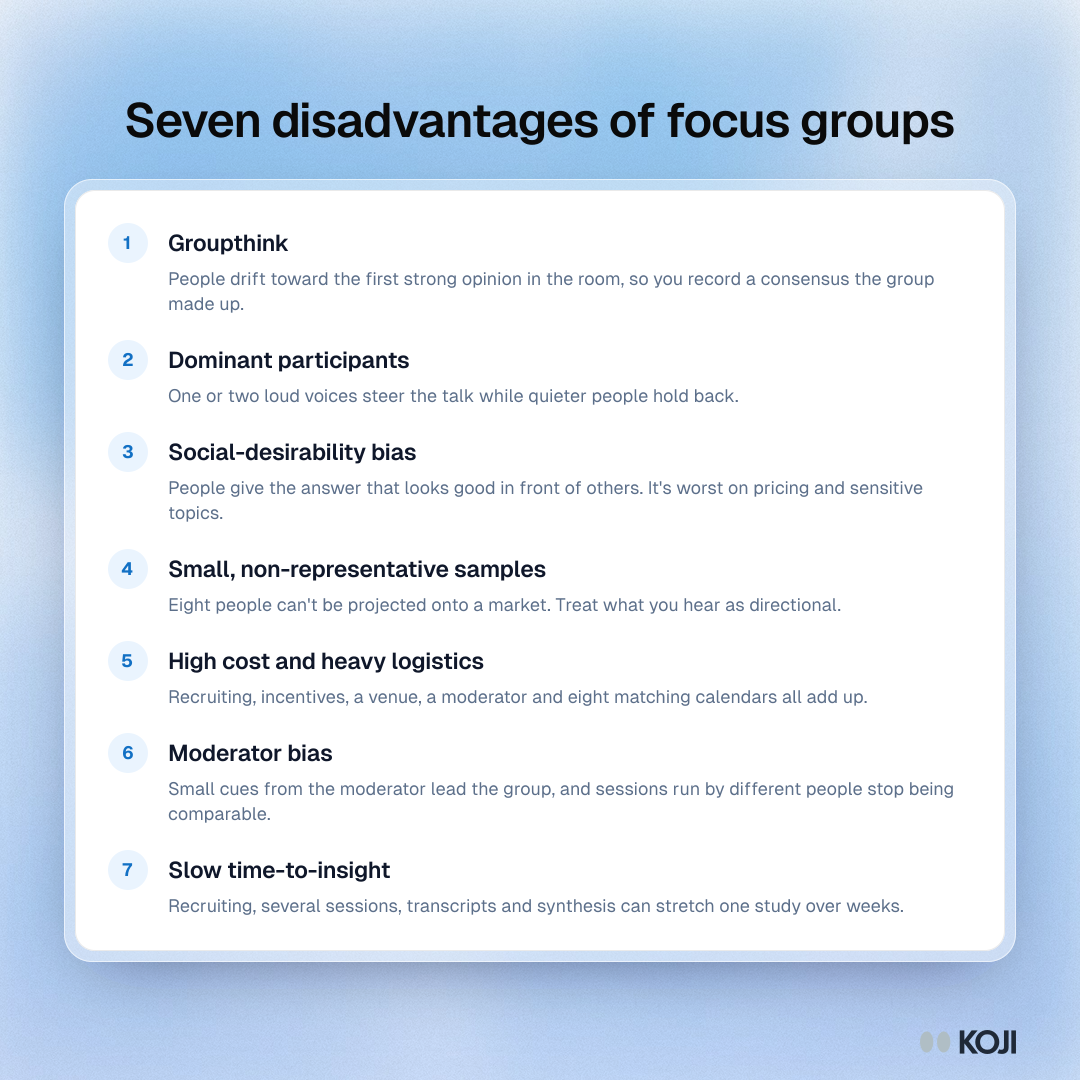
1. Groupthink
The biggest weakness. In a group setting, people conform to the opinions expressed by others. If one participant voices a strong view, others suppress dissent to avoid conflict — so you capture a manufactured consensus, not genuine individual opinions.
2. Dominant participants
One or two charismatic or opinionated people often steer the entire conversation. Quieter participants defer, and you end up with the perspective of a vocal minority rather than a true cross-section of the audience.
3. Social-desirability bias
People answer differently in front of an audience than they would privately. They give the answer that makes them look good — a serious problem for sensitive topics, pricing, or anything tied to identity.
4. Small, non-representative samples
A focus group of 8 people cannot be projected onto a market. Findings are directional, not statistically valid.
5. High cost and heavy logistics
Recruiting, scheduling, incentives, a facility (or video platform), a professional moderator, and analysis all add up. Coordinating 8 strangers' calendars for the same hour is its own bottleneck, and no-shows can sink a session.
6. Moderator bias
Results depend heavily on the moderator's skill and neutrality. Subtle cues can lead the group, and inconsistent moderation across sessions undermines comparability.
7. Slow time-to-insight
Between recruiting, running multiple sessions, transcribing, and synthesizing, a focus group study can take weeks — too slow for fast product cycles.
Focus Groups vs. Surveys vs. Interviews
- Surveys scale to thousands and quantify, but can't probe. (See Survey vs Interview.)
- One-on-one interviews eliminate group bias and go deep, but traditionally don't scale. (See Focus Groups vs Interviews.)
- Focus groups add social dynamics and speed-per-session, at the cost of groupthink and representativeness.
For decades, teams accepted this trade-off because running dozens of individual interviews by hand was impractical. That constraint no longer exists.
The Modern Alternative: AI-Moderated Interviews at Scale
The reason focus groups exist is efficiency — talking to several people at once. But that same efficiency is what introduces groupthink and dominant-voice bias. What if you could interview every participant individually, at the same time, with a consistent AI moderator? That is exactly what Koji does.
Koji runs AI-moderated one-on-one interviews in parallel, so you keep the depth of qualitative research while eliminating the disadvantages of the group format:
- No groupthink or dominant voices. Every participant is interviewed privately, so you hear each person's genuine, unfiltered opinion.
- No social-desirability distortion. People are more candid with an AI interviewer than in front of peers, especially on sensitive topics.
- Consistent moderation. The AI asks every participant the same core questions with the same neutrality, then probes each answer individually — no moderator bias, no off days.
- Scale and speed. Run dozens or hundreds of interviews simultaneously and get results in hours, not weeks. Teams using AI-assisted research report dramatically faster time-to-insight.
- No scheduling or facility cost. Participants join asynchronously by text or voice from anywhere — no room, no calendars, no no-shows.
- Automatic synthesis. Koji performs thematic analysis across every conversation and surfaces ranked themes and representative quotes, so you skip manual transcription and coding.
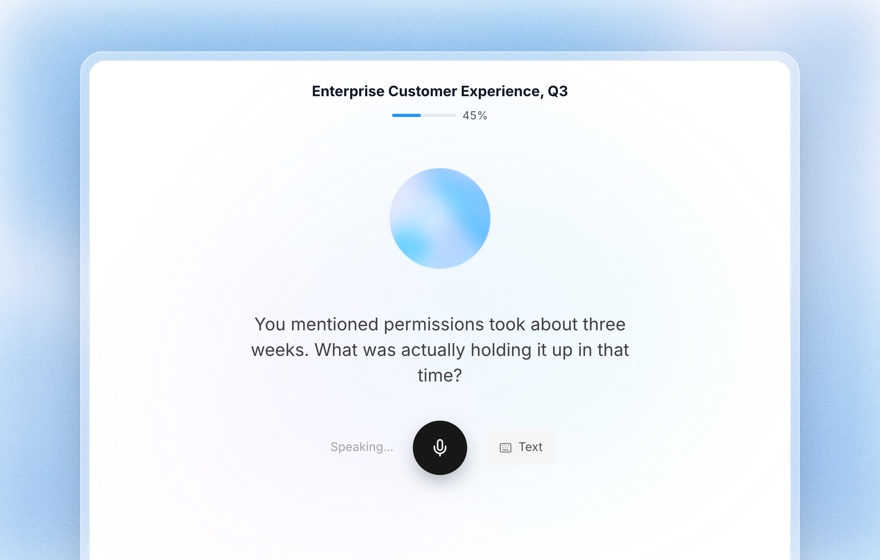
You can still capture structured data alongside the conversation using Koji's six structured question types — open-ended, scale, single choice, multiple choice, ranking, and yes/no — blending the quantification of a survey with the depth of an interview in a single study.
Focus Group vs. Koji at a Glance
| Factor | Traditional focus group | Koji (AI-moderated 1:1) |
|---|---|---|
| Groupthink / dominant voices | High risk | Eliminated (private interviews) |
| Social-desirability bias | High | Low (no peer audience) |
| Sample size | 6–10 per session | Dozens to hundreds in parallel |
| Moderator consistency | Varies by person | Identical every time |
| Cost & logistics | High (facility, recruiting, incentives) | Low (asynchronous, no venue) |
| Time to insight | Weeks | Hours |
If your goal is idea generation in a live room, a focus group still has a place. If your goal is honest, representative, scalable insight, AI-moderated interviews give you the upside of a focus group without the bias and cost — and you don't need a PhD in research methods to run them.
How to Reduce Focus Group Bias (If You Must Run One)
If a live focus group is unavoidable, these practices limit the worst distortions:
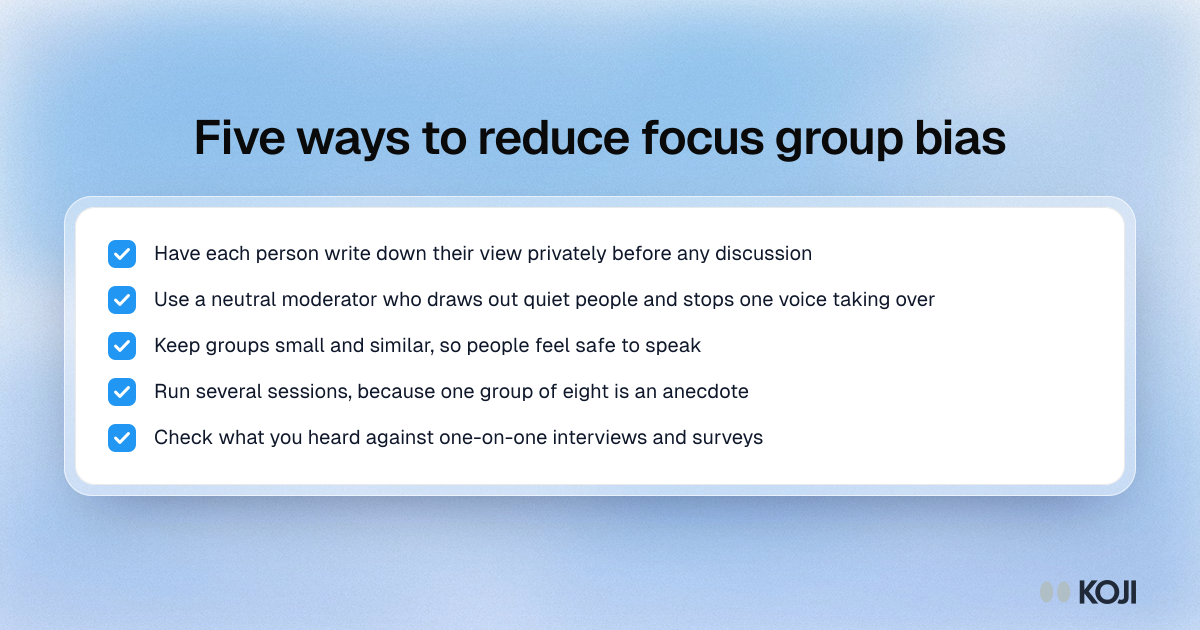
- Pre-task privately first. Have each participant write their individual opinion before any discussion, so you capture genuine views before group conformity sets in.
- Use a strong, neutral moderator. A skilled facilitator actively draws out quiet participants and prevents any one person from dominating.
- Keep groups small and homogeneous. Mixing very different segments amplifies social-desirability bias; smaller, similar groups feel safer to speak in.
- Run multiple sessions. A single group of eight is anecdote, not evidence. Several sessions reveal whether a theme is consistent.
- Triangulate. Pair focus groups with one-on-one interviews and quantitative surveys so no single biased method drives the decision.
Even with these safeguards, you are managing the disadvantages, not removing them. That is the fundamental appeal of AI-moderated 1:1 interviews — the bias never enters the room in the first place, because there is no room.
Related Resources
- Focus Group Research Guide — how to plan and run a traditional focus group
- Focus Groups vs Interviews — choose the right qualitative method
- Focus Group Alternatives — modern options beyond the room
- AI-Moderated Focus Groups — the AI-native approach explained
- Market Research Methods — where focus groups fit in the toolkit
- Structured Questions Guide — combine six question types with AI-powered conversational follow-up
Want focus-group depth without groupthink, scheduling, or facility costs? Koji runs AI-moderated one-on-one interviews in parallel and synthesizes them automatically.
Related Articles
AI-Moderated Focus Groups: How to Run Group Research Without a Human Moderator
How AI-moderated focus groups work, when they outperform traditional groups, and how to run them at scale. Get the depth of focus group research without scheduling, moderation, or groupthink.
The Best Focus Group Alternatives in 2026: Why AI Interviews Are Replacing Traditional Group Research
Focus groups are expensive, slow, and riddled with groupthink. Discover the best focus group alternatives in 2026 — including AI-moderated interviews that give you richer individual insights at a fraction of the cost and time.
Focus Group Research: The Complete Guide
Learn when to use focus groups, how to design and moderate them, and when AI-powered individual interviews are a better fit.
Focus Groups vs. Interviews: How to Choose the Right Method
Learn when to use focus groups vs. individual interviews in qualitative research. Includes a comparison table, decision framework, and guidance on avoiding groupthink bias.
Market Research Methods: The Complete Guide (2026)
A complete, practitioner-focused guide to market research methods — qualitative vs quantitative, primary vs secondary, when to use each, and how AI-native research compresses months of fieldwork into hours.
Memory Conformity: Why Participants Who Talk to Each Other Start Remembering the Same Thing (2026)
Groupthink bends opinions. Memory conformity bends recalled facts: in Gabbert, Memon and Allan's study, 71% of witnesses who discussed an event reported details only their partner had seen. Where co-witnesses hide in customer research, and how to keep accounts independent.
Structured Questions in AI Interviews
Mix quantitative data collection — scales, ratings, multiple choice, ranking — with AI-powered conversational follow-up in a single interview.