Find Your Ideal Customer Profile in 3 Rounds of Interviews
A founder playbook for finding your ICP: interview wide across candidate segments, go deep in the strongest one, then confirm with new people found where you would sell. Questions, scoring and sample sizes for each round.
Short answer: you find your ideal customer profile (ICP) by interviewing in three rounds, each narrower than the last. Round 1 goes wide: about 5 interviews in each of 3 or 4 candidate segments, to see where the problem is most painful. Round 2 goes deep: 10 to 15 interviews inside the one or two segments that stood out, to learn what triggers the search, what they use today and who pays. Round 3 confirms: 10 to 15 interviews with new people found through the channel you'd actually sell through, to check that the pattern holds and that you can reach them. Most early-stage teams can run all three in four to six weeks.
This is for the founder with a product and some early users who can't yet say who the product is really for. Some users love it, some drift away, and every sales call feels like a different pitch. That isn't a product problem yet. It's usually an ICP problem, and interviews are the quickest way to fix it.
Try it this week: list every type of customer you've sold to or talked to, then circle the 3 or 4 you'd most like to be right about. Those are your Round 1 segments.
Why a vague ICP costs so much
When CB Insights analysed 111 startup post-mortems, 35% named "no market need" as a reason the company failed, second only to running out of cash (CB Insights, Why Startups Fail, 2021). Many of those companies had users. What they lacked was a group of people with the problem badly enough, often enough, and with the money to pay for a fix.
A vague ICP hides that. If you describe your customer as "SMBs" or "product teams", your interviews will contradict each other, your messaging will be generic, and you won't be able to tell a weak market from a mixed one.
Superhuman shows the other side. When the team first ran the Sean Ellis survey ("How would you feel if you could no longer use Superhuman?"), 22% of users said "very disappointed", well under the 40% benchmark Ellis uses for product-market fit. Instead of changing the product for everyone, the team studied the users who would be very disappointed, built the product around what they loved and what held back users like them, and reached 58% within about a year (First Round Review, 2018). Narrowing who it was for came first.
Steve Blank put the principle in the first line of his Customer Development Manifesto: "There are no facts inside your building, so get outside." Your ICP is a guess until customers confirm it.
The three rounds at a glance
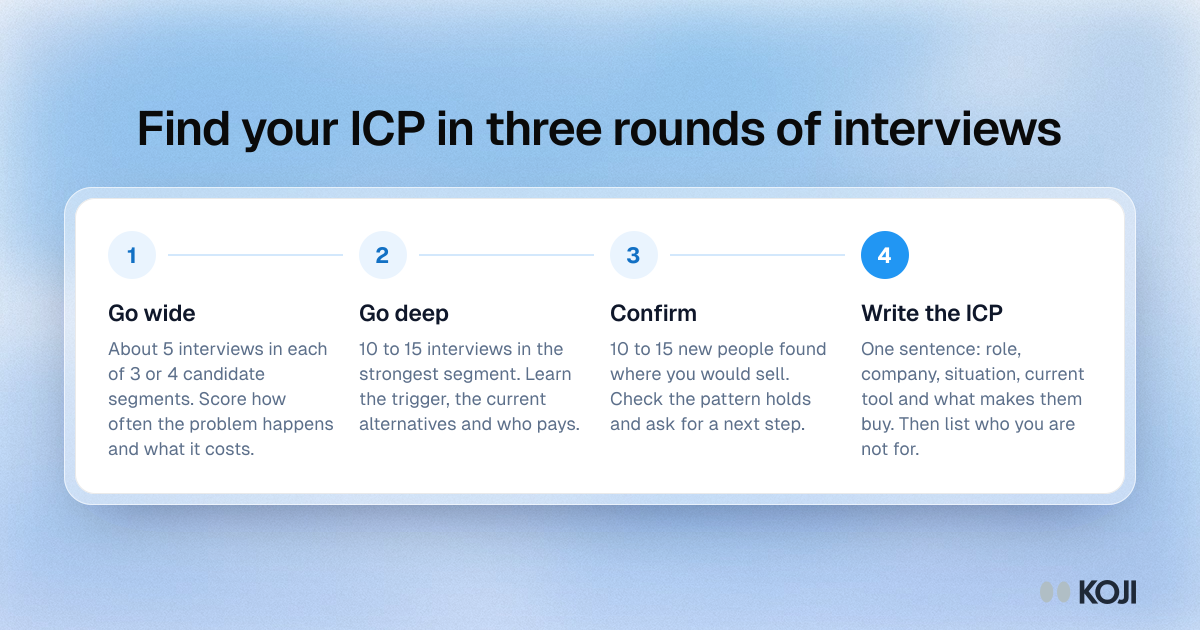
| Round | Who you talk to | Interviews | What you're deciding |
|---|---|---|---|
| 1. Wide | 3 to 4 candidate segments | About 5 per segment | Which segment has the sharpest pain |
| 2. Deep | The 1 or 2 strongest segments | 10 to 15 | What triggers the search, what they use now, who pays |
| 3. Confirm | New people from that segment, found where you'd sell | 10 to 15 | Whether the pattern holds and you can reach them |
Why these numbers? In a well-known study, Greg Guest, Arwen Bunce and Laura Johnson found that most of the themes in their 60 interviews had already appeared within the first 12, for a fairly similar group of people (Field Methods, 2006). That only holds when the group is similar. A mixed group of "everyone who might buy" needs far more interviews to reach the same point, which is exactly why you narrow before you go deep.
Before Round 1: write down your candidate segments
Describe each segment by things you could filter on, not by personality:
- Role: who has the problem day to day (an operations lead, a clinic owner, a first PM)
- Company: size, industry, stage (a 20 to 50 person agency, a seed-stage B2B SaaS company)
- Situation: the circumstance that makes the problem urgent (just hired a second salesperson, just lost a big customer)
Situation is the one founders skip, and it's often the one that matters most. "Agencies" is a market. "Agencies that just lost their biggest client" is a segment with a reason to act this month.
Round 1: go wide
Goal: find the segment where the problem is most frequent and most painful.
Who: about 5 people from each of 3 or 4 segments. Mix current users, people who tried you and left, and people who've never heard of you.
What to ask: stick to past behaviour, not opinions about your idea.
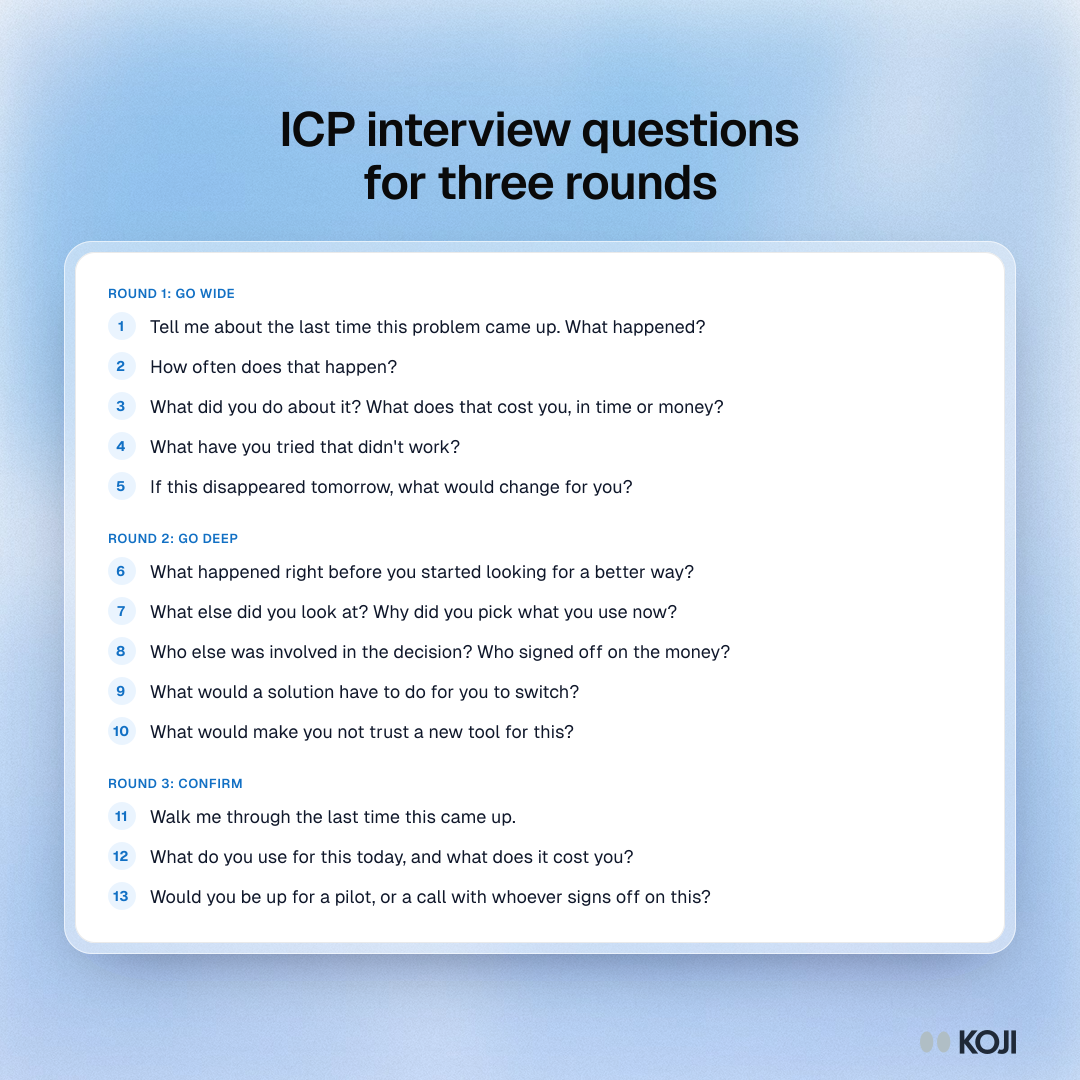
- Tell me about the last time this problem came up. What happened?
- How often does that happen?
- What did you do about it? What does that cost you, in time or money?
- What have you tried that didn't work?
- If this disappeared tomorrow, what would change for you?
How to score each interview: right after each one, rate four things from 1 to 3: how often the problem happens, how much it costs them today, whether they're already paying or working around it, and how easy they'd be to find again. A segment where most people score high on all four is your lead candidate. A segment where people describe the problem but have never tried to solve it usually isn't.
Round 2: go deep
Goal: understand the strongest segment well enough to describe the moment someone starts looking for a solution.
Who: 10 to 15 people from the one or two segments that scored best. If two segments are close, keep both and compare them.
What to ask:
- What happened right before you started looking for a better way?
- What else did you look at? Why did you pick what you use now?
- Who else was involved in the decision? Who signed off on the money?
- What would a solution have to do for you to switch?
- What would make you not trust a new tool for this?
What you're listening for: the same trigger, the same alternatives and the same buyer showing up across interviews. If Round 2 answers still contradict each other, the segment is still too broad. Split it by the place where the answers diverge (company size, role, or situation) and keep going.
Round 3: confirm
Goal: check that the pattern holds with people you didn't already know, and that you can reach them.
Who: 10 to 15 new people from the segment, found through the channel you'd actually use to sell: a community they belong to, a job title you can search for, a list you can buy, or a panel filtered to the segment. If you can't find 10 of them without favours, that's a finding in itself.
What to ask: repeat the core questions, then add a commitment test:
- Walk me through the last time this came up.
- What do you use for this today, and what does it cost you?
- Would you be up for a pilot, or a call with whoever signs off on this?
The last question is the commitment test. Ask for something that costs them a little: a follow-up call with their manager, a pilot, a pre-order or a letter of intent. Polite interest isn't a signal. A next step is.
If you already have active users from this segment, run the Sean Ellis question with them too. Compare the share who'd be "very disappointed" inside the segment with the share across all your users. If the segment scores clearly higher, you've found your focus.
Running the interviews with real people
A few habits make each round faster and the answers more honest:

Photo by Vitaly Gariev on Unsplash
- Talk to the person with the problem, not the person you hope will buy. In B2B they're often different, and you need both.
- Keep it short. Twenty to thirty minutes is enough for Round 1. People say yes to short asks.
- Write notes the same day. Score the four factors right after each conversation, while you still remember the details.
- Don't pitch until the end. Once you describe your product, every answer bends towards it.
- Ask for introductions. "Who else do you know who deals with this?" is the cheapest recruiting channel there is, and the answer tells you whether the segment talks to itself.
Writing your ICP after Round 3
Write it as one sentence you could hand to a salesperson or put into a search filter:
[Role] at [company type and size] who [situation or trigger], currently [what they use now], and who [what makes them buy].
For example: "Operations leads at 20 to 80 person B2B service firms who just took on their first enterprise client, currently tracking work in spreadsheets, and who buy when a missed deadline costs them a renewal."
Then list who you are not for. Saying no to the segments that scored low in Round 1 is what turns a profile into a strategy. The ICP guide has a full template with the fields to fill in.
Mistakes that waste a round
- Segments defined by demographics alone. Age and company size rarely explain who buys. The situation usually does.
- Only talking to fans. Your happiest users tell you why the product works, not who else it would work for. Include people who left.
- Asking "would you use this?" Future-tense questions get polite yeses. Ask what they did last time.
- Stopping at Round 2. A pattern among people you already knew may not hold among strangers. Round 3 is the one that tells you whether you can sell to them.
- Never revisiting it. Your ICP will shift as the product grows. Rerun Round 3 each time you move into a new market or a new price point.
How Koji helps
Koji runs AI-moderated interviews in text or voice, so you can run all three rounds without booking calls and see the patterns across them in one place.
- Write the guide by asking. Describe what you want to learn in the research assistant ("find out which of these four customer types feels this problem most") and it drafts the study, questions and screening included, for you to edit. The template library includes interview guides such as Jobs to Be Done.
- Screen for each segment. Add screening questions with qualifying answers, so only people in the segment you're testing get through. Add a single-choice question for role or company size to tag each interview by segment.
- Interview your own users. Import your customer list into Participants, group people into audiences by segment and send each audience an invitation and reminder from Koji, with each person's own link and sent, opened and started tracking (paid plans).
- Find people you don't know yet. For Round 3, Find people searches professional profiles by job title, seniority, location, company size and industry, and panel recruitment fields interviews from a research panel filtered to your audience (both on paid plans).
- Follow-ups on every answer. The AI interviewer asks "what happened next?" and "what did that cost you?" the way you would, so every interview has the past-behaviour detail Round 1 scoring needs.
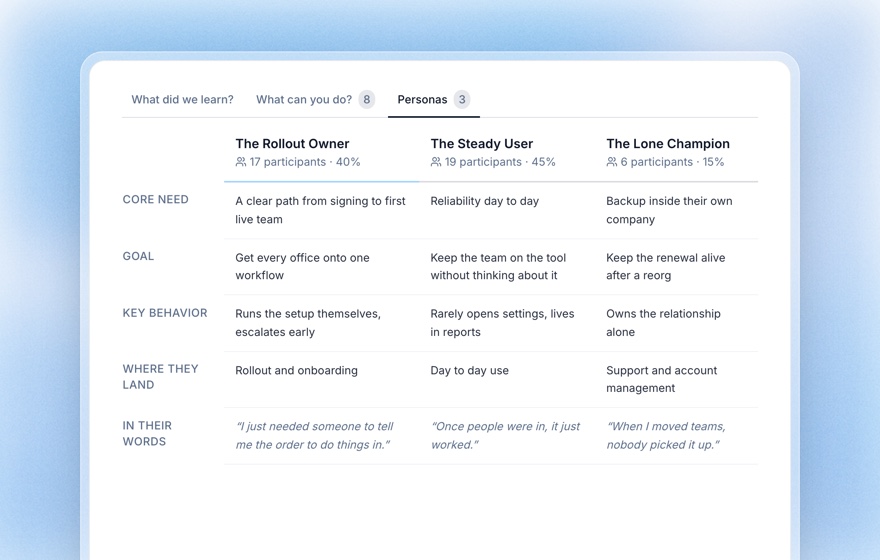
- See the segments in the report. Each report shows themes and findings with the share of participants behind them and the quotes that support them, plus a Personas view that groups participants by needs, goals and behaviours, with the share each persona represents.
Related Resources
- Ideal Customer Profile (ICP): definition, template and examples
- Sean Ellis Test: the 40% question for product-market fit
- How Many Interviews Are Enough?: sample sizes for qualitative research
- The Mom Test: how to ask questions people can't lie to you about
- Screener Questions Guide: recruit the right people for each round
- Structured Questions Guide: tag interviews by role, size or segment
Sources
- CB Insights, "The Top 12 Reasons Startups Fail", 2021 (analysis of 111 post-mortems)
- Rahul Vohra, "How Superhuman Built an Engine to Find Product/Market Fit", First Round Review, 2018
- Steve Blank, The Customer Development Manifesto
- Greg Guest, Arwen Bunce and Laura Johnson, "How Many Interviews Are Enough? An Experiment with Data Saturation and Variability", Field Methods 18(1), 2006
Related Articles
How Many Interviews Are Enough? A Guide to Sample Size
Understand saturation, practical guidelines, and research-backed recommendations for qualitative sample sizes.
Ideal Customer Profile (ICP): Definition, Template, and How to Build One with AI Interviews (2026)
A complete guide to building an Ideal Customer Profile — definition, B2B and B2C templates, ICP vs persona, real examples, and how to validate your ICP with Koji's AI interviewer in days, not months.
The Mom Test: How to Talk to Customers Without Being Misled
Learn Rob Fitzpatrick's Mom Test methodology to ask questions that even your mother can't lie to you about.
Screener Questions for User Research: A Complete Guide
Learn how to write effective screener questions that find the right research participants — and how Koji's intake forms and AI interviews make screening faster and more natural.
Sean Ellis Test: The 40% Rule for Product-Market Fit (Complete 2026 Guide)
The Sean Ellis Test (40% rule) measures product-market fit with one question. Complete 2026 guide: how to run it, score interpretation, common mistakes, and how AI interviews unlock 5x richer insights.
Structured Questions in AI Interviews
Mix quantitative data collection — scales, ratings, multiple choice, ranking — with AI-powered conversational follow-up in a single interview.