Negative Case Analysis: How to Use the Participants Who Don't Fit
Negative case analysis means searching on purpose for participants who contradict your findings, then refining the findings until they account for them. Its origins, eight steps and a worked example.
Negative case analysis is the practice of deliberately looking for participants, or moments in the data, that don't fit your emerging findings, and then using them to test and refine those findings. Each exception either reveals a limit on a pattern ("this holds for new customers, not long-standing ones"), points to a better explanation, or turns out to be a genuine outlier you can account for. Lincoln and Guba named it as one of the main techniques for establishing credibility in qualitative research, and it's one of the simplest ways to stop a study from only finding what you expected.
This guide explains what negative case analysis is, where it comes from, how to do it step by step, and how to fit it into fast-moving product and customer research.
What is negative case analysis?
Every qualitative study produces patterns: most participants churned because of setup effort, most trial users never reached the reporting feature, most managers distrusted the dashboard. Patterns are useful, but "most" is doing a lot of work in those sentences. Negative case analysis asks: what about everyone else?
A negative case (sometimes called a deviant or disconfirming case) is any participant, response or episode that contradicts or doesn't fit a pattern you've identified. Negative case analysis means:
- Actively searching for those cases rather than waiting to stumble on them.
- Examining each one closely.
- Revising your finding until it accounts for the exceptions, or explaining clearly why an exception doesn't change it.
The goal isn't to make every finding universal. It's to make each finding precise: true for whom, under what conditions and why.
Where the method comes from
The idea has deep roots in sociology.
- Analytic induction. Florian Znaniecki proposed in 1934 that social scientists should develop explanations that hold for every case studied, revising the explanation whenever a case contradicts it. Alfred Lindesmith's study of opiate addiction (1947) and Donald Cressey's study of embezzlement (1953) became classic examples, each refining a hypothesis case by case until no exceptions remained.
- Naturalistic inquiry. In Naturalistic Inquiry (1985), Yvonna Lincoln and Egon Guba set out criteria for the trustworthiness of qualitative research. Under credibility, the qualitative counterpart of internal validity, they listed negative case analysis alongside techniques such as prolonged engagement, triangulation, peer debriefing and member checking.
Today few researchers insist that a finding must fit every single case. Most use negative case analysis in a softer form: as a disciplined search for disconfirming evidence that sharpens findings and shows readers the analysis was tested, not just assembled.
Why it matters
It counters confirmation bias. Once you have a hypothesis, it's easy to notice supporting quotes and skim past the rest. Searching for exceptions on purpose balances that.

Photo by Denise Jans on Unsplash
It sharpens findings. "Customers churn because setup is hard" is weaker than "Customers who set up without a teammate churn because setup is hard; those who set up with one rarely mention it." The second version came from looking at the people the first version didn't fit.
It finds segments. A cluster of negative cases is often a segment you didn't know you had. That's frequently the most valuable output of a study.
It earns trust. Stakeholders who have been burned by research that told them what they wanted to hear will trust findings that show their limits.
It catches analysis errors. Sometimes a negative case reveals a theme was coded too broadly, or that two different things were lumped together.
How to do negative case analysis, step by step
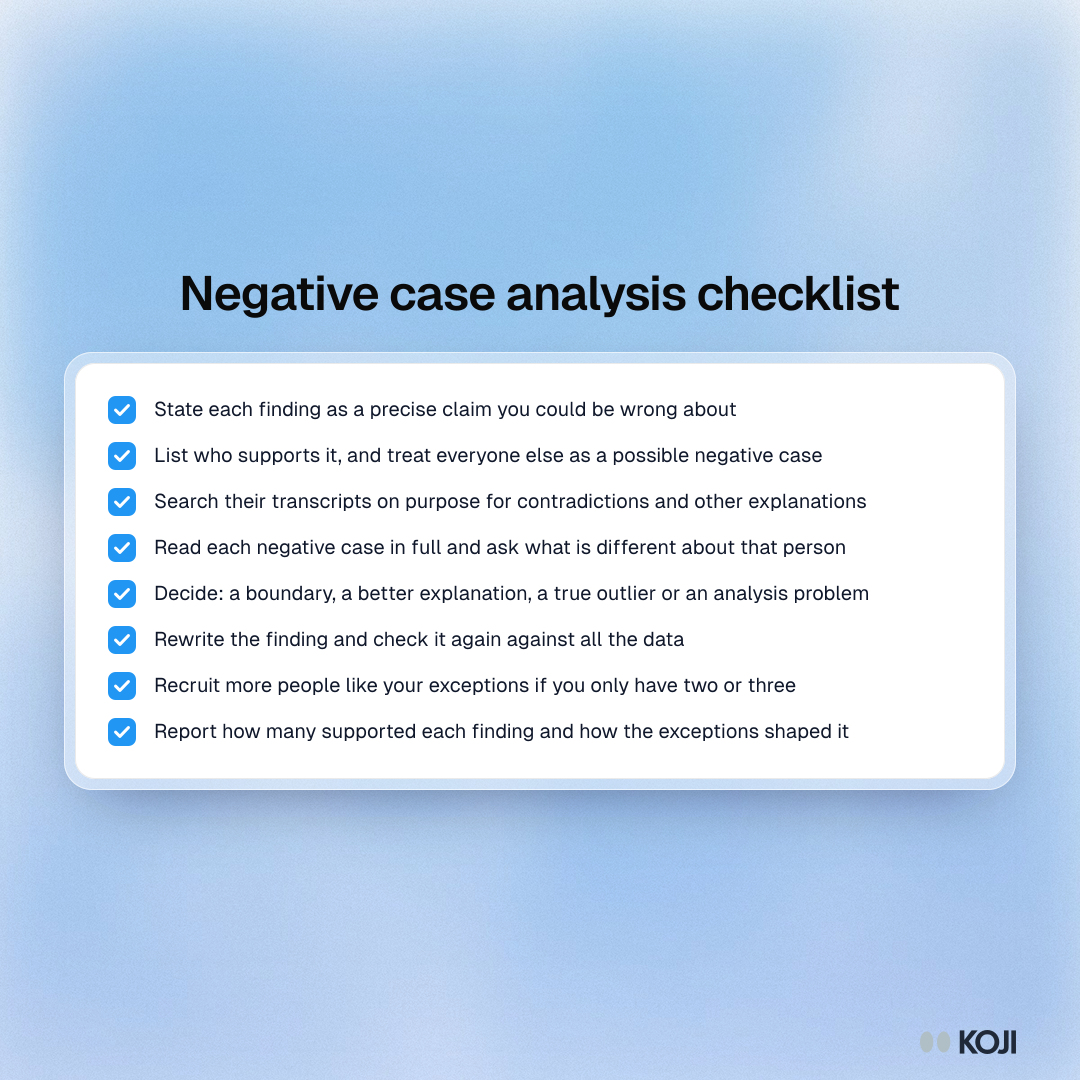
1. State each finding precisely
Write the finding as a clear claim you could be wrong about: "Participants who abandoned onboarding did so at the data import step." Vague findings ("onboarding is a pain point") can't have negative cases.
2. Count who supports it, and who doesn't
For each finding, list the participants whose data supports it. Everyone else is a potential negative case, including people who never mentioned the topic. Silence isn't contradiction, but it's worth checking.
3. Search on purpose
Go back to the transcripts of the participants outside the supporting group. Look for direct contradictions ("import was the easy part"), different explanations for the same outcome, and the same conditions with a different outcome.
4. Examine each negative case
Read the whole transcript, not just the passage. Ask what is different about this person: their role, tenure, plan, context, timing or the way the question was asked.
5. Decide what it means
Each negative case usually lands in one of four places:
- It sets a boundary. The finding holds, but only for a defined group. Narrow the claim.
- It suggests a better explanation. The exception fits a different, more general explanation that also covers the original cases. Replace the finding.
- It's a genuine outlier. Something unusual explains it, and the pattern still holds. Note it and say why.
- It reveals an analysis problem. The theme was too broad, or the question was leading. Fix the coding or flag the limitation.
6. Revise and repeat
Rewrite the finding and check it again against all the data. Repeat until the remaining exceptions are explained.
7. Collect more data if you need to
If negative cases point to a segment you only have two or three people from, recruit more of them. This is where negative case analysis becomes part of theoretical sampling: you deliberately seek the cases most likely to challenge your current understanding, a form of purposive sampling.
8. Report the exceptions
Say how many participants supported each finding, describe the negative cases and explain how they shaped the final claim. A sentence like "Three participants described the opposite experience; all had set up with a dedicated admin" adds credibility, not doubt.
A worked example
A team runs 30 interviews about why customers downgrade. The first pass suggests a clear theme: price. Twenty participants mention cost.
Negative case analysis starts with the other ten. Reading their transcripts, the team finds that seven downgraded after a champion left the company, and price never came up. Going back to the twenty "price" cases, they notice that twelve of them also mention a champion leaving, and that price only became an issue once nobody internally could explain the value.
The revised finding: customers downgrade when they lose an internal champion; price is the reason given, not the cause. That changes the response from a discount to a champion-replacement playbook, and it came entirely from looking at the people the first finding didn't fit.
Common mistakes
- Treating silence as support. A participant who didn't mention a theme isn't evidence for it.
- Explaining away every exception. If each negative case gets its own special story, the finding may simply be wrong.
- Dropping exceptions from the report. Hiding them makes findings look stronger and less trustworthy at once.
- Waiting until the end. Negative cases are most useful while you can still change your interview guide or recruit more participants.
- Confusing rare with wrong. A theme mentioned by few people isn't a negative case. A negative case contradicts a pattern.
Negative case analysis with Koji
Koji runs AI-moderated voice and text interviews and builds a report across them, which makes the search for exceptions much faster.
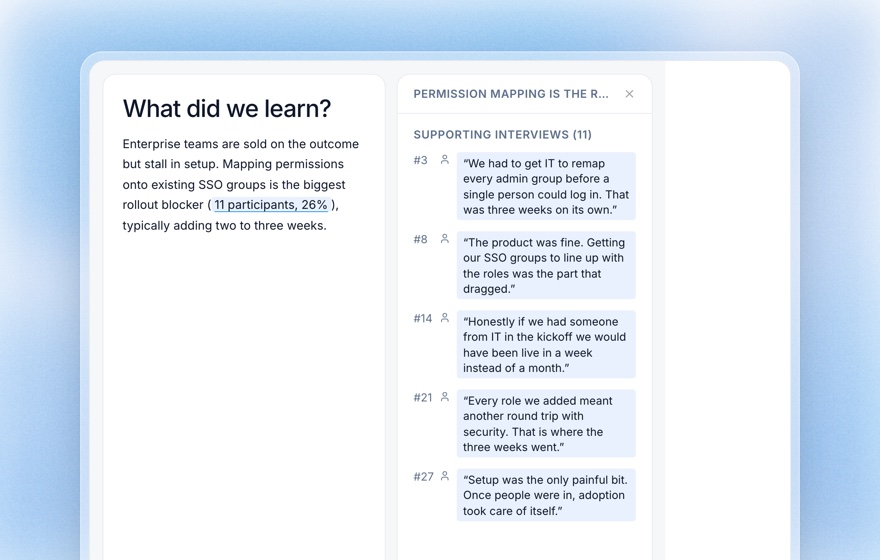
- See who supports a finding, and who doesn't. Each finding in a Koji report shows how many participants back it, such as 11 of 42, with a button to view the supporting responses. Everyone outside that group is where you start looking for negative cases. See tracing report findings to evidence.
- Read the whole interview. Open any participant's interview to see their summary, key findings and full transcript, so you judge an exception in context, not from one quote.
- Spot outliers in structured answers. When a study includes structured questions, sort the responses table by an answer to find the people whose rating or choice cuts against the pattern, then read what they said in the follow-ups.
- Check segments. The report's personas tab groups participants into types. A negative case that matches a persona is a boundary, not noise.
- Ask about the exceptions next. If negative cases point to a group you're short of, add a follow-up question or a screening question and run a second round. You can duplicate a study to keep the original brief.
Related Resources
- Structured questions in AI interviews: find outliers in ratings and choices quickly
- Qualitative research validity and reliability: the wider set of credibility techniques
- Tracing report findings to evidence: see exactly who supports each finding
- Member checking in qualitative research: test findings with participants
- Template analysis: building and revising a coding template
- Writing insight statements: phrase findings precisely enough to test
Related Articles
Member Checking in Qualitative Research: How to Validate Findings With Participants
What member checking is, the four main types, a step-by-step process, how to handle participant disagreement, and how to run a member check at scale with AI interviews.
Qualitative Research Validity and Reliability: How to Build Studies You Can Trust
A practical guide to Lincoln and Guba's trustworthiness framework — credibility, transferability, dependability, and confirmability — and how to build each into your qualitative research studies.
Structured Questions in AI Interviews
Mix quantitative data collection — scales, ratings, multiple choice, ranking — with AI-powered conversational follow-up in a single interview.
Template Analysis: Nigel King's Flexible Approach to Thematic Coding
Template analysis builds a hierarchical coding template from part of your data, often with a few a priori themes, and revises it until it fits. The six steps, an example template and how it compares.
Tracing Report Findings Back to the Evidence
Every finding, chart and recommendation in a Koji report links to the interviews behind it. Learn how to open the evidence panel, read supporting quotes and check a finding before you share it.
How to Write Research Insight Statements That Drive Action
Learn to transform raw interview observations into compelling insight statements. Includes four proven formats, a step-by-step process, before/after examples, and common mistakes to avoid.