Nominal Group Technique: Steps, Examples and When to Use It
A practical guide to the nominal group technique: the four steps, how to plan and run a session, examples for product teams and how it compares with Delphi and focus groups.
The short answer: the nominal group technique (NGT) is a structured meeting for generating ideas and agreeing priorities. A small group answers one question in four stages: everyone writes ideas silently, the facilitator collects them round-robin, the group clarifies each one, and then everyone votes or ranks privately. Andre Delbecq and Andrew Van de Ven developed it in 1971 to get the benefits of a group without the usual problems of open discussion, where the loudest or most senior person sets the agenda. Use it when you need a ranked list a group actually agrees on, such as the top problems in onboarding or the features customers care about most.
The name explains the idea. The group is a group in name only (nominal) for the most important parts of the session: people think and vote alone, and only come together to share and clarify.
Where NGT comes from
Delbecq and Van de Ven introduced the method in "A Group Process Model for Problem Identification and Program Planning" (Journal of Applied Behavioral Science, 1971). They developed it from social-psychology research on group decision-making, and later wrote it up as a practical guide with David Gustafson in Group Techniques for Program Planning: A Guide to Nominal Group and Delphi Processes (1975).
It spread fastest in health care, education and public services, where planners needed to get doctors, patients, managers and community members to agree on priorities without one group drowning out another. The CDC still publishes an evaluation brief, "Gaining Consensus Among Stakeholders Through the Nominal Group Technique", which describes it as "a structured variation of a small-group discussion to reach consensus."
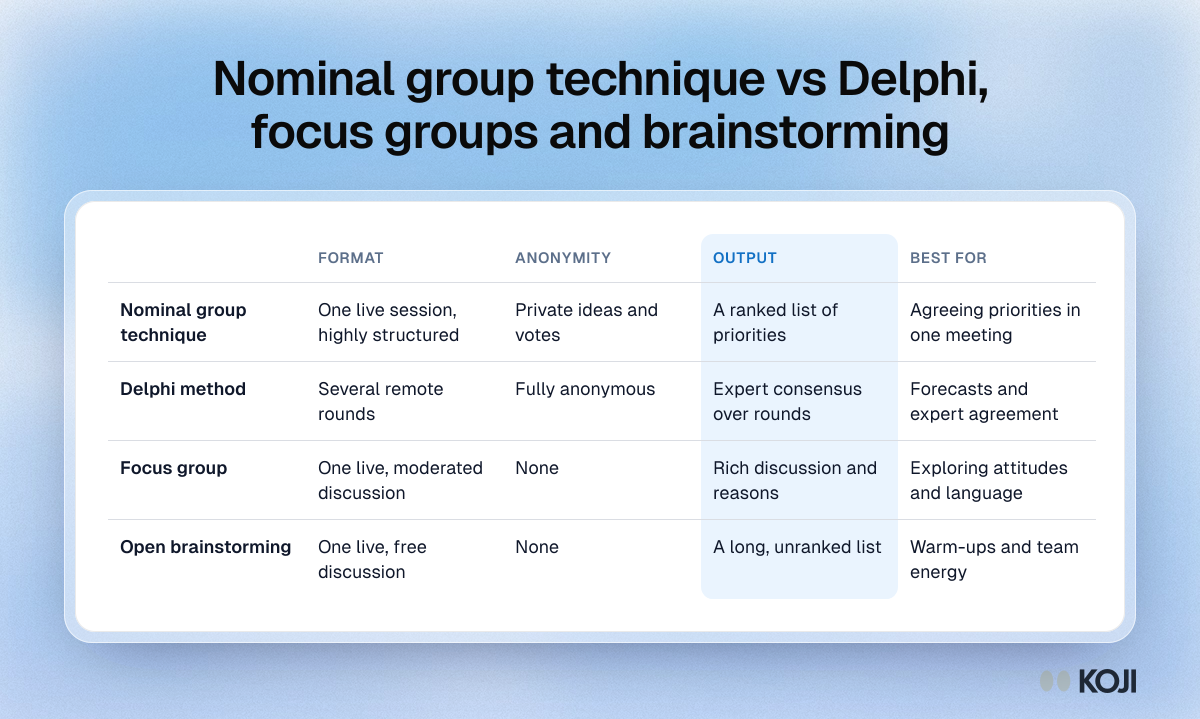
For product and research teams it fills a useful gap. It is faster than a Delphi study, more rigorous than a whiteboard session, and it produces a ranked output instead of a pile of sticky notes.
Why structure beats open brainstorming
The case for NGT rests on decades of evidence that unstructured group brainstorming produces fewer ideas than the same number of people working alone.
- Nominal groups out-produce real groups. Michael Diehl and Wolfgang Stroebe reviewed the research in "Productivity Loss in Brainstorming Groups: Toward the Solution of a Riddle" (Journal of Personality and Social Psychology, 1987). Of the 22 experiments they tabulated, 18 found nominal groups (people working alone, with their ideas pooled) superior to real groups.
- The main cause is waiting your turn. In their own four experiments, Diehl and Stroebe tested free riding, fear of evaluation and production blocking. Production blocking, where people forget or drop ideas while others are talking, accounted for most of the productivity loss.
- The loss grows with group size. Brian Mullen, Craig Johnson and Eduardo Salas's meta-analysis (Basic and Applied Social Psychology, 1991) found brainstorming groups produced less than nominal groups in both quantity and quality, with bigger losses in larger groups.
- NGT itself was tested early. Van de Ven and Delbecq compared 20 nominal groups, 20 Delphi groups and 20 conventional discussion groups of seven people each (Academy of Management Journal, 1974). Both NGT and Delphi were more effective than conventional group discussion.
NGT's silent generation step removes production blocking: everyone writes at once. The private vote removes the pressure to agree with the most senior person in the room. The round-robin makes sure quiet participants' ideas get the same airtime as everyone else's.
The four steps of the nominal group technique
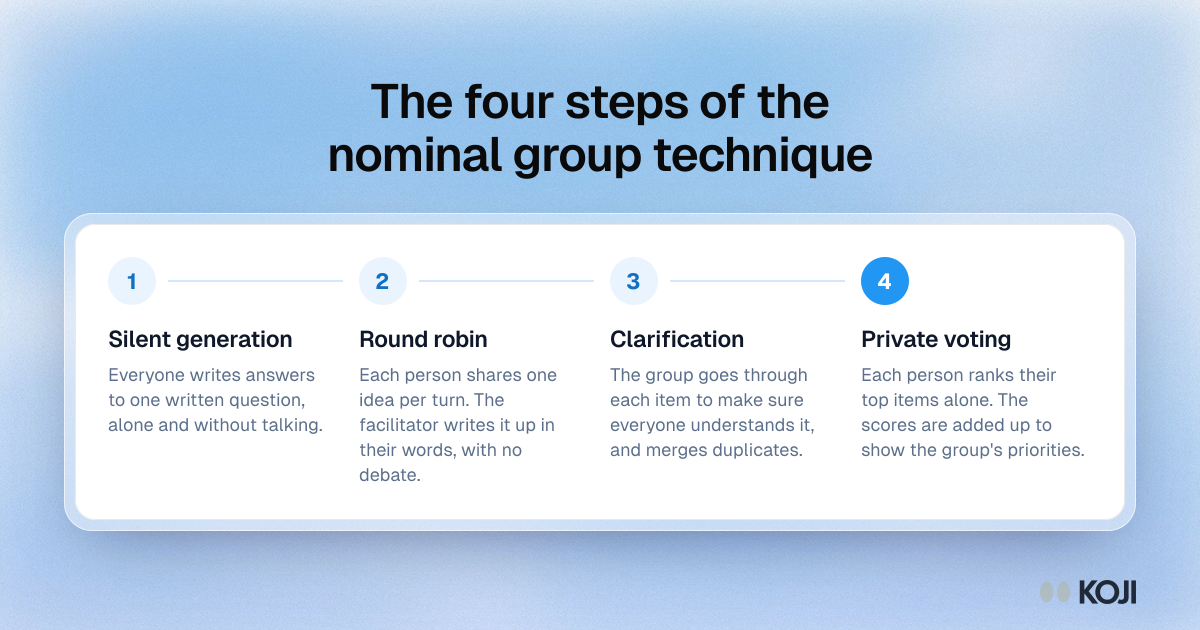
Sinead McMillan, Michelle King and Mary Tully summarise the method in "How to use the nominal group and Delphi techniques" (International Journal of Clinical Pharmacy, 2016): it "comprises four key stages: silent generation, round robin, clarification and voting (ranking or rating)."
Step 1: Silent generation
The facilitator presents one clear question, in writing, and each participant writes as many answers as they can without talking. McMillan and colleagues note that participants are typically given up to twenty minutes. Ten is usually enough for a focused question.
The question carries the whole session, so test it beforehand. Good NGT questions are specific and open: "What makes it hard to get your team using a new tool in its first month?" works. "What do you think of our product?" does not.
Step 2: Round robin
Going around the table, each person reads out one idea at a time, and the facilitator writes it up exactly as said, numbered. Nobody debates at this stage. The round continues until every idea is on the board. Participants can pass and come back in, and can add new ideas that someone else's sparked.
Step 3: Clarification
The group goes through the list, item by item. The goal is shared understanding, not persuasion: anyone can ask what an item means, and the author explains. Duplicates are merged with the agreement of the people who wrote them. Keep the facilitator strict here; this is where open discussion tends to creep back.
Step 4: Voting and ranking
Each person privately chooses their top items and ranks them. A common rule, used in the CDC's guidance, is to rank the top five, giving 5 points to the most important and 1 to the least. The facilitator adds up the scores. Items with the highest totals, and the number of people who picked them, show the group's priorities.
Some teams run a short discussion of the results and a second vote, especially when the scores are close. That is fine, as long as the second vote is also private.
Planning a session
Group size. The CDC brief suggests a room for five to nine participants. McMillan and colleagues note that NGT studies have used groups of between two and fourteen people, but that a maximum of seven has been recommended. If you have more people, run several groups on the same question and combine the votes.
Who to invite. Mix the perspectives you need to agree, such as customers from different segments, or sales, support and product. Avoid putting someone's manager in the same group if you can; the private vote helps, but the clarification step still feels different with the boss in the room.
Time. Plan for 60 to 90 minutes for one question: roughly ten minutes of silent writing, 20 to 30 minutes of round robin, 20 minutes of clarification and ten minutes for the vote and results.
Materials. One written question, cards or forms for silent writing, a board everyone can see and a ranking sheet. For remote sessions, a shared document and a private form for the vote work well.
Running the session
The facilitator's job is mostly to protect the structure. A few habits help:

Photo by Redmind Studio on Unsplash
- Read the question aloud and leave it visible for the whole session.
- Write ideas in the participant's words. Rewording them in the round robin quietly shifts ownership to the facilitator.
- Keep the round robin moving. One idea per person per turn stops one prolific person from filling the board.
- Stop arguments in clarification. "Let's note that you disagree; the vote will show us where the group lands."
- Show the scores straight away. People trust the result more when they watch it being counted.
Examples for product and research teams
- Prioritising onboarding problems. Six recently onboarded customers answer "What slowed you down in your first two weeks?" and rank the top five. The ranked list goes straight into the next quarter's onboarding work.
- Aligning internal teams on churn reasons. Sales, support and product each run one NGT session on "Why do customers leave in their first year?" Comparing the three ranked lists shows where the teams' pictures of churn differ, which is useful input for a round of churned customer interviews.
- Choosing research questions. A research team and its stakeholders use NGT to agree which three questions next quarter's studies should answer.
- Feature priorities with a customer advisory board. Board members silently list the problems they most want solved and rank them, so the loudest customer does not set the roadmap.
Strengths and limitations
Strengths. Every participant contributes equally. It produces a ranked, numeric output in one session. It is cheap and easy to learn. Results are easy to explain to stakeholders because the counting is transparent.
Limitations. It handles one question at a time. The ranked list tells you what the group values, not why, so it needs follow-up research to explain the top items. A small group can only represent so much, so treat results as the view of that group, not your whole market. And the structure can feel rigid to people used to free discussion.
NGT is related to dot voting, which shares the private-priority idea but usually skips silent generation and clarification. Compared with focus groups, it gives up depth of discussion in exchange for equal voice and a clear ranking.
How Koji helps
Koji does not replace a live NGT meeting, but it can run the parts of the method that work better one person at a time, and do it with far more people than fit in a room.
- Silent generation at scale. An AI-moderated interview asks every participant the same open question, by voice or text, alone and in their own time, which is the same condition that makes NGT's first step work. The interviewer follows up on vague answers so each idea is clear, which covers much of what the clarification step does.
- Private ranking. Add a ranking question to the study and participants drag the items into order. The report shows each item's average position, so you get the same kind of ranked output as an NGT vote. Multiple choice and scale questions work for top-five picks and importance ratings. See the structured questions guide.
- A two-round design. Run an open study first to collect ideas, then duplicate the study and add the merged list as a ranking question for a second round with the same or a wider group.
- Automatic themes. Koji's analysis groups open answers into themes across interviews, with the quotes behind each one, which gives you a first draft of the merged idea list.
- Screening questions keep each round to the people whose priorities you need.
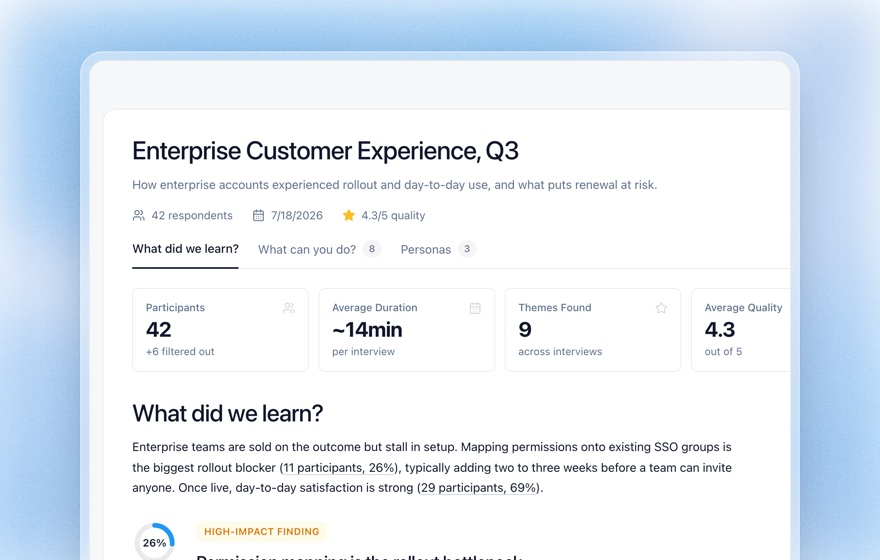
The trade-off is fair to state: a live NGT session builds shared ownership in the room, which a remote study does not. Many teams use both, running Koji to gather and rank ideas from dozens of customers, then a short live NGT session with internal stakeholders to agree what to do about the top items.
Related Resources
- The Delphi method
- Dot voting for prioritisation
- Focus group research
- Ranking vs rating questions
- Choice and ranking questions
- Structured questions guide
Sources
- Andre L. Delbecq and Andrew H. Van de Ven, "A Group Process Model for Problem Identification and Program Planning", Journal of Applied Behavioral Science 7(4), 1971.
- Andre L. Delbecq, Andrew H. Van de Ven and David H. Gustafson, Group Techniques for Program Planning: A Guide to Nominal Group and Delphi Processes, Scott, Foresman, 1975.
- Andrew H. Van de Ven and Andre L. Delbecq, "The Effectiveness of Nominal, Delphi, and Interacting Group Decision Making Processes", Academy of Management Journal 17(4), 1974.
- Michael Diehl and Wolfgang Stroebe, "Productivity Loss in Brainstorming Groups: Toward the Solution of a Riddle", Journal of Personality and Social Psychology 53(3), 1987.
- Brian Mullen, Craig Johnson and Eduardo Salas, "Productivity Loss in Brainstorming Groups: A Meta-Analytic Integration", Basic and Applied Social Psychology 12(1), 1991.
- Sinead S. McMillan, Michelle King and Mary P. Tully, "How to use the nominal group and Delphi techniques", International Journal of Clinical Pharmacy 38, 2016.
- Centers for Disease Control and Prevention, "Gaining Consensus Among Stakeholders Through the Nominal Group Technique", Evaluation Brief No. 7.
Related Articles
Choice and Ranking Questions in AI Interviews: Capture Preference Data at Scale
Learn how to use single choice, multiple choice, ranking, and yes/no questions in Koji AI interviews — with automatic report charts that show preference distributions across all your participants.
The Delphi Method: A Complete Guide to Reaching Expert Consensus
A practical guide to the Delphi method — the structured, multi-round technique for building expert consensus through anonymous questionnaires and controlled feedback. Learn the process, panel size, rounds, and modern AI-assisted alternatives.
Dot Voting: A Facilitation Guide for Prioritizing Ideas with Teams and Customers
A practical guide to dot voting — how to run it, allocation rules, variants, common pitfalls like groupthink and anchoring, and how to scale a vote beyond the room to hundreds of real customers with AI interviews.
Focus Group Research: The Complete Guide
Learn when to use focus groups, how to design and moderate them, and when AI-powered individual interviews are a better fit.
Ranking vs. Rating Questions: Which to Use and When
Rating questions score each item independently and scale easily; ranking questions force trade-offs and reveal true priorities. Learn the strengths, weaknesses, and biases of each, and how to choose the right format for clean, decision-ready data.
Structured Questions in AI Interviews
Mix quantitative data collection — scales, ratings, multiple choice, ranking — with AI-powered conversational follow-up in a single interview.