Dyadic Interviews: When to Interview Two People Together
What dyadic (paired or joint) interviews are, when to interview two people together or apart, and how to recruit, moderate and analyse them.
The short answer: a dyadic interview (also called a paired or joint interview) is a qualitative interview with two participants at once, usually two people who share a relationship or a decision: a couple, a patient and carer, a manager and the person who uses the tool, two co-founders. Use it when the thing you are studying happens between people, such as a shared purchase, a care routine or a team workflow, and you want to hear them build on, correct and disagree with each other. Interview them separately instead when the topic is sensitive, when one person is likely to dominate, or when you need each person's private view.
Many good studies do both. The choice is less "joint or separate?" than "which questions need the pair, and which need each person alone?"
What a dyadic interview is
In a dyadic interview, one interviewer asks open-ended questions and two participants answer, talking to the interviewer and to each other. The method sits between the one-to-one interview and the focus group. David Morgan, the sociologist who has done most to define it, and his colleagues describe it as sharing "many of the advantages of focus groups, in terms of the interaction between the participants, while minimizing problems related to bringing a number of participants together".
That interaction is the point. In a one-to-one interview you hear one account. In a dyadic interview you hear two accounts meeting: one person starts a story, the other fills in what they forgot, and sometimes they discover in front of you that they remember the decision differently. In a comparison of transcripts, Morgan and Hoffman (2018) found that dyadic interviews were more likely than focus groups to contain explicit links to what the previous speaker had just said, and to contain more statements of agreement. Pairs build on each other more closely than groups do.
How researchers actually use dyadic interviews
The method is more established than many product teams realise, mostly in health and family research. In a 2024 systematic review in Field Methods, Morgan found 471 journal articles that reported dyadic interviews. Of these, 38% interviewed the two members of each pair separately, 55% interviewed them together, and 7% used both formats. The pairs were overwhelmingly people who already knew each other: over 40% were married couples or the equivalent, and about 30% were other family pairs, with coworkers, patients and providers, and friends much less common.
Studies can be sizeable. In a 2022 paper on the strengths and limits of the method, Joanna Szulc and Nigel King drew on 47 dyadic interviews with 94 participants from their own earlier study.
The review's main conclusion is useful for anyone outside academia: the method has been used almost entirely with pairs who share an existing relationship. That is where it works best. Two strangers paired at random give you a small, awkward focus group.
When to use a dyadic interview
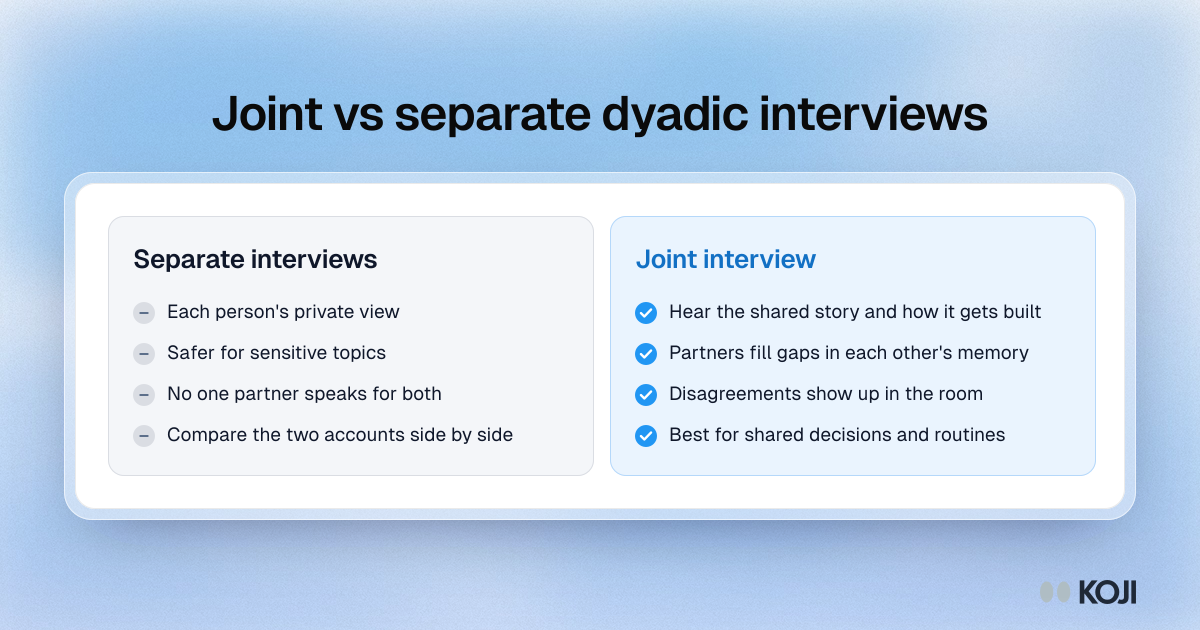
Use a joint interview when the research question is about something the pair does or decides together.
- Shared decisions. A couple choosing a mortgage, two co-founders picking a tool, a family deciding on a care home. The decision is a negotiation, and you want to watch it replay.
- Shared routines. A patient and carer managing medication, a parent and teenager sharing a device, two colleagues splitting a workflow. Each knows half of the routine.
- Shared memory. When one person forgets the details, the other often remembers them, and the prompting between them produces a fuller account than either would alone.
- Hard-to-reach or less confident participants. Some people speak more freely with a familiar person beside them. One of the studies in Morgan's 2013 paper that introduced the method involved people with early-stage dementia.
When to interview separately instead
Joint interviews have real costs, and researchers who use them are open about it.
- Sensitive topics. People may hold back in front of a partner, boss or parent. Researchers in development economics, for example, note that partners interviewed alone are often more forthcoming about sensitive matters, and that a joint interview only works if each feels free to disagree.
- Power imbalance. A manager and a report, a parent and a child, or a dominant and a quieter partner. The account you get may be the more powerful person's.
- Private views matter. If you need to know whether each person is satisfied, not whether the pair agrees in public, ask them alone.
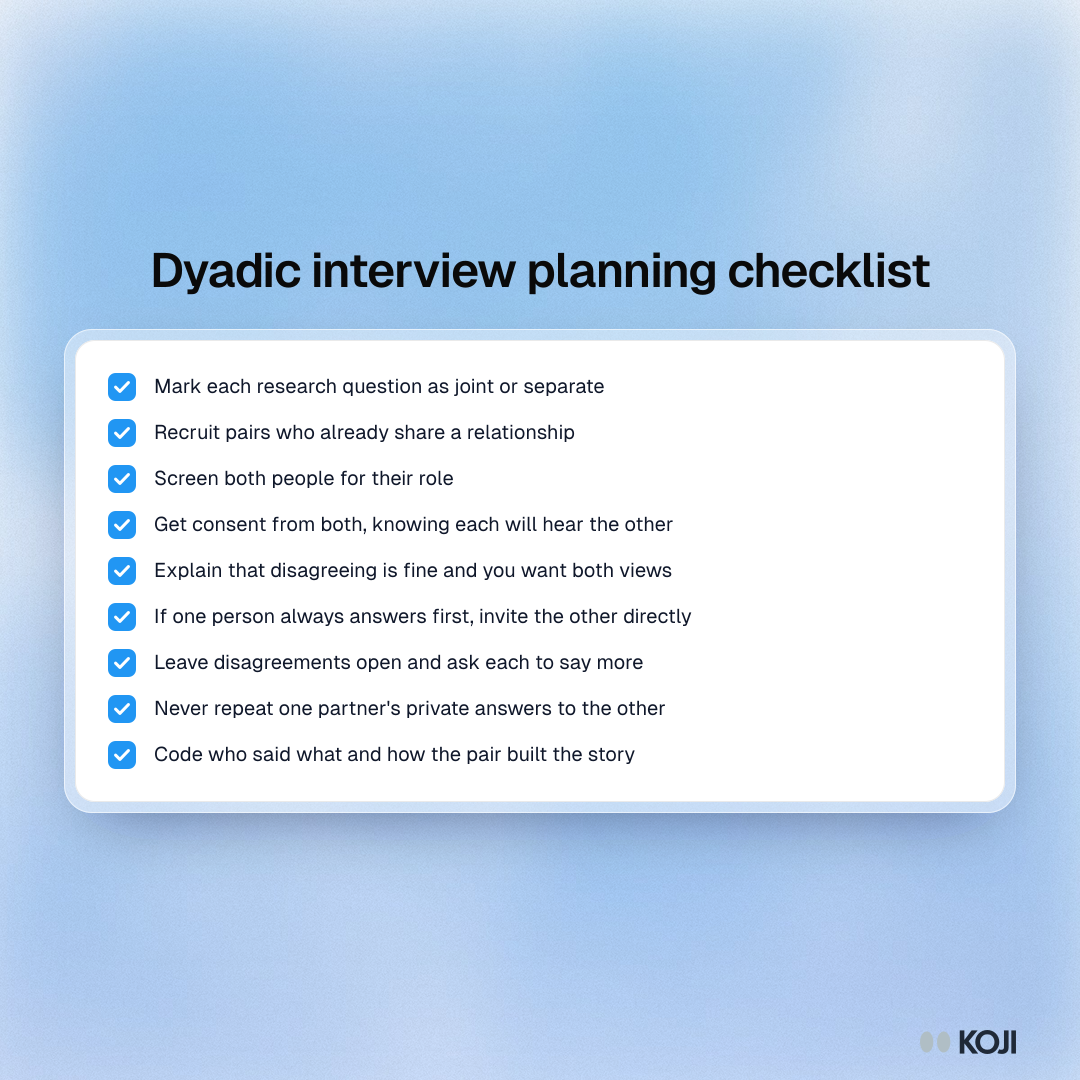
- Consent and confidentiality. Anything one person says in a joint interview, the other hears. Make sure both agree to that before you start, and never repeat what one partner said in a separate interview to the other.
Separate interviews can still be analysed as a pair. Researchers compare the two accounts side by side, looking for where they match, where they differ and what each leaves out. A study of couples living with endometriosis argued that separate interviews analysed this way offer "considerable methodological benefits", while noting their own ethical and practical challenges.
How to run a dyadic interview
1. Decide on the format for each question
List your research questions and mark each one joint or separate. A common design is a joint interview on the shared story, followed by short separate interviews on each person's own experience and anything they might not say in front of the other.
2. Recruit pairs, not people
Recruit through one member and ask them to bring the other, or recruit both directly. Screen both people: each should meet your criteria for their role. Plan for the scheduling cost, since you need two people free at once, and for the chance that one partner drops out.
3. Running the joint session
Start by explaining the ground rules: there are no right answers, it is fine to disagree, and you want to hear from both. Ask open questions to the pair rather than to one person, then watch who answers. If one person keeps answering first, invite the other directly: "How did that look from your side?"

Photo by Vitaly Gariev on Unsplash
Let them talk to each other. Some of the best material comes when you stop asking and they start correcting each other's memory. When they disagree, do not settle it. Ask each to say more. The difference is often the finding.
Keep the session shorter than you would for a focus group. Forty-five to sixty minutes is plenty for two people.
4. Analyse the interaction, not just the content
Code what each person said, and also how they said it together: who started each topic, where one corrected the other, where they agreed quickly and where they disagreed. A shared account that both endorse is strong evidence. A topic one partner avoids is a lead for the separate interview.
Common mistakes
- Pairing strangers. Without a shared relationship, you lose the reason to interview them together.
- Letting one person speak for both. If you only hear one voice, you have a one-to-one interview with an audience.
- Resolving disagreements. Your job is to understand both versions, not to decide who is right.
- Leaking between interviews. In a mixed design, never tell one partner what the other said alone.
- Analysing two people as one. Keep track of who said what. A pair's account is two accounts.
How Koji helps
Koji runs one-to-one AI-moderated interviews by voice, text or phone call. It does not put two people into one conversation, so it will not replace the joint session itself. Where it helps is the separate half of a dyadic design, which is also the half most teams skip because it doubles the scheduling.
- Interview both members of each pair separately. Import both people from a CSV and each gets their own private interview link, tied to them. Add a pair ID column to your file: the download of invite links keeps your original columns next to each person's response status, so you can match partners and chase anyone who has not started.
- Ask each person the same questions in their own time. Every participant gets the same core questions with the same follow-up depth, which makes the side-by-side comparison of two accounts fair. Neither partner waits for the other's diary to clear.
- Give each person privacy. Each interview is one person talking to the interviewer, so you can ask about the parts of a shared decision someone might not raise in front of their partner.
- Follow up after a joint session. After a human-moderated joint interview, send each partner a short Koji interview on the questions marked separate.
- Compare the accounts. The report groups themes across all interviews and links every finding to the people and quotes behind it. Add structured questions, such as a satisfaction scale or a "who made the final call?" choice question, to make differences between partners easy to see.
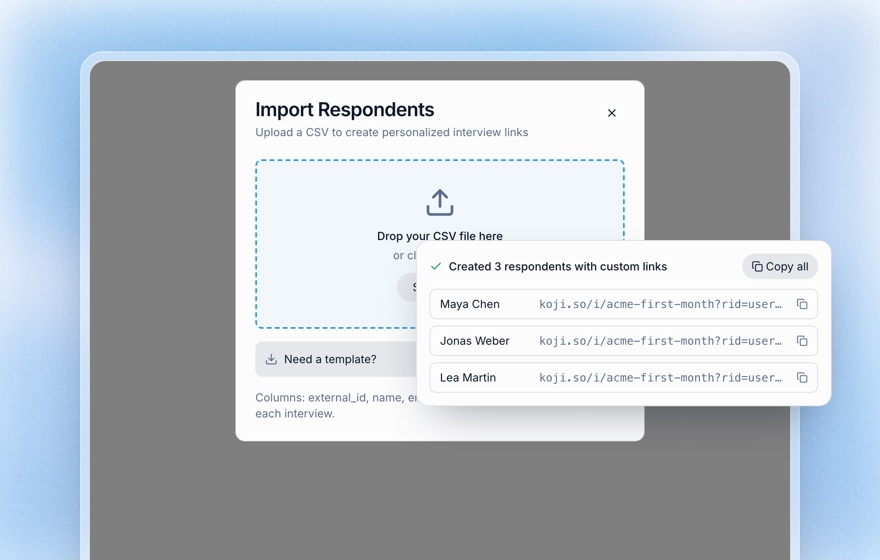
Compared with booking two separate human-moderated sessions per pair, this cuts the scheduling and keeps the questions identical. The joint conversation, where you watch two people work out their story together, still needs a human in the room.
Related Resources
- In-depth interview methodology
- AI-moderated focus groups
- Focus group alternatives
- Building rapport in research interviews
- Hard-to-reach participants
- Structured questions guide
Sources
- David L. Morgan, Jutta Ataie, Paula Carder and Kim Hoffman, "Introducing Dyadic Interviews as a Method for Collecting Qualitative Data", Qualitative Health Research, 2013.
- David L. Morgan and colleagues, "Dyadic Interviews as a Tool for Qualitative Evaluation", 2016.
- David L. Morgan and Kim Hoffman, "A System for Coding the Interaction in Focus Groups and Dyadic Interviews", 2018.
- David L. Morgan, "Invited Review: Collecting Data Through Dyadic Interviews: A Systematic Review", Field Methods, 2024.
- Joanna Maria Szulc and Nigel King, "The Practice of Dyadic Interviewing: Strengths, Limitations and Key Decisions", Forum: Qualitative Social Research 23(2), 2022.
- "Conducting dyadic, relational research about endometriosis: A reflexive account of methods, ethics and data analysis", available on PubMed Central.
Related Articles
AI-Moderated Focus Groups: How to Run Group Research Without a Human Moderator
How AI-moderated focus groups work, when they outperform traditional groups, and how to run them at scale. Get the depth of focus group research without scheduling, moderation, or groupthink.
Building Rapport in Research Interviews: How to Make Participants Open Up
Learn proven techniques to build trust and comfort with research participants so they share honest, detailed insights instead of surface-level answers.
The Best Focus Group Alternatives in 2026: Why AI Interviews Are Replacing Traditional Group Research
Focus groups are expensive, slow, and riddled with groupthink. Discover the best focus group alternatives in 2026 — including AI-moderated interviews that give you richer individual insights at a fraction of the cost and time.
How to Research Hard-to-Reach Audiences: Executives, B2B Buyers, and Niche Segments
The people hardest to recruit for research are often the ones whose insights matter most. Learn how async AI interviews unlock executives, B2B buyers, and niche specialists who will never take a 60-minute call.
In-Depth Interviews: The Complete Methodology Guide
Everything you need to plan, conduct, and analyze in-depth interviews — the gold standard of qualitative research.
Structured Questions in AI Interviews
Mix quantitative data collection — scales, ratings, multiple choice, ranking — with AI-powered conversational follow-up in a single interview.