The Lead User Method: How to Find Customers Who Are Ahead of the Market
How to use Eric von Hippel's lead user method: what lead users are, how to find them with screening or pyramiding, and how to learn from what they built.
The short answer: the lead user method finds the small group of people who already face a need the rest of the market will face later, and who care about it enough to have built their own fixes. You identify a trend, search for the people furthest along it, often outside your own market, and learn from the solutions they have already made. Eric von Hippel at MIT developed the method in the 1980s. In a study at 3M, lead user projects produced ideas forecast to sell more than eight times as much as ideas from the company's usual methods.
Most customer research asks typical customers what they need. That works for improving what exists. It works badly for breakthroughs, because typical customers can only describe needs they already feel. Lead users feel them first.
What is a lead user?
Von Hippel defined lead users by two traits. In his words, lead users "face needs that will be general in a marketplace, but face them months or years before the bulk of that marketplace encounters them", and they "are positioned to benefit significantly by obtaining a solution to their needs".
Both traits matter:
- Ahead of the trend. Their situation today looks like the market's situation tomorrow. A hospital treating a new class of infection, a bank running into a regulation before it spreads, or a creator already publishing in ten languages.
- High expected benefit. The need costs them enough that they are willing to invest in a solution. That is why so many of them have already built one: a workaround, a script, a modified tool, sometimes a working prototype.
That second trait is the practical reason the method works. You are not asking people to imagine the future. You are studying solutions that already exist in rough form.
User innovation is more common than most teams assume. In a study of 153 buyers of outdoor sports products, Christian Lüthje (2004) found that 37% had come up with ideas for new or improved products, and more than 9% had built prototypes or even marketable products. Among 136 firms using printed circuit board design software, Urban and von Hippel (1988) found that 24.3% had developed or built their own version for their own use.
Lead users vs power users vs early adopters
These three groups get mixed up, and the difference decides who you recruit.
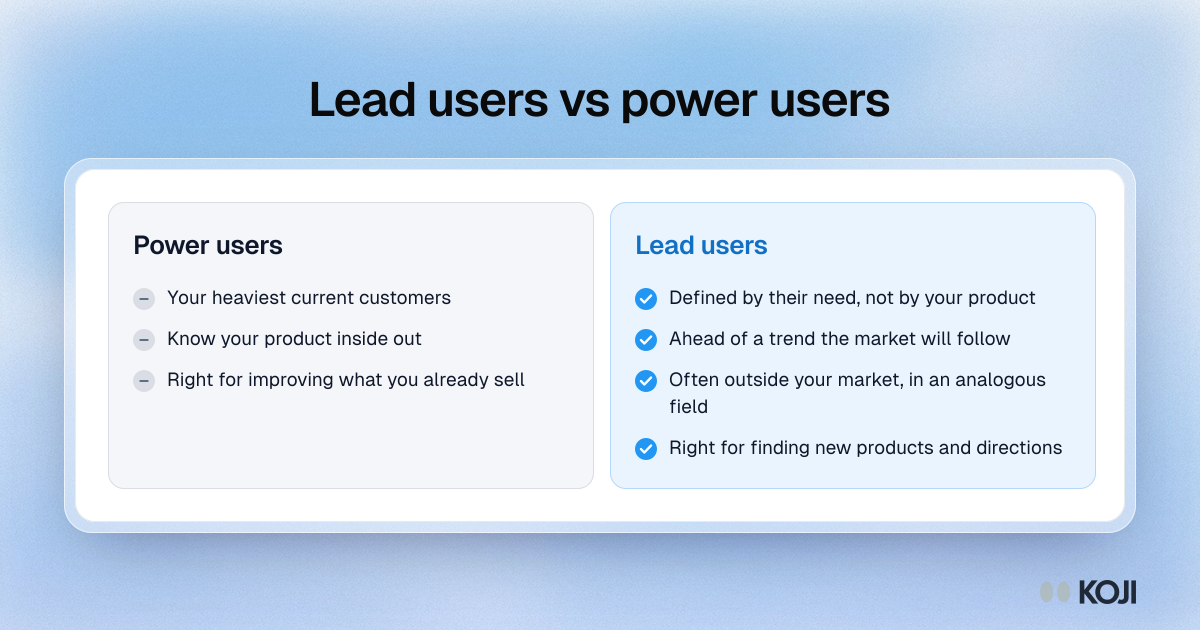
- Power users are your heaviest current customers. They know your product inside out, and they are the right people for improving it. See power user interviews.
- Early adopters are the first to buy new products in a category. They adopt solutions; they do not usually create them.
- Lead users are defined by their need, not by their relationship with you. Many have never used your product. The most useful ones often sit in an analogous field: a different market that faces an extreme version of the same problem.
The analogous field is the method's most distinctive idea. In the 3M project that von Hippel, Stefan Thomke and Mary Sonnack described in Harvard Business Review (1999), a team looking for cheaper ways to prevent surgical infections learned from specialists in veterinary hospitals, who keep infection rates very low, and from Hollywood make-up artists, who work with materials that are gentle on skin and easy to remove. Neither group was a typical buyer of surgical drapes, but both had already solved parts of the problem.
Why it works: the evidence
The best-known test of the method comes from 3M. Gary Lilien, Pamela Morrison and colleagues compared lead user projects with traditional idea-generation projects run at the same company during the same period (Management Science, 2002). They found that annual sales of ideas from the average lead user project were conservatively forecast at $146 million after five years, more than eight times the forecast for the average traditional project. A summary of the study published when it came out reported that the lead user ideas also had a higher market share in year five, 68% on average against 33% for other ideas.
Two caveats are worth stating. The 3M figures are sales forecasts, not realised sales, and lead user projects are more expensive and slower than a round of customer interviews. The method earns its cost when you are looking for a new product line or a new direction, not a feature tweak.
How to run a lead user study
The steps below are a practical sequence built from how lead user projects are usually run. Expect weeks, not days, for a full project.
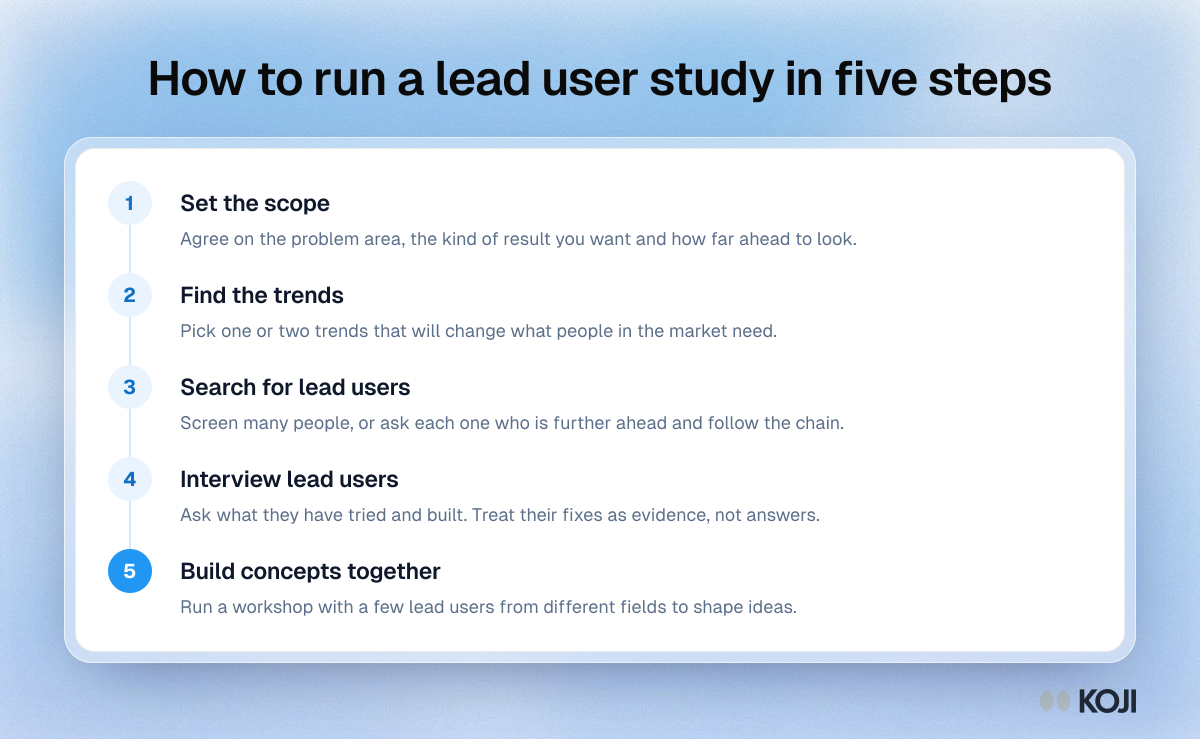
1. Set the scope
Agree on the market or problem area, the kind of result you want (a new product line, a service, a new strategy) and how far ahead you want to look. Lead user work is generative. If the team has already chosen the solution, run concept testing instead.
2. Find the trends
List the trends that will change what people in your market need: new regulations, new technology, new behaviour, rising costs. Talk to experts and read widely. The aim is to pick one or two trends that matter, because lead users are only "lead" relative to a trend. Someone who is ahead on cost pressure may be behind on automation.
3. Search for lead users
There are two ways to find them.
Screening means surveying many people and picking out those who score high on both traits: how far along the trend they are, and how much they would gain from a solution. Screening works when lead users are reasonably common in a population you can reach.
Pyramiding (also called networking) means asking each person you speak to who they know that is even further ahead, and following the chain. It relies on the fact that people deep in a field tend to know who is deeper still. In four experiments, von Hippel, Franke and Prügl (Research Policy, 2009) found that pyramiding located the single most expert person in a group after interviewing about 28.4% of the group on average, and one of the top three after about 15.9%. When lead users are rare, pyramiding is usually far cheaper than screening everyone.
Good pyramiding questions:
- "Who do you know who has gone further with this than you have?"
- "Who do people in your field go to when they hit this problem?"
- "Is there another industry that deals with a more extreme version of this?"
4. Interviewing lead users
Lead user interviews are about what the person has done, not what they would like. Ask them to walk through the problem as they experience it today, what they have tried, and what they built or changed. Ask to see the workaround. Probe for why they made each choice, what it cost them, and what still does not work.

Photo by Adam Patterson on Unsplash
Treat their solution as evidence, not as the answer. A lead user's homemade tool shows you the need and some of the design constraints; your job is to work out the version the wider market will want in a few years.
5. Build concepts together
Traditional lead user projects end with a workshop where a handful of lead users, often from different fields, work with the company's team to develop concepts. This is where the ideas get combined and stress-tested. Agree on terms for any ideas they contribute before the workshop, not after.
Common mistakes
- Recruiting power users and calling them lead users. Heavy use of your product is not the same as being ahead of a trend.
- Skipping the trend work. Without a clear trend, "lead" has no direction and you end up with a list of enthusiasts.
- Looking only in your own market. The most original solutions often come from analogous fields.
- Asking for ideas instead of evidence. "What should we build?" gets wish lists. "Show me what you built" gets insight.
- Treating lead users as representative. By definition they are not. Validate the resulting concepts with mainstream customers before you invest.
How Koji helps
Koji runs AI-moderated interviews by voice, text or phone call, and it fits the parts of a lead user project that need many conversations run the same way: screening, pyramiding and the first round of lead user interviews. The concept workshop stays with your team.
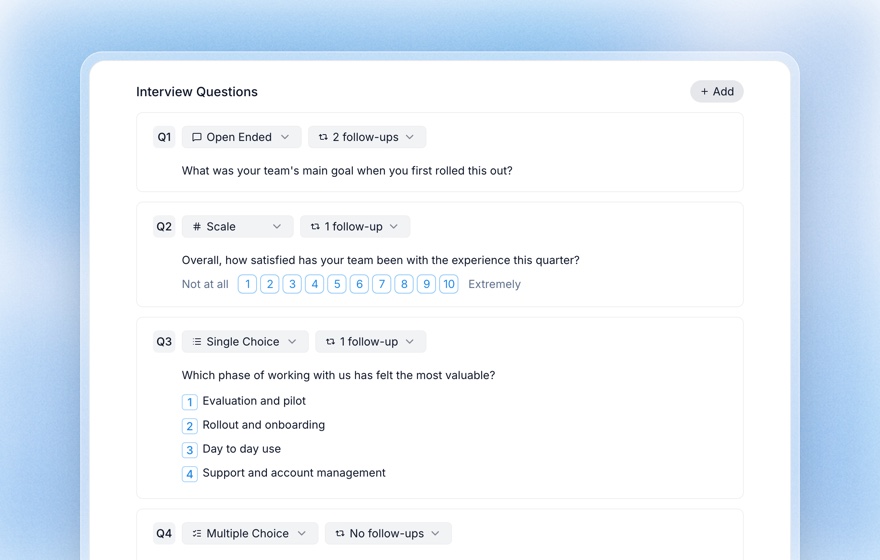
- Screen for both traits at scale. Add screening questions that check whether someone works in the area at all, then use scale questions inside the interview to measure how far along the trend they are and how much the problem costs them. Every answer lands in the report, broken down by option, so you can see who scores high on both. The structured questions guide covers the question types.
- Pyramid in the same conversation. End each interview with an open-ended question asking who is further ahead and which other fields face a harder version of the problem. Set the follow-up depth so the interviewer asks why they named that person or field.
- Interview the people you are referred to. Import nominated contacts from a CSV and each person gets their own private interview link. Interviews run in 28 languages, which helps when the best lead users are in another country or another industry.
- Dig into what they built. Set follow-ups on the "what have you tried or built" question, with your own instructions, so the interviewer asks what the workaround cost, what it does and what still breaks.
- Separate lead users from everyone else. The report's personas group participants by shared needs and behaviour, and every finding links to the interviews behind it, so the small group ahead of the trend does not get averaged away.
The trade-off is a fair one to name. A skilled human interviewer can follow an unexpected referral chain on the spot and judge expertise in a way a script cannot. Koji's strength is reach and consistency: you can screen hundreds of people, in their own language and their own time, and spend your team's hours on the dozen who turn out to be ahead.
Related Resources
- Power user interviews
- Non-user research
- Design thinking research
- Screener questions guide
- Concept testing methodology
- Structured questions guide
Sources
- Eric von Hippel, "Lead Users: A Source of Novel Product Concepts", Management Science 32(7), 1986.
- Glen L. Urban and Eric von Hippel, "Lead User Analyses for the Development of New Industrial Products", Management Science 34(5), 1988.
- Eric von Hippel, Stefan Thomke and Mary Sonnack, "Creating Breakthroughs at 3M", Harvard Business Review, 1999.
- Gary L. Lilien, Pamela D. Morrison, Kathleen Searls, Mary Sonnack and Eric von Hippel, "Performance Assessment of the Lead User Idea-Generation Process for New Product Development", Management Science 48(8), 2002.
- Christian Lüthje, "Characteristics of innovating users in a consumer goods field", Technovation 24(9), 2004.
- Eric von Hippel, Nikolaus Franke and Reinhard Prügl, "Pyramiding: Efficient search for rare subjects", Research Policy 38(9), 2009.
Related Articles
Concept Testing: The Complete Methodology Guide
How to evaluate product and marketing ideas with target audiences before development — covering methods, metrics, sample sizes, and AI-powered approaches.
Design Thinking Research: The Complete Guide to the Empathize Phase
Master the Design Thinking empathize phase with proven user research techniques. Learn empathy mapping, immersion, observation, and how AI-powered interviews accelerate human-centered design.
Non-User Research: How to Interview the People Who Never Chose You
Your roadmap is built entirely from the opinions of people who said yes. A guide to researching the four types of non-user — rejecters, the unaware, the DIY crowd, and the constrained — including how to recruit them and what to ask.
Power User Interviews: How to Learn from Your Best Customers to Drive Growth
Learn how to identify and interview your power users to understand what drives product mastery, advocacy, and expansion — and how AI interviews make this research scalable.
Screener Questions for User Research: A Complete Guide
Learn how to write effective screener questions that find the right research participants — and how Koji's intake forms and AI interviews make screening faster and more natural.
Structured Questions in AI Interviews
Mix quantitative data collection — scales, ratings, multiple choice, ranking — with AI-powered conversational follow-up in a single interview.