Purposive Sampling: The Complete Guide to Strategic Participant Selection
A complete guide to purposive (purposeful) sampling in qualitative research — covering all major types, when to use each, how to determine sample size, and how AI tools enable purposive sampling at scale.
Bottom line: Purposive sampling (also called purposeful sampling or judgmental sampling) is the deliberate selection of research participants based on specific characteristics relevant to your research question. Unlike random sampling, it optimizes for depth and relevance rather than statistical representativeness — making it the right choice for most qualitative research, including user interviews, customer discovery, and UX studies.
When you need to understand why users abandon your checkout, you do not want a random cross-section of your customer base. You want people who have actually abandoned a checkout recently. That is purposive sampling in action.
What Is Purposive Sampling?
Purposive sampling is a non-probability sampling technique where researchers deliberately select participants based on their ability to provide relevant, information-rich data for the specific research question at hand.
Also known as judgmental sampling, selective sampling, or purposeful sampling, the approach contrasts sharply with random probability sampling — the standard in quantitative research:
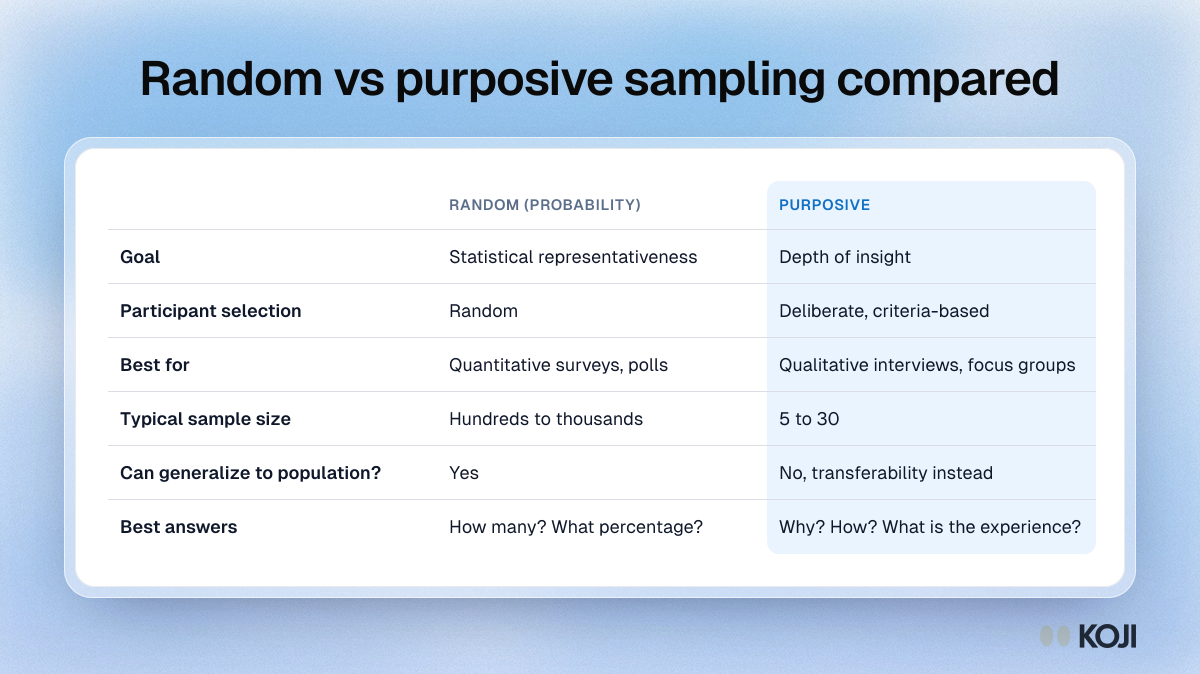
| Random (Probability) Sampling | Purposive Sampling | |
|---|---|---|
| Goal | Statistical representativeness | Depth of insight |
| Participant selection | Random | Deliberate, criteria-based |
| Best for | Quantitative surveys, polls | Qualitative interviews, focus groups |
| Typical sample size | Hundreds to thousands | 5–30 |
| Can generalize to population? | Yes | No (transferability instead) |
| Best answers | "How many?" "What percentage?" | "Why?" "How?" "What is the experience?" |
Research published in Quality & Quantity (2024) confirmed that purposive sampling remains the most commonly used sampling approach in qualitative research across social sciences, health, and UX disciplines, precisely because it surfaces the richest, most relevant data for understanding complex human experiences.
Why Purposive Sampling Matters for Product and UX Research
The quality of your qualitative research is determined largely by the quality of your participant selection. Talk to the wrong people — people who have not experienced the phenomenon you are studying — and even perfect interview technique produces misleading findings.

Photo by The Jopwell Collection on Unsplash
Purposive sampling solves this problem by making participant selection a deliberate research decision rather than a logistical convenience. It shifts the question from "who can we get?" to "who should we talk to and why?"
As Michael Patton, a leading qualitative methodologist, writes: "A relatively small and purposively selected sample may be employed, with the aim of increasing the depth of understanding. Depth, not breadth, is the goal."
The 5 Most Useful Types of Purposive Sampling
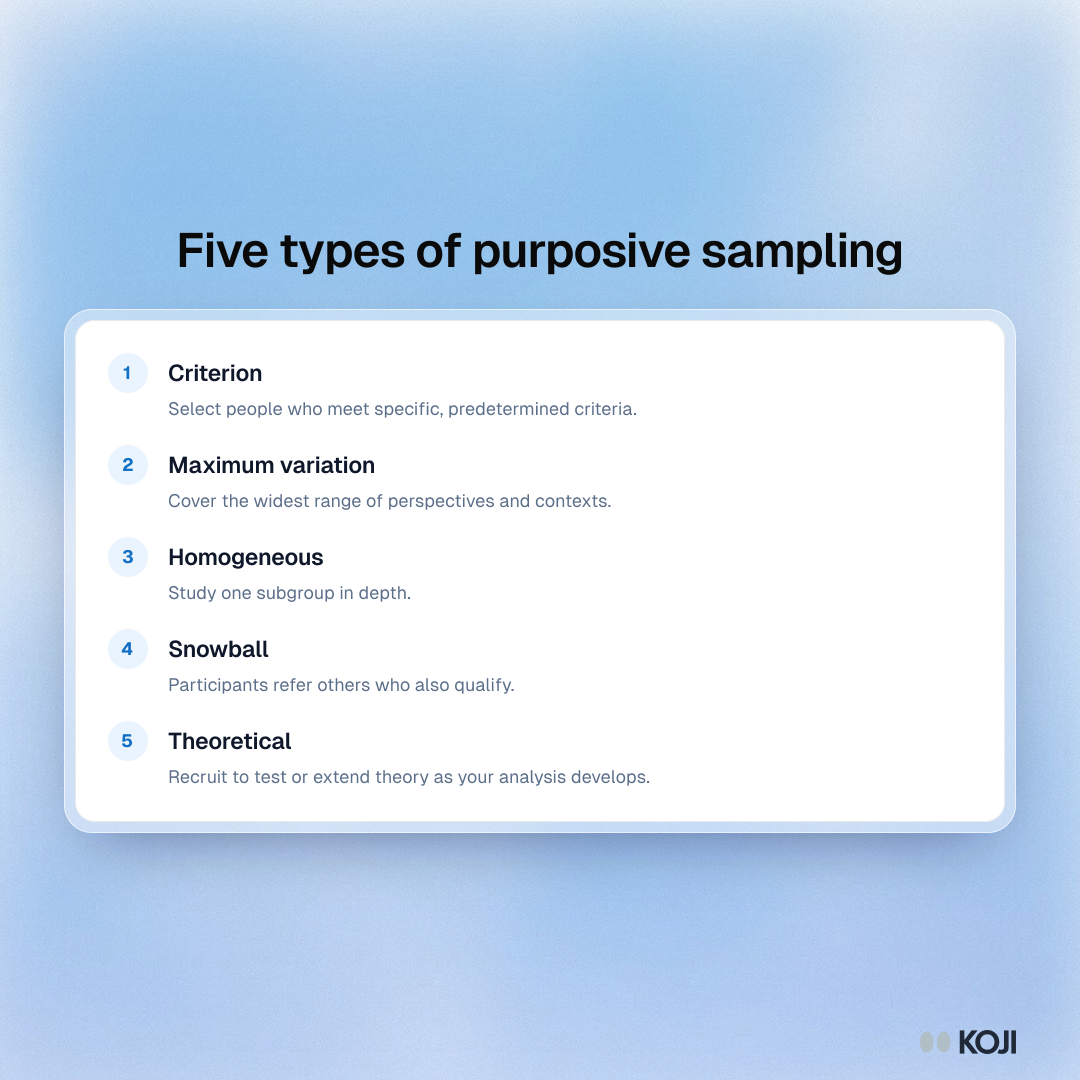
There are up to 16 recognized types of purposive sampling in the methodological literature. For product, UX, and market researchers, five are especially practical.
1. Criterion Sampling
What it is: Select participants who meet specific, predetermined criteria directly relevant to your research question.
Example: Studying the enterprise software onboarding experience — criterion: "completed onboarding in the last 60 days and is using the product at least three times per week."
Best for: Usability studies, feature feedback interviews, churn research, NPS follow-up — any time you need participants with lived experience of a specific product scenario or workflow.
How to apply it: Write your screening criteria before recruiting begins. Be specific enough that the criterion is actually screening — "frequent user" means different things to different people; "uses the product at least 3x per week" is a criterion that can be verified.
Common mistake: Criteria that are so broad they include nearly everyone ("has used the product at least once") effectively become convenience sampling. Good criteria are specific and genuinely restrictive.
2. Maximum Variation Sampling
What it is: Deliberately select participants who represent the widest possible range of perspectives, experiences, or contexts relevant to your research question.
Example: Researching how teams adopt new project management tools — you recruit from small startups, mid-market companies, and enterprises; from engineering, marketing, and operations teams; from power users and reluctant adopters.
Best for: Exploratory research, customer discovery, identifying universal patterns that hold across diverse contexts, early product development when you are not yet sure which user segments matter most.
Why it works: When the same theme emerges from participants with very different backgrounds and experiences, it is far more likely to be a genuine insight than a sample artifact. Maximum variation sampling is one of the most powerful credibility-building techniques in qualitative research — it provides natural triangulation built into the sampling strategy itself.
How to apply it: Before recruiting, map out 2–3 dimensions of variation relevant to your research question (company size, role, product experience level, geography, usage frequency). Ensure your participant list includes representation across each dimension.
3. Homogeneous Sampling
What it is: Select participants who share specific characteristics to study a particular subgroup in depth.
Example: You want to understand the experience of solo practitioners (freelancers) using your project management tool, separate from and prior to studying team-based users.
Best for: Segment-specific research, persona deep dives, understanding a niche but strategically important user group, any time you want focused insight into one distinct audience.
The tradeoff: Depth within one segment at the expense of breadth across segments. Use homogeneous sampling when you already know the segment matters and want to understand it deeply. Use maximum variation when you are still discovering which segments matter.
Common pairing: Homogeneous sampling often follows maximum variation — you run a broad exploratory study using maximum variation, identify which segments have the most distinct and important experiences, then run targeted homogeneous studies to go deep on those specific segments.
4. Snowball Sampling
What it is: Start with a few participants who meet your criteria, then ask them to refer others in their network who also qualify. The sample grows as each participant refers more, like a snowball rolling downhill.
Example: Researching procurement decision-making in large enterprises — a notoriously hard-to-reach population. Start with one VP of Procurement contact, who refers three others, who refer more.
Best for: Hard-to-reach populations (executives, rare specializations, people with specific life experiences), niche B2B segments where trust matters for candid conversation, research into communities where insider access is required.
The key caution: Snowball samples can become network-homogeneous — you end up talking to people who all know each other, share the same professional context, and hold similar views. Counteract this by starting multiple independent snowball chains from different network origins, ensuring that your network clusters do not all connect back to the same hub.
5. Theoretical Sampling
What it is: Participant selection is guided by your emerging analysis — you recruit new participants specifically to test or extend theories that are developing as you analyze earlier interviews.
Example: You are building a theory of how teams make software purchase decisions. Your first interviews reveal that whether or not procurement is involved is a critical variable. You then specifically recruit participants from companies with formal procurement processes and those without, to test this emerging theory.
Best for: Grounded theory research, iterative discovery work, multi-wave research where each wave is designed based on findings from the previous one.
The practical challenge: Theoretical sampling requires real-time analysis between recruitment waves, making it slower and more complex to operationalize than other types. For product teams working under time pressure, a practical approximation is to run a first wave, do a rapid synthesis, then run a targeted second wave to probe the most surprising or uncertain findings.
How Many Participants Do You Need?
There is no universal answer, but these evidence-based guidelines apply across most research contexts:
For criterion and homogeneous sampling: 6–12 participants per distinct segment is typically sufficient to reach thematic saturation — the point at which additional interviews no longer surface new, substantively different themes.
For maximum variation sampling: 12–20 participants to ensure that variation dimensions are adequately covered. Research by Guest, Bunce, and Johnson (2006) found that 80–92% of major themes emerged within the first 12 interviews in studies designed for maximum variation — supporting the common recommendation of 12–15 as a starting point.
For snowball sampling: Recruit until saturation. This can be as few as 8 (tight, well-connected network) or as many as 30+ (highly diverse network with many distinct subgroups).
The practical rule: Plan for 8–12 interviews to start. Conduct a mid-point analysis after the first 5–6. If major new themes are still emerging with every interview, recruit more. If the last 3 interviews are adding only minor nuances to well-established themes, you have likely reached saturation.
"Purposive sampling allows researchers to concentrate on participants most likely to provide relevant data, thereby saving time and reducing costs associated with data collection." — Review of Managerial Science, 2025
How to Implement Purposive Sampling: A Step-by-Step Process
Step 1: Define your research question precisely
Purposive sampling only works when you know exactly what you are trying to understand. "Improve our product" is not a research question. "Understand why enterprise buyers in mid-market companies do not complete the first workflow within 7 days of signup" is.
Step 2: Identify the key characteristics that define an ideal participant
Ask: Who has the most direct, recent, and relevant experience of the phenomenon I am studying? What minimum qualifications must they have? What dimensions of variation matter for my question?
Step 3: Choose your sampling type
Use the table above. Criterion sampling for most focused product research. Maximum variation for open exploration. Snowball for hard-to-reach populations. Theoretical for iterative, grounded research.
Step 4: Write specific screening criteria
Convert your participant characteristics into yes/no screening questions. Each criterion should be:
- Specific enough to genuinely screen participants
- Verifiable (can you check whether they meet it?)
- Directly relevant to your research question
Step 5: Document your sampling rationale
Write down why you chose these criteria and this sampling approach before you begin. This documentation supports the transferability and confirmability of your research — readers need to understand who you talked to and why, to judge whether your findings apply to their context.
Step 6: Recruit to criteria, not to fill slots
Resist the temptation to relax criteria when recruitment is slow. A study with 8 participants who perfectly match your criteria produces more trustworthy findings than one with 20 who only roughly qualify. Criteria dilution is one of the most common ways purposive sampling studies lose their methodological rigor.
Common Mistakes in Purposive Sampling
Convenience masquerading as purposive: "We talked to whoever was available" is convenience sampling, even when dressed up with criteria language. Purposive sampling requires that your criteria — not logistical convenience — actually drive participant selection.
Criteria that are too broad or too vague: Good criteria exclude most people. If 80% of your user base meets your screening criteria, they are not criteria — they are descriptions.
Ignoring non-users and former users: If you are studying a problem that causes churn, recruiting only current active users misses the people who experienced the problem most acutely — and responded by leaving. Include churned users, trial abandoners, and non-adopters when they are central to your research question.
Unconscious homogenization: Researchers sometimes gravitate toward participants who are easy to talk to, who share their professional background, or who are enthusiastic about the research. This produces agreeable findings that may not represent the full range of relevant experiences.
Forgetting to document: Purposive sampling is only as rigorous as its documentation. If you cannot explain exactly who you recruited, by what criteria, and why, your sampling strategy cannot support transferability claims in your final report.
How Koji Makes Purposive Sampling Scalable
Traditional purposive sampling is bottlenecked by manual recruitment and scheduling. Finding 12 participants who meet specific behavioral criteria, individually scheduling them, conducting hour-long interviews, and then transcribing and analyzing the results can take three to four weeks of a researcher's time.
Koji removes these constraints, enabling purposive sampling at scale:
Import your own participant list: Upload a CSV of participants from your CRM, product analytics tool, or participant panel. These people already meet your criteria — you have selected them based on behavioral or demographic data before they enter the study.
Intake forms as real-time screeners: Koji's intake forms let you add pre-interview screening questions that filter out participants who do not meet your criteria, even when recruiting from a broad inbound audience.
Personalized interview contexts: Each participant receives a unique interview link with their specific context pre-loaded. The AI interviewer can reference their particular experience (signup date, usage patterns, plan type), turning purposive selection into genuinely personalized conversations.
Structured question types for precision: Koji's 6 structured question types — open-ended, scale, single choice, multiple choice, ranking, and yes/no — let you combine qualitative depth with quantitative screening within a single session. You can verify that participants meet behavioral criteria during the interview itself, and weight your analysis accordingly.
Scale without quality degradation: Run criterion sampling studies with 50, 100, or 500 participants in the time it takes to schedule 10 manual interviews. The AI maintains consistent moderation quality across all sessions — no interviewer fatigue, no leading questions from a researcher who already has hypotheses, no variation in probing depth based on which interviewer happened to be assigned.
Traditional approach: 5 days of scheduling + 3 hours of interviews + 4 days of analysis = 2-week turnaround for 8 interviews.
With Koji: 30 minutes to configure, interviews run asynchronously, AI-generated thematic analysis available within 24 hours of the last completed session.
Related Resources
- Choosing what to review - the selection problem for evidence you already hold
- Structured Questions in AI Interviews — How to use Koji's 6 question types to mix qualitative and quantitative data within a single purposive study
- Screener Questions Guide — How to write effective screening questions that actually enforce your sampling criteria
- How Many User Interviews Do You Need? — Sample size guidance and saturation frameworks for qualitative studies
- Importing Participants via CSV — How to load your own purposively selected participant list into Koji
- Research Bias Guide — How selection bias and convenience sampling threaten the validity of qualitative findings
- CRM Research Integration Guide — Using behavioral and CRM data to define and recruit criterion samples
Further reading on the blog
- Best Research Participant Recruitment Platforms in 2026: The Complete Buyer's Guide — Finding qualified participants is the #1 challenge in user research. This guide compares the top recruitment platforms—Prolific, UserIntervi
- Best AI Market Research Tools in 2026: The Complete Buyer's Guide — AI has fundamentally changed market research. This guide compares the leading AI market research platforms—from AI-native interview tools li
- B2B Customer Research: The Complete Guide for Product Teams (2026) — B2B customer research is harder than B2C — you are navigating buying groups of 10+ stakeholders, gatekeepers, and enterprise procurement cyc
When you need participants you don't have
Koji can recruit them for you. Open the Panel recruit tab on your study's Interviews page and describe who you want to hear from. Koji finds matching people through Koji's panel in 130+ countries and shows you the price per completed interview before you launch.
- Targeting and screening. Panel profile data filters people before they arrive, and anything the panel cannot see becomes a screening question asked before the interview starts. Anyone who does not qualify is returned to their panel and you are not charged.
- Quality. Every interview passes a quality check. A conversation under a minute or with fewer than three answers is never billed, and interviews scoring below 3 on Koji's quality scale are free.
- Reporting. Panel respondents land in the same study as your own customers. Koji codes every conversation as it comes in and writes the report with the themes, the evidence behind each one, and clear next steps.
Related Articles
How to Use Your CRM Data for Targeted AI Research: Import Participants and Personalize Every Interview
Your CRM already contains your best research sample. Learn how to export customer segments, import them into Koji, send personalized interview links, and get 3–5x higher response rates than generic research recruitment.
How Many User Interviews Do You Need? The Sample Size Guide for Qualitative Research
Discover the right number of user interviews for your research. Learn about data saturation, theoretical saturation, and practical frameworks for knowing when you've collected enough qualitative data.
Importing Participants via CSV
How to import a list of people from a CSV so each one gets a private invite link, and track who has responded.
Research Bias: The Complete Guide to Cognitive Biases That Corrupt User Research
A comprehensive guide to the 9 most damaging cognitive biases in user research — from confirmation bias to social desirability bias — with practical strategies to detect and eliminate them before they corrupt your findings.
How to Choose What to Review: Sampling Rules for Tickets, Recordings, and Transcripts You Already Have
Every sampling guide covers who to recruit. This one covers what to read from evidence you already own - and why selecting the interesting items means you can describe but never estimate.
Screener Questions for User Research: A Complete Guide
Learn how to write effective screener questions that find the right research participants — and how Koji's intake forms and AI interviews make screening faster and more natural.
Structured Questions in AI Interviews
Mix quantitative data collection — scales, ratings, multiple choice, ranking — with AI-powered conversational follow-up in a single interview.