The Funnel Technique: How to Order Interview Questions from Broad to Specific
The funnel technique orders interview questions from broad to narrow so participants raise topics before you do. The five levels, how to write a funnelled guide, when to invert it, and how to run it in AI interviews.
The funnel technique is a way of ordering interview questions so you start broad and get narrow. You open with wide, open-ended questions about the participant's world, move to narrower open questions about the specific area you care about, and only then ask closed or detailed questions. Nielsen Norman Group describes it as "asking broad open-ended questions before gradually introducing more narrowly-scoped open-ended questions, as well as closed questions." The point is simple: whatever you mention first shapes what people say next, so you let the participant set the agenda before you set yours.
This guide covers why the order matters, the five levels of a funnel, how to write one, when to flip it, and how to run it in AI-moderated interviews.
Why question order changes the answers
Every question you ask teaches the participant what you think is important. Ask about pricing in minute two and pricing will turn up in every answer after it. That is not the participant lying. It is how memory and conversation work: the most recent topic is the most available one, and people try to be relevant to what you seem to want.
The evidence for this is old and consistent.
- Earlier questions change later answers. In a split-ballot experiment, Schwarz, Strack and Mai (1991) asked people about their satisfaction with life in general and with their marriage. When the general question came first, the two answers correlated at .32. When the marriage question came first, the correlation jumped to .67. Same people, same questions, different order. The specific question pulled the general answer toward it.
- Order can flip a majority. In Hyman and Sheatsley's 1950 study, 36% of Americans said a communist country's reporters should be allowed into the US when that question came first. When it came after a question about letting American reporters into Russia, 73% said yes. People wanted to look consistent with their first answer.
- Wording plants details. Loftus and Palmer (1974) showed people a film of a car crash and asked how fast the cars were going when they "smashed" into each other, or when they "contacted" each other. The "smashed" group estimated 40.8 mph on average; the "contacted" group estimated 31.8 mph. One verb moved the answer by 9 mph.
Interviews are not surveys, and a skilled moderator can recover from a bad question. But the mechanism is the same. If you name the feature, the competitor or the problem before the participant does, you will never know whether they would have raised it on their own. And "would they have raised it on their own" is often the most useful thing you can learn.
The five levels of a funnel
A funnel is not one question. It is a sequence across the whole interview, and again inside each topic. Here is the full shape.
- Context. Who the person is and what their work or life looks like. "Walk me through a normal week in your role."
- Broad experience. The general area, without naming your topic. "How does your team decide what to build next?"
- Specific episode. A real, recent example inside that area. "Tell me about the last time a customer request changed your roadmap."
- Targeted probe. Narrow open questions about the parts of that story you care about. "You said the request came through support. What happened to it after that?"
- Closed check. Confirm, rate or count once the story is on the table. "Would you say that happens every month, every quarter, or less often?"
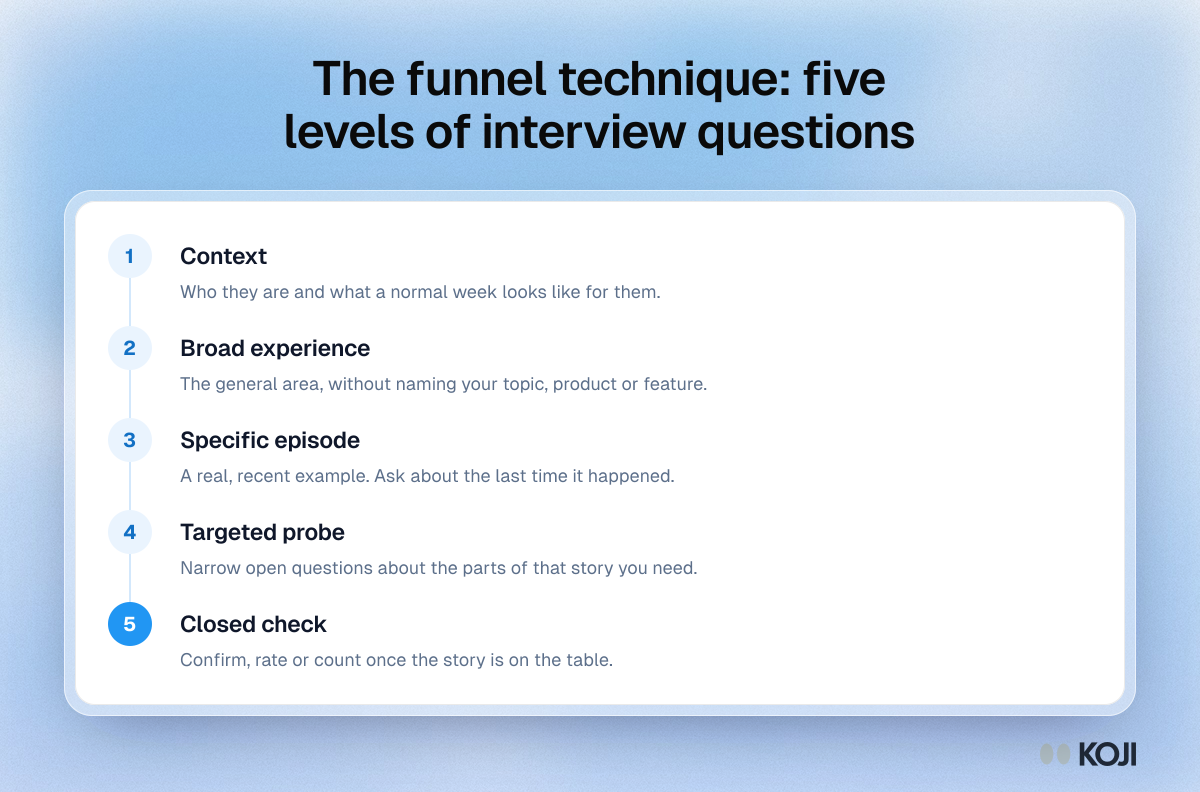
The levels are cumulative. Each one only works because the one before it gave you something to narrow into. If the participant never mentions support tickets at level 2 or 3, that silence is data. You can still ask about support at level 4, but now you know it was your topic, not theirs.
How to write a funnelled discussion guide
Start from your research question, not from your list of things to ask. Then work outward.
1. Write the narrowest questions first. List what you need to know at the end: the closed checks and specific probes. "How often do you export reports?" "Which tool do you use for that?" These are the bottom of the funnel.
2. Ask what a person would have to talk about for those answers to come up naturally. If you need to know about exports, the participant has to be talking about sharing results. If they are talking about sharing results, they have to be talking about what happens after a project ends. That is your broad question.
3. Remove your vocabulary from the top. The top of the funnel should not contain your product name, your feature names or your category terms. "How do you share findings with your team?" works. "How do you use dashboards to share findings?" has already told them the answer you expect.
4. Anchor the middle on episodes. Broad questions get broad answers. The middle of the funnel should move to a specific, recent, real event: "the last time", "the most recent", "walk me through what happened". Stories carry detail that opinions don't.
5. Save scales and yes/no questions for the end of each topic. A rating is easiest to interpret once you have heard the story behind it. A 6 out of 10 means little on its own. A 6 out of 10 from someone who just told you about losing a day to a broken export means a lot.
6. Repeat the funnel for each topic. A 45-minute interview usually has three to five topic funnels inside one big funnel. Close each one before opening the next, and open each one broad again.
Funnel vs inverted funnel
Sometimes you want the reverse: start narrow and widen out. That is the inverted funnel.
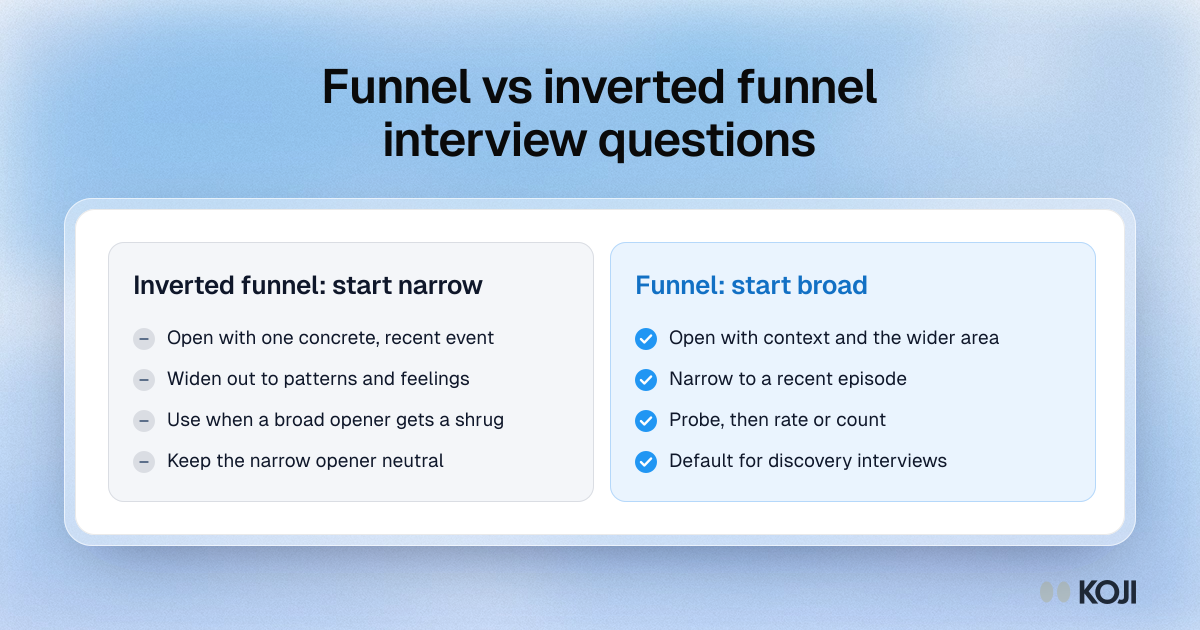
Use the standard funnel when:
- You want to know what matters to the participant before they know what matters to you.
- The participant is comfortable talking and has a lot to say about the area.
- You are doing discovery or generative work.
Use an inverted funnel when:
- The participant is not used to thinking about the topic and a broad opener would get a shrug. ("How do you feel about data privacy?" often gets nothing. "Have you ever deleted an app because of what it asked for?" gets a story.)
- You need a concrete memory to anchor everything else, such as a specific purchase, a cancellation or a support call.
- You are speaking to someone short on time who needs to see quickly why the conversation is relevant to them.
Even in an inverted funnel, keep the narrow opener neutral. Starting specific is fine. Starting leading is not.
Running a funnel in a live session
A guide is a plan, and participants don't read it. In practice the funnel bends.

Photo by LinkedIn Sales Solutions on Unsplash
Participants jump ahead. Someone answering your broad question may land straight on the specific problem you care about. Follow them. You don't need to drag them back up the funnel to stay on script; just note that they raised it unprompted, which is the strongest signal you can get.
Participants also stall at the top. If a broad question gets a short answer, don't jump to your closed questions. Go one level down instead: ask for an example. "Can you think of a time that happened recently?" is the most useful sentence in interviewing.
Watch your follow-ups too. The funnel applies inside probes, not only between planned questions. When a participant says "it's frustrating", the broad probe is "tell me more about that". The narrow, leading probe is "is it frustrating because it's slow?" Ask the broad one first. If they don't mention speed, you have learned something.
Finally, keep a quick note of which topics came up before you introduced them. When you analyse the interviews, that count is worth more than any rating: it tells you what is top of mind without your help.
Common mistakes
- Opening with your product. "What do you think of our onboarding?" puts you at the bottom of the funnel in the first minute.
- Asking for opinions at the top. "What do you want from a reporting tool?" invites people to design your product for you. Ask what they do, not what they want.
- Skipping the episode level. Going straight from "how do you share findings" to "how often do you export" misses the story that explains the number.
- Treating closed questions as the goal. The closed check confirms what the story told you. If you only needed the number, a survey would have been cheaper.
- Probing with your hypothesis. The funnel applies to follow-ups too. Every probe should be at least as broad as the participant's last answer.
How Koji helps
Koji runs AI-moderated interviews from a research brief, and the brief is where you build the funnel.
You set the order. Interview questions in the brief can be dragged into any order. Put your broad open-ended questions at the top and your scales and choice questions at the bottom of each topic. How strictly the AI interviewer keeps to that order depends on the interview mode: structured mode asks every question in order, exploratory mode lets the conversation follow the participant, and hybrid sits in between. For a funnel, hybrid usually fits best: the participant can jump ahead, and the structured checks still get asked.
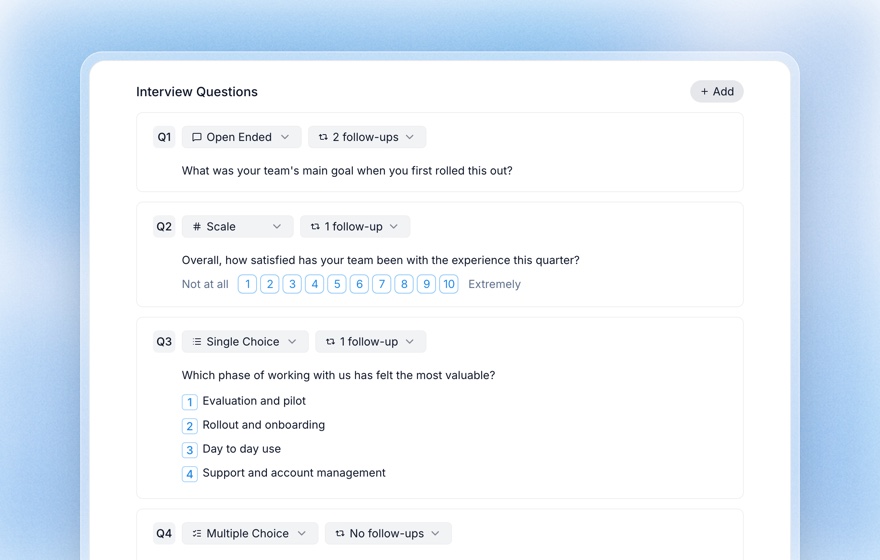
Each question has its own type. Koji supports six question types: open-ended, scale, single choice, multiple choice, ranking and yes/no. That maps neatly onto the levels: open-ended for context, experience and episodes, then structured types for the closed check. See the structured questions guide for how each type is asked in voice and text.
Follow-up depth is set per question. For each question you choose how many follow-ups the AI may ask, from none up to three, and you can add instructions for what to probe. A broad opener can get three follow-ups and an instruction to ask for a recent example. A closed check can get none, or one that asks "what would change that?" after a rating.
Analysis keeps the levels separate. In the report, open-ended questions get a thematic summary with participant quotes, while scales and choices get charts. Themes are counted by how many interviews mention them, so you can see which topics participants raised across the study, and each finding links to the supporting quotes.
Compared with running every funnel by hand, the difference is consistency. Human moderators drift over a long run of sessions, and the drift is usually toward their own hypotheses. The AI interviewer asks the same broad opener in the same neutral words in every interview, in voice or text, and applies the same follow-up rules each time. You still need to write a good funnel, but you don't have to hold it together across fifty conversations.
Related Resources
- Structured questions guide
- Question order bias
- Probing questions in user interviews
- Writing interview questions
- Open-ended vs closed-ended questions
- Discussion guide template
Sources
- Rosala, M. The Funnel Technique in Qualitative User Research. Nielsen Norman Group.
- Schwarz, N., Strack, F., & Mai, H. P. (1991). Assimilation and contrast effects in part-whole question sequences: A conversational logic analysis. Public Opinion Quarterly, 55, 3–23.
- Hyman, H. H., & Sheatsley, P. B. (1950), as summarised in the SAGE Encyclopedia of Survey Research Methods, entry "Question order effects".
- Loftus, E. F., & Palmer, J. C. (1974). Reconstruction of automobile destruction: An example of the interaction between language and memory. Journal of Verbal Learning and Verbal Behavior, 13(5), 585–589.
Related Articles
Discussion Guide Template: How to Structure Your Research Sessions
Learn how to create a research discussion guide that keeps interviews focused and uncovers deep insights. Includes templates, question structures, and how AI platforms like Koji replace static guides with adaptive conversation.
Open-Ended vs. Closed-Ended Questions: Examples and When to Use Each
Open-ended questions reveal the "why" in respondents' own words; closed-ended questions deliver clean, countable data. Learn the difference, see examples of both, and discover why the best research pairs them — and how AI captures both at once.
Probing Questions for User Interviews: 40+ Examples to Get Deeper Answers
A practical guide to probing questions in user interviews — the six types of probes, 40+ ready-to-use examples, common mistakes, and how Koji's AI interviewer probes every answer automatically and consistently.
Question Order Bias: How Survey & Interview Sequencing Skews Your Data (2026)
Why the sequence of your questions changes the answers — the classic Pew and Schwarz findings, the four main order effects, a practical sequencing checklist, and how AI moderation neutralizes the risk.
Structured Questions in AI Interviews
Mix quantitative data collection — scales, ratings, multiple choice, ranking — with AI-powered conversational follow-up in a single interview.
How to Write Great Interview Questions
Learn to craft open-ended, neutral interview questions that surface genuine user insights instead of confirmation bias.