Cultural Probes: How to Run a Probe Study and Follow It Up
Cultural probes are kits of open tasks, like postcards, a camera and a map, that people complete at home to inspire design. How to build a kit, run the study and follow it up.
A cultural probe study gives participants a kit of open-ended tasks, such as postcards with odd questions, a disposable camera with a shot list, a map to mark up and a small diary, to complete on their own over one to four weeks. What comes back is fragmentary and personal on purpose: it is meant to inspire design ideas and surface questions, not to measure anything. To run one well, design a small kit around one theme, send it with a friendly brief, keep in touch while people work on it, and then follow it up with an interview about what each participant made, because the conversation is where most of the meaning comes out.
This guide covers where probes come from, when they are the right method, how to build and run a kit, how to follow up and interpret what comes back, and the mistakes that turn probes into a slow, expensive survey.
What cultural probes are
Cultural probes were introduced by William Gaver, Tony Dunne and Elena Pacenti in "Design: Cultural Probes" (interactions, 6(1), 1999). The team was working on how to increase the presence of older people in three communities: Majorstua in Oslo, the Bijlmer near Amsterdam and Peccioli, a village outside Pisa. Rather than run interviews or questionnaires, they mailed people packages of maps, postcards, cameras and booklets, each with playful prompts, and let the returns build up over several weeks.
The point was not to collect data in the usual sense. Gaver and his colleagues wanted "fragmentary clues" about people's lives and thoughts that would provoke the designers, not answers that could be counted. Later work by Gaver and others, including "Cultural probes and the value of uncertainty" (interactions, 2004), argued strongly against treating the returns as findings to be analysed. A probe is a conversation starter between the designer and a person's everyday life.
Since then the method has been adapted widely. Many teams now talk about "design probes" (Tuuli Mattelmäki's work at Aalto is a common reference), which keep the self-documentation kit but use the returns more directly, often as the basis of a follow-up interview. Most product teams today run this adapted version, and it is the one this guide describes.
When to use a probe study
Probes suit early, open, generative questions where you do not yet know what to ask:
- You are entering an unfamiliar context. Homes, care settings, small family businesses, shift work. Places where you cannot easily observe, and where people struggle to describe their routines in the abstract.
- The subject is private or emotional. Money, health, loneliness, caring for a relative. People often share more with a camera and a notebook at home than with a stranger in a session.
- You want to inspire, not validate. Probes are a poor fit for testing a concept or a flow. They are a strong fit for widening a team's sense of what is possible.
They are the wrong tool when you need comparable answers across many people, a quick turnaround, or evidence for a specific decision. For behaviour over time with consistent prompts, a diary study is more structured. For seeing work as it happens, contextual inquiry is more direct.
| Cultural probes | Diary study | Contextual inquiry | |
|---|---|---|---|
| Main goal | Inspiration and new questions | Behaviour and experience over time | Understanding work in its setting |
| Prompts | Open, playful, varied | Consistent, repeated | Led by the researcher on site |
| Researcher present | No | No | Yes |
| Output | Fragments to interpret | Comparable entries | Observations and notes |
| Typical length | 1 to 4 weeks | 1 to 6 weeks | A few hours per visit |
Building the probe kit
A good kit is small, physical or digital, and easy to start. Each item should be a different way into the same theme, so people who dislike writing can photograph, and people who dislike photos can draw.
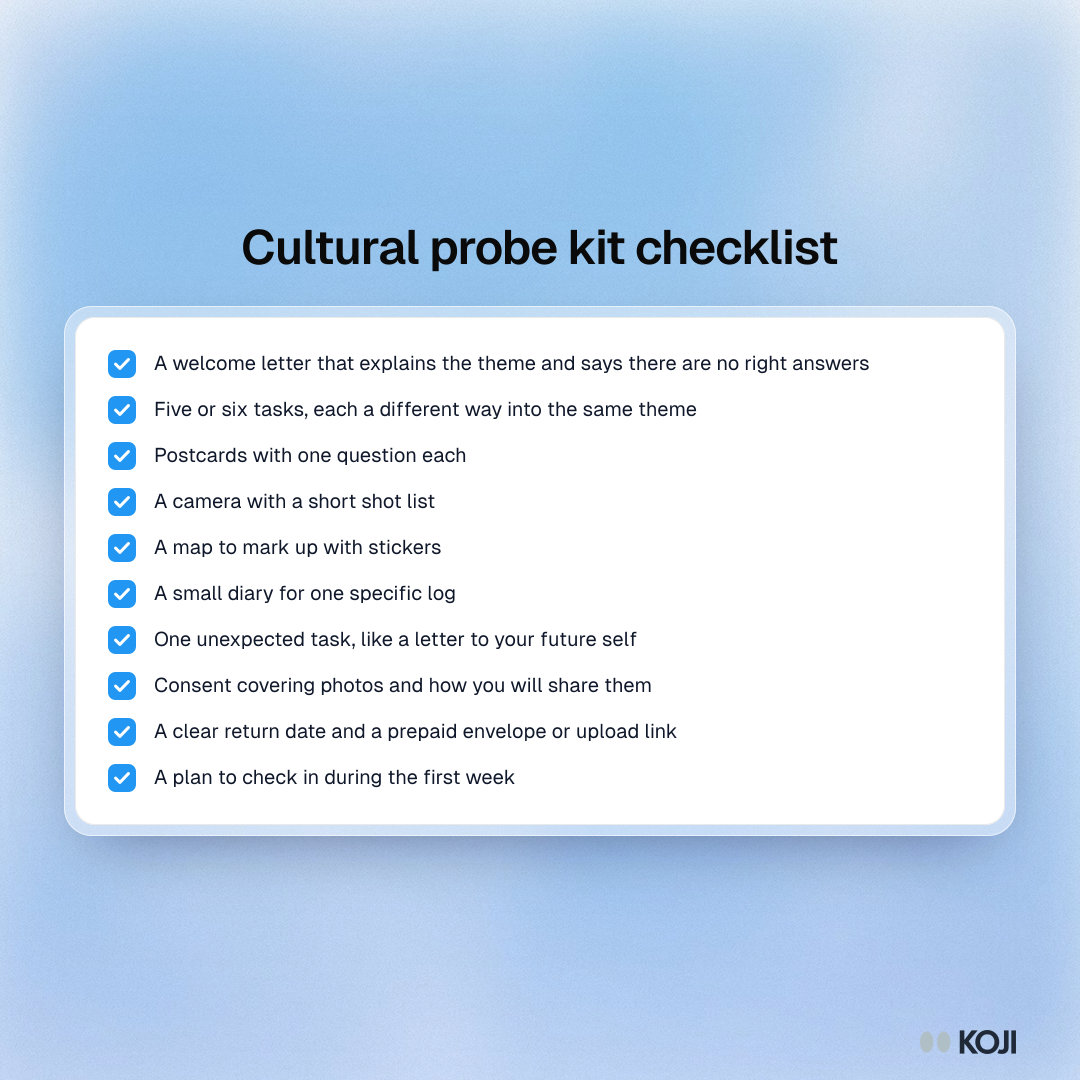
Common items, and what each one is good for:
- Postcards with one question each. "Tell us about a piece of advice you were given that you ignored." Short, low effort and easy to post back.
- A camera and a shot list. "Something you are proud of. The first thing you see in the morning. Something that annoys you every day." A phone works, but a disposable camera makes the task feel special and stops people over-curating.
- A map. A map of the home, the neighbourhood or a working day, with stickers to mark places where things go well or badly.
- A small diary or notebook. A few days of one specific log, such as every time you ask someone for help, rather than a general journal.
- Something unexpected. A collage sheet, a "letter to your future self", a list to finish. The odd items often bring back the most surprising material.
Keep the kit to five or six tasks. More than that and people skip the hard ones, which are usually the most useful.
Running the study
- Pick one theme. "How people manage money as a couple" is a theme. "Our banking app" is not.
- Recruit a small group. Eight to fifteen people is typical. You want depth and variety, not a sample.
- Brief people in person or on a call. Explain that there are no right answers, that unfinished tasks are fine, and how and when the kit comes back.
- Send the kit with a clear return date. One to four weeks is usual. Include prepaid envelopes or a simple upload link.
- Check in once or twice. A short message in the first week lifts completion more than any reminder at the end.
- Collect the returns and read them as a team before you speak to anyone.
- Follow up with each participant in a conversation about what they made.

Photo by Fujiphilm on Unsplash
Ethics and consent
Probes reach into private spaces, and photos often include other people, children and addresses. Get consent for how you will store and share the material, tell people they can skip anything, and agree in advance whether images may appear in internal decks. Blur faces of people who did not agree to take part.
Following up: where the meaning comes out
A photo of a kitchen drawer means very little until the person tells you why they took it. The follow-up conversation is where you turn fragments into understanding. Ask about the material, not about your product:
- "Talk me through this photo. Why this one?"
- "You marked this spot on the map in red. What happens there?"
- "You left this postcard blank. Was there a reason?"
- "Which task was easiest, and which did you not want to do?"
Keep the follow-up open and let the participant lead. Then probe further on the moments that carry emotion, contradiction or workarounds. The user interview guide covers follow-up techniques in more depth.
Running the follow-up interviews with Koji
Probe studies often stall at the follow-up stage, because scheduling a call with every participant takes weeks. Koji can run those follow-ups as AI-moderated interviews, by voice or text, that people take whenever suits them, in their own language.
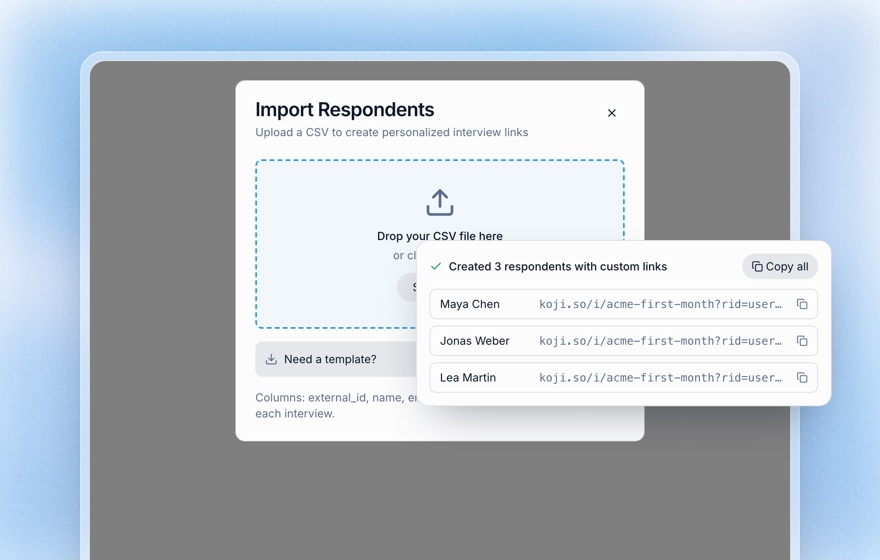
- Import your participants from a CSV and Koji creates a personalised interview link for each person, so every follow-up is tied to the right participant.
- Write the interview guide around the kit. Open-ended questions about each task work best, and the AI interviewer asks follow-up questions when an answer is short or vague.
- Add a few structured questions where comparison helps, such as a single choice question on which task felt most meaningful, or a scale question on how much effort the kit took. See the structured questions guide for the six question types.
- Read the report once interviews come in. Koji groups answers into themes with supporting quotes, which gives the team a first pass to argue with during interpretation.
Interpreting what comes back
Interpretation is a team activity, not a coding exercise. A practical approach:
- Lay everything out. Print the photos, postcards and quotes from follow-ups, or put them on a shared board.
- Look for what surprises you. Mark anything that contradicts what the team believed.
- Cluster loosely. Affinity mapping works well, as long as you resist forcing every fragment into a theme.
- Turn clusters into questions and design openings. "People keep paper backups of things they trust the app with. Why?" is more useful than "Theme 3: trust".
- Keep the raw material visible. A single photo often carries the insight better than a summary slide.
Common mistakes
- Treating returns as data to count. Twelve participants and a stack of postcards cannot tell you what percentage of users feel anything.
- Building a kit that is really a questionnaire. If every item is a direct question about your product, you have a slow survey.
- Skipping the follow-up. Without the conversation you are guessing at what people meant.
- Too many tasks. Long kits come back half empty.
- No check-in. Silence in week one is the main cause of kits that never return.
Related Resources
Related Articles
Affinity Mapping: Organize Qualitative Data Into Themes
Learn how to use affinity mapping to group qualitative research data into meaningful clusters and uncover actionable patterns.
Contextual Inquiry: The Complete Guide to Observational Research
Learn how to run contextual inquiry sessions to uncover the real workflows, workarounds, and behaviors your users can't articulate in interviews.
Diary Studies: The Complete Guide to Longitudinal User Research
Learn how to design, run, and analyze diary studies that capture real user experiences in context. Includes how AI interviews complement diary research at scale.
Ethnographic Research: Methods, Examples, and UX Applications
A complete guide to ethnographic research in UX and product design. Learn field study methods, how to bridge the say-do gap, remote ethnography techniques, and how AI accelerates ethnographic insight at scale.
Generative Research: How to Uncover User Needs You Didn't Know Existed
A complete guide to generative (exploratory) user research — what it is, when to use it, which methods work best, and how AI-powered platforms like Koji make it faster and more scalable than ever.
Structured Questions in AI Interviews
Mix quantitative data collection — scales, ratings, multiple choice, ranking — with AI-powered conversational follow-up in a single interview.