Sponsorship Bias: When Knowing Who Is Asking Changes the Answers
What sponsorship bias is, how it changes both who responds and what they say, the evidence behind it, when to run a blind or branded study and an eight-point checklist to limit it.
Sponsorship bias is the shift in research results caused by participants knowing, or guessing, who is behind the study. When customers know your company is asking about your product, many soften criticism, praise features they barely use and tell you what they think you want to hear. Others do the opposite and use the interview to vent. Either way, the answers say as much about their relationship with you as about the product.
It affects two things: who agrees to take part, and what they say once they do. You can't always hide who's asking, and sometimes you shouldn't. But you can choose deliberately between a branded and a blind study, and design the questions so the sponsor matters less. This guide covers what sponsorship bias is, the evidence, when to reveal the sponsor and a checklist for limiting the effect.
What sponsorship bias is
Every research invitation carries a signal about who wants to know. A survey from your bank, an interview request from a university, a feedback form from a startup founder and a call from an anonymous market research firm all prompt different reactions before the first question is asked.
Sponsorship bias is the part of that reaction that ends up in your data. It is related to several other biases but not the same:
- Social desirability bias is the general pull towards answers that make the participant look good.
- Courtesy bias is the pull towards polite answers that avoid offending the person asking.
- Demand characteristics are cues in a study that tell participants what the researcher hopes to find.
Sponsorship bias is what happens when the sponsor's identity is the cue. Once a participant knows the product team is listening, courtesy and demand characteristics both get stronger.
Two ways the sponsor changes your data
It changes who answers. People respond to some senders more than others. Your loyal customers are more likely to open an email with your logo on it. People who left on bad terms may delete it unread. A study branded with your name can end up over-representing fans, which overlaps with self-selection bias.
It changes what they say. Once someone knows who's asking, their answers take your feelings into account. Rob Fitzpatrick built The Mom Test around this problem. "You shouldn't ask anyone if your business is a good idea," he writes. "It's a bad question and everyone will lie to you at least a little." People who like you will protect your feelings. People who want something from you, like a discount or a feature, will tell you what helps them get it.
The evidence: sponsors shape responses
Who sends the questionnaire affects whether it comes back. Phil Edwards and colleagues published a systematic review in the BMJ in 2002 that pooled 292 randomised controlled trials, with 258,315 participants, testing ways to raise response to postal questionnaires. Questionnaires that came from a university were more likely to be returned than those from other organisations, with an odds ratio of 1.31. For comparison, the same review found monetary incentives roughly doubled the odds of a response, an odds ratio of 2.02. The sender is not as strong a lever as paying people, but it is a real one.
Small signals about the sender matter too. The 2009 Cochrane update of that review, covering electronic questionnaires as well, found the odds of a response were lower when the word "Survey" appeared in the email subject line (odds ratio 0.81) and when the email had a male signature (0.55). Participants judge who's asking from very little.
Sponsorship shapes results even among researchers. A 2017 Cochrane review by Andreas Lundh and colleagues, drawing on 75 papers, concluded that drug and device studies sponsored by industry more often reported results favourable to the sponsor's products than studies with other sponsors, through biases that standard risk-of-bias tools did not explain. That review is about how studies are designed and reported, not about participants. But it's a useful reminder that the sponsor's interest can leak into a study from both sides of the table.
Blind or branded: which should you run?
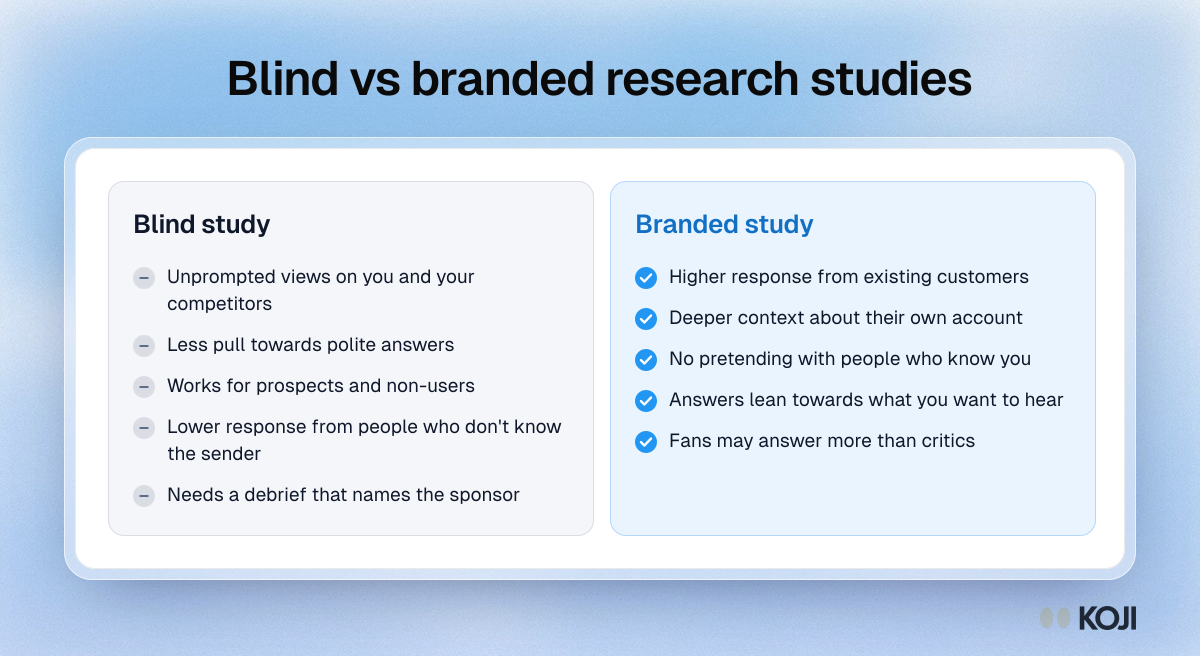
A blind study hides the sponsor, at least until the end. A branded study tells participants up front. Neither is always right.
Run it blind when:
- You're comparing your product with competitors and want unprompted views.
- You're testing brand perception, positioning or messaging, where knowing the sponsor changes the very thing you measure.
- You're interviewing people who don't know you yet, such as prospects or non-users. See non-user research.
Run it branded when:
- You're talking to existing customers about their own account, history or experience. They'll recognise the product anyway, and pretending otherwise damages trust.
- You need context only a known relationship gives, such as details of their setup or a recent support case.
- Your response rate depends on recognition. A personal invitation from a company people use is far more likely to be answered than one from a stranger.
Blind is not the same as deceptive. Hiding the sponsor's name during the questions is a common and accepted practice. Lying about who will use the data is not. Privacy law in many places, including the GDPR, requires you to tell people who is responsible for their data, so plan the disclosure with your privacy team. A short debrief at the end that names the sponsor is good practice. See deception, cover stories and debriefing.
How to limit sponsorship bias
Whether you run blind or branded, these habits reduce how much the sponsor shapes the answers.
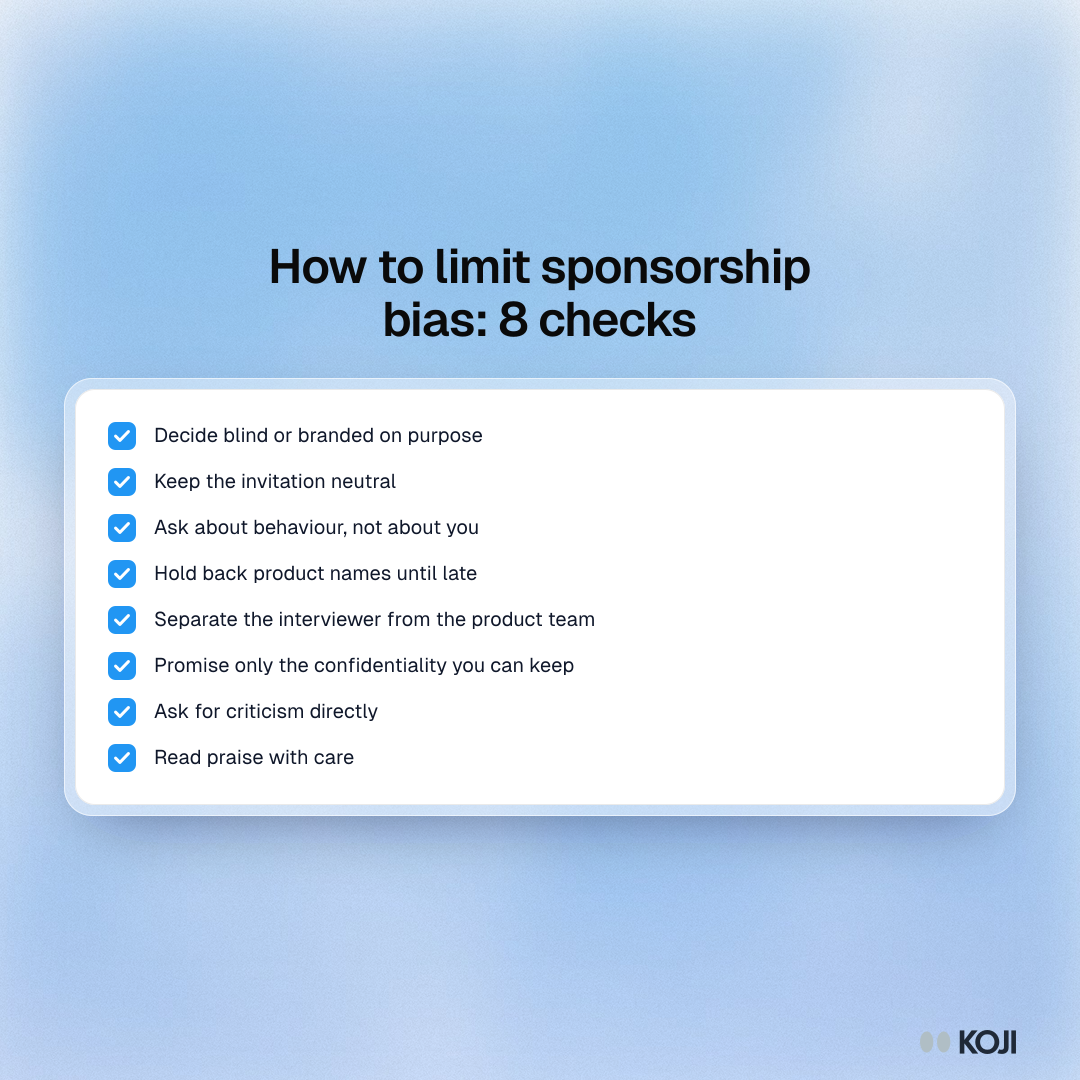
- Decide blind or branded on purpose. Write down which you chose and why, so it's in the report.
- Keep the invitation neutral. Describe the topic, the time it takes and what happens to the answers. Don't hint at the answer you want.
- Ask about behaviour, not about you. "Tell me about the last time you exported a report" beats "How do you like our export feature?"
- Hold back product names until late. Use the funnel technique: start broad and only mention your product once the participant has described their world in their own terms.
- Separate the interviewer from the product team. A participant will be more candid with a neutral researcher than with the person who built the feature.
- Promise only the confidentiality you can keep. Honest reassurance about who sees the answers makes criticism easier to give.
- Ask for criticism directly. "If you could change one thing, what would it be?" gives people permission to be critical.
- Read praise with care. Treat compliments as low-value data unless they come with a specific example of what happened.
Who should ask the questions
The person or voice asking the questions is part of the sponsorship signal. A founder interviewing customers hears more praise than a researcher from outside the team would. An account manager asking about renewal hears whatever protects the relationship.

Photo by Vitaly Gariev on Unsplash
Where you can, have someone without a stake in the answer run the session, and introduce them as there to learn rather than to defend. If the founder or product manager has to do it, say so honestly and work harder on the question design: open questions, specific past events and explicit invitations to criticise. Courtesy bias and the Mom Test both cover techniques that help.
How Koji helps
Koji runs AI-moderated interviews by voice or text. It doesn't remove the sponsor from the picture, but it gives you control over the sponsorship signal and puts a neutral interviewer between participants and your team.
- You decide what the welcome page says. The headline, subheadline and description are yours to write, so the page can name your company or simply describe the topic. A workspace logo only appears if you apply a brand theme.
- Honest trust signals. You can show or hide the anonymous badge, change its wording and add your own badges and consent text. When someone arrives through a personal invite link, the anonymous badge is hidden automatically, because their answers are tied to who they are.
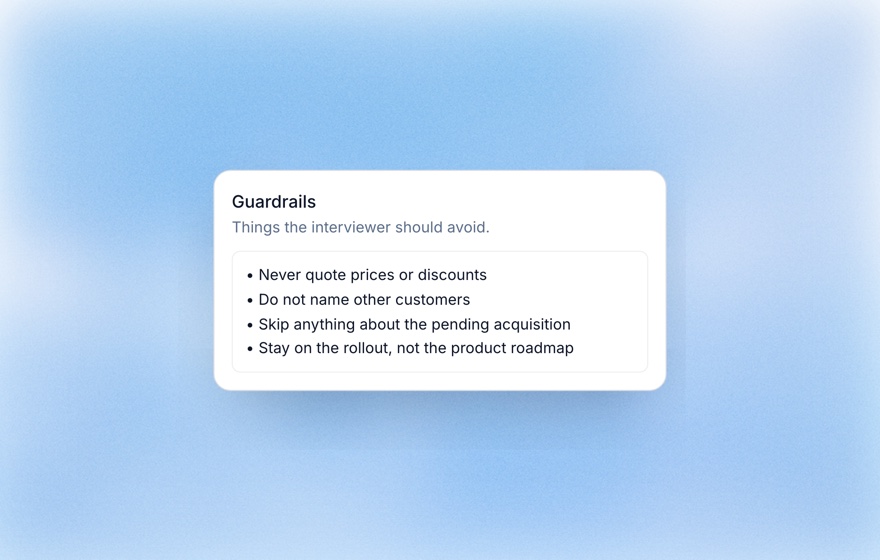
- Tell the interviewer what not to say. Guardrails list topics the AI interviewer must avoid, such as naming your company or product until the end, or quoting prices.
- A neutral voice asking. The AI interviewer has no feelings for participants to protect, and AI follow-ups, from none up to three per question, ask for specific examples instead of accepting a polite "it's great".
- Check before launch. The Preview tab lets you take your own interview by voice or text, exactly as a participant would, so you can hear where the brand comes through too early.
Related Resources
- Courtesy bias
- Social desirability bias
- Demand characteristics
- Deception, cover stories and debriefing
- The Mom Test methodology
- Structured questions guide
Sources
- Edwards, P., Roberts, I., Clarke, M., DiGuiseppi, C., Pratap, S., Wentz, R., & Kwan, I. (2002). Increasing response rates to postal questionnaires: Systematic review. BMJ, 324, 1183.
- Edwards, P. J., Roberts, I., Clarke, M. J., et al. (2009). Methods to increase response to postal and electronic questionnaires. Cochrane Database of Systematic Reviews, MR000008.
- Fitzpatrick, R. (2013). The Mom Test: How to talk to customers and learn if your business is a good idea when everyone is lying to you.
- Lundh, A., Lexchin, J., Mintzes, B., Schroll, J. B., & Bero, L. (2017). Industry sponsorship and research outcome. Cochrane Database of Systematic Reviews, MR000033.
Related Articles
Courtesy Bias: Why Respondents Tell You What You Want to Hear
Courtesy bias is when respondents give overly positive, agreeable answers to avoid offending the interviewer or sponsor. Learn where it shows up, the evidence, and how neutral moderation, anonymity, and behavior-based questions fix it.
Demand Characteristics: When Participants Tell You What They Think You Want
Demand characteristics are the cues in a study that let participants guess your hypothesis and change their behavior to fit it. Learn where they come from, how they differ from social desirability and the Hawthorne effect, and how to design research that captures honest behavior.
The Mom Test: How to Talk to Customers Without Being Misled
Learn Rob Fitzpatrick's Mom Test methodology to ask questions that even your mother can't lie to you about.
Social Desirability Bias: What It Is and How to Eliminate It in Research
Social desirability bias makes people tell you what sounds good instead of what is true. Learn what causes it, why it quietly wrecks product decisions, and the seven evidence-based ways to reduce it — including why AI-moderated interviews get more honest answers.
Structured Questions in AI Interviews
Mix quantitative data collection — scales, ratings, multiple choice, ranking — with AI-powered conversational follow-up in a single interview.
5-Point vs 7-Point Likert Scale: How Many Scale Points Should You Use? (2026)
A decision guide for rating-scale length — what the reliability research actually says about 5 vs 7 points, the odd-vs-even and neutral-midpoint debates, when each fits, and how AI follow-ups make any scale richer.