Grand Tour Questions: How to Open an Interview With the Big Picture
Grand tour questions ask participants to walk you through a whole experience in their own words. Spradley's four types, mini tour follow-ups, examples for product research and mistakes to avoid.
A grand tour question asks a participant to walk you through a whole experience in their own words: "Walk me through a typical Monday", "Tell me everything that happened from the moment you decided to switch providers", "Show me how you put the weekly report together." The term comes from the anthropologist James Spradley, who used it in The Ethnographic Interview (1979) for the broad, descriptive question that opens an interview and maps the territory. You follow it with mini tour questions that zoom in on one part of what you heard. Together they get you the participant's version of events, in their order and their vocabulary, before your own questions have shaped anything.
This guide covers what grand tour questions are, Spradley's four types, why they work, how to follow up with mini tours, examples for product and UX research, mistakes to avoid and how Koji runs the same structure in AI-moderated interviews.
What a grand tour question is
Spradley described three main kinds of question in ethnographic interviews. Descriptive questions ask people to describe their world. Structural and contrast questions come later and ask how things are organised and how they differ. Grand tour questions are the widest descriptive question: they ask for an overview of a space, a stretch of time, a process, a sequence of events, a group of people or a set of activities.
A grand tour question has three traits:
- It is broad. It covers a whole day, a whole process or a whole event, not one step of it.
- It asks for description, not opinion. "Walk me through" and "tell me about", not "what do you think of".
- It lets the participant choose the route. You learn what they consider the important landmarks, and what they skip.
Spradley paired it with mini tour questions, which work the same way on a much smaller part of the experience. If the grand tour was "Walk me through how you close the books each month", a mini tour might be "You mentioned chasing receipts. Walk me through how that part goes."
The four types of grand tour question
Spradley distinguished four kinds. Each suits a different research goal.
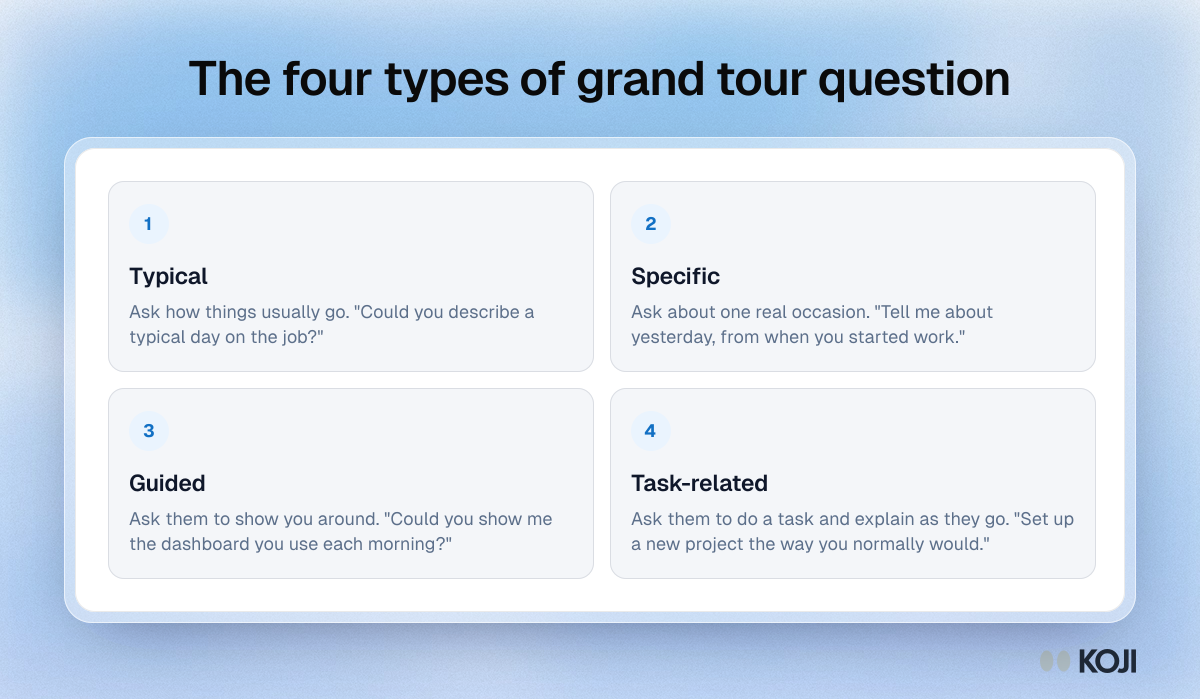
- Typical. Ask the participant to generalise about how things usually go. "Could you describe a typical day on the job?" Good for a first map of routines and roles.
- Specific. Ask about one particular occasion. "Tell me about yesterday, from when you started work." Good for real detail, because people remember a real day better than an average one.
- Guided. Ask the participant to show you around. "Could you show me the dashboard you use each morning and talk me through it?" Good for contextual inquiry, field visits and screen shares.
- Task-related. Ask the participant to do something and explain as they go. "Could you set up a new project the way you normally would, and tell me what you're doing?" Good for usability work and process mapping. It sits close to the think-aloud protocol.
In product research, a useful habit is to start with a typical tour to get the shape of things, then switch to a specific tour ("Now tell me about the last time that happened") for the detail. A typical answer tells you what people believe they do. A specific one is closer to what they actually did.
Why grand tour questions work
They let memory work the way it wants to. Asking someone to narrate an event from the start, in order and in their own words, is close to what forensic psychologists do in the cognitive interview, a technique designed to help witnesses remember more. Two of its core instructions are to mentally reinstate the context of the event and to report everything, however minor it seems. In an early lab test by Ronald Geiselman, Ronald Fisher and colleagues (1985), participants interviewed this way recalled about 41 correct facts on average, against 29.4 with a standard police interview.
The effect holds up across many studies. A meta-analysis by Günter Köhnken and colleagues (1999) pooled 42 studies with 55 comparisons and nearly 2,500 interviewees. The cognitive interview produced a large increase in correctly recalled details (d = 0.87) and a much smaller increase in incorrect ones (d = 0.28), so accuracy stayed nearly the same: 85% for the cognitive interview against 82% for standard interviews. A later review by Amina Memon, Christian Meissner and Joanne Fraser (2010), covering 46 published articles, found the same pattern. A grand tour isn't a forensic interview, but it borrows the same idea: give people a familiar structure to walk through, and they remember more of it.
They reduce your influence. Every narrow question you ask early carries your assumptions about what matters. A grand tour lets the participant raise the topics first. If they talk through a whole week of work and never mention your feature, that is a finding.
They give you the participant's vocabulary. People describe their world in their own terms during a tour: "the Monday scramble", "the approval chain", "the export dance". Those phrases make better follow-up questions, survey options and theme labels than your internal names.
They give you landmarks for the rest of the interview. Each step the participant mentions is a place you can come back to with a mini tour. Steve Portigal, author of Interviewing Users, lists sequence questions such as "Walk me through a typical day…" and "…Then what do you do next?" among the basic question types an interviewer needs.
From grand tour to mini tour: a step-by-step process
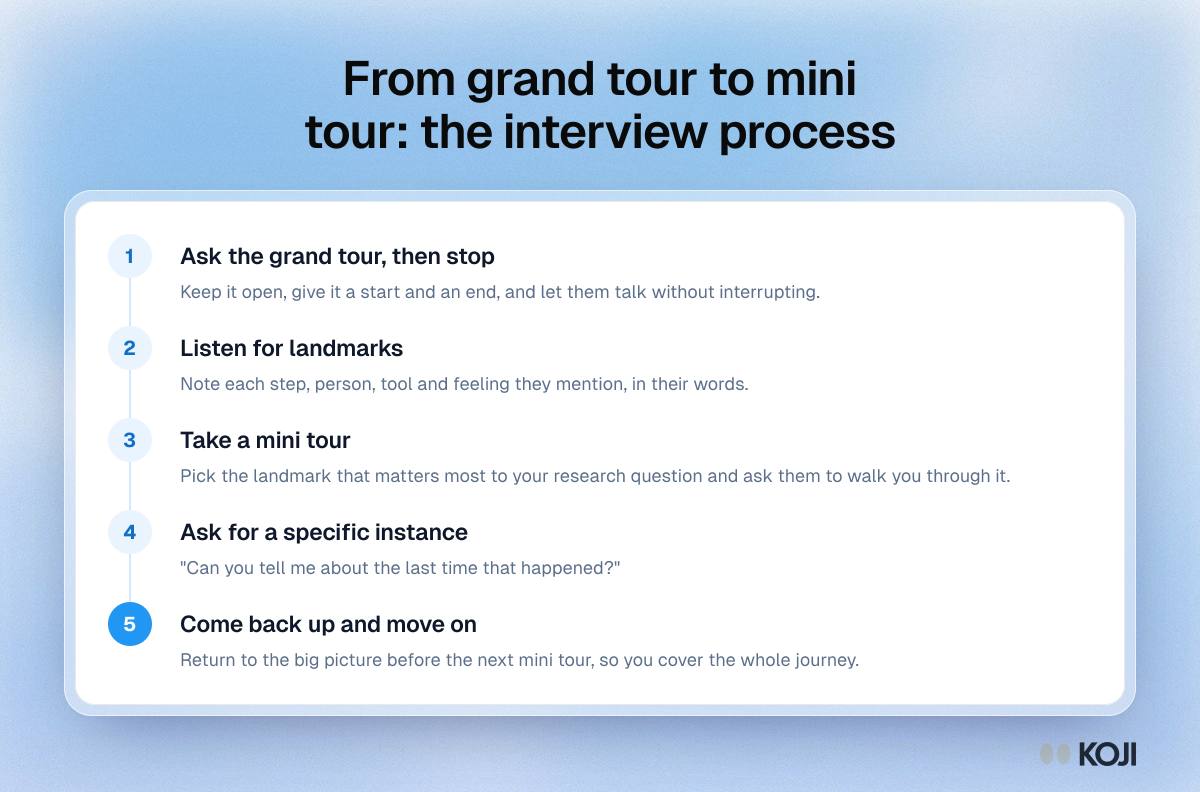
- Ask the grand tour question, then stop. Keep it open and give it a clear start and end: "Walk me through what happened from the moment you first heard about the new expense policy until your first claim was paid." Then let them talk. Don't interrupt to ask about details yet. See using silence in interviews.
- Listen for landmarks and note them. Write down each step, person, tool and feeling they mention, in their words. These are your follow-up list. Mark anything they rushed past, sighed about or said "that's a whole story".
- Pick one landmark and take a mini tour. "You said the approval chain takes a while. Walk me through how that part works." Choose the landmark that matters most to your research question, not the one that's easiest to ask about.
- Ask for a specific instance. "Can you tell me about the last time that happened?" A mini tour on a real occasion turns a general description into a story with details you can use.
- Come back up and move on. "Thanks, that's really clear. Going back to the bigger picture, what happened after the claim was approved?" Return to the overview before taking the next mini tour, so you cover the whole journey and not just the first step.
Examples for product and UX research
| Research goal | Grand tour question | A mini tour to follow it |
|---|---|---|
| Understand a role | "Walk me through a typical week in your job." | "You mentioned the Thursday planning call. Talk me through how that goes." |
| Onboarding | "Tell me everything that happened from signing up to the first time it felt useful." | "You said setup took a while. Walk me through that part." |
| Switching and churn | "Take me back to when you started looking for something else. What happened, from the start?" | "You mentioned a demo with the other vendor. How did that go?" |
| A workflow | "Could you show me how you put the monthly report together, start to finish?" | "When you copy the numbers across, what exactly are you doing?" |
| Buying decisions | "Walk me through how your team chose the tool you use now." | "Who else had a say, and when did they come in?" |
Notice that the grand tour never mentions your product or a specific feature. If the participant brings it up, you can mini tour it. If they don't, you've learned where it sits in their world.
Running a grand tour in a live interview
- Set the frame. "I'd like to understand how this works for you from start to finish, so I'll mostly listen." People give longer answers when they know a long answer is wanted.
- Give it boundaries. "A typical day" works. "Your experience with software" is too vague to walk through. Name a start and an end point.
- Use their words in your follow-ups. If they call it "the approval chain", so do you.
- Resist the urge to fix things. If they describe a workaround, don't explain the feature that would solve it. Ask how the workaround came about.
- Watch the time. A good grand tour answer can run for several minutes. Plan your guide so that's welcome, not a problem. See how long user interviews should be.

Photo by Vitaly Gariev on Unsplash
Common mistakes
- Asking a grand tour and then a list of closed questions. The tour gives you landmarks. If you ignore them and go back to your script, you lose the main benefit.
- Stacking several questions into one. "Walk me through your day, and what tools do you use, and what's frustrating?" splits their attention. Ask one tour at a time.
- Starting too narrow. "Tell me about the export button" is a mini tour. Without the big picture first, you can't tell whether the export matters.
- Accepting only the typical version. "Usually I just..." is useful, but follow it with "Tell me about the last time" to get what actually happened.
- Interrupting the tour to probe. Note the landmark and come back to it. Breaking in early teaches the participant to give short answers.
How Koji helps
Koji runs AI-moderated interviews by voice, text and phone, in 28 languages, and you can build the grand tour and mini tour structure straight into the study.
Set how the interview opens. The research brief has an Opening Approach field where you describe, in plain instructions, how the interviewer should start. Write "Open by asking them to walk through a typical week in their role" and the interviewer turns it into a natural first question.
Make the grand tour your first question, with room to roam. Add it as an open-ended question and set its follow-ups. For every question you can let the interviewer ask from none up to three follow-ups and tell it what to probe for, for example: "Pick the step they spent longest on and ask them to walk through the last time it happened." That's a mini tour, asked consistently in every interview.
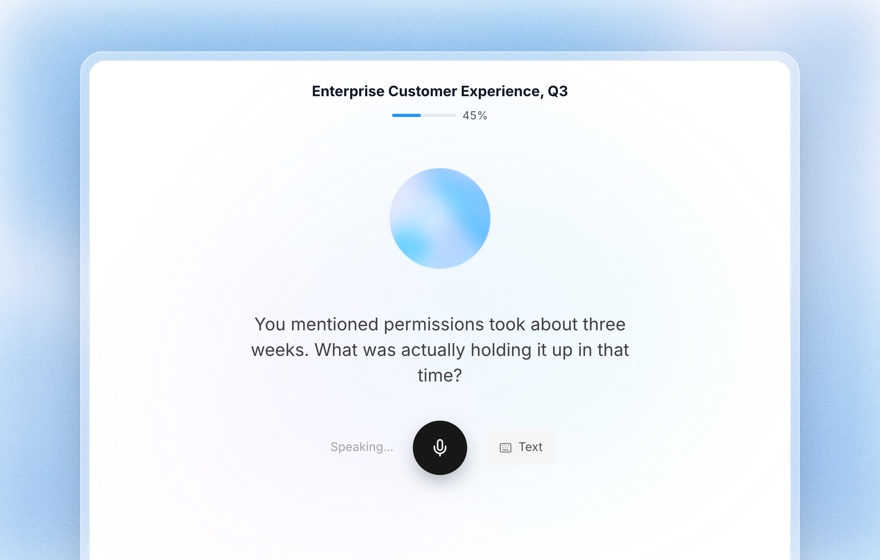
It asks for real examples. Koji's interviewer is set up to ask about past behaviour rather than hypotheticals and to look for specific examples and stories when it is allowed to probe, which is the same move as switching from a typical tour to a specific one.
Add topics without leading. The brief's Topics to Explore field lists areas you want covered. The interviewer works them in naturally, so you don't have to name your feature in the opening question.
See the vocabulary in the analysis. When Koji analyses an open-ended answer, it codes themes either with descriptive labels or in the participant's own framing, each tied to a supporting quote. The report then links every finding to the participants and quotes behind it, so the language from the grand tours carries through to what you share.
A survey can't run a grand tour: a long free-text box usually gets short answers, and nobody follows up on the interesting step. A human interviewer can run a brilliant one but not 50 in a week. With an AI interviewer, every participant gets the same open start and the same follow-up rules, and you still read every story in full.
Related Resources
- Semi-structured interview guide
- Ethnographic research
- Contextual inquiry
- Funnel technique for interview questions
- Day in the life research
- Structured questions guide
Sources
- Geiselman, R. E., Fisher, R. P., MacKinnon, D. P., & Holland, H. L. (1985). Eyewitness memory enhancement in the police interview: Cognitive retrieval mnemonics versus hypnosis. Journal of Applied Psychology, 70(2), 401-412.
- Köhnken, G., Milne, R., Memon, A., & Bull, R. (1999). The cognitive interview: A meta-analysis. Psychology, Crime & Law, 5(1-2), 3-27.
- Memon, A., Meissner, C. A., & Fraser, J. (2010). The cognitive interview: A meta-analytic review and study space analysis of the past 25 years. Psychology, Public Policy, and Law, 16(4), 340-372.
- Portigal, S. (2010). Deep-dive interviewing secrets (UIE seminar slides). See also Portigal, S. Interviewing Users. Rosenfeld Media.
- Spradley, J. P. (1979). The Ethnographic Interview. Holt, Rinehart and Winston.
Related Articles
Contextual Inquiry: The Complete Guide to Observational Research
Learn how to run contextual inquiry sessions to uncover the real workflows, workarounds, and behaviors your users can't articulate in interviews.
Day-in-the-Life Research: How to Shadow Customers and Map Their Real Workflows
A complete guide to day-in-the-life (DITL) research — how to shadow customers through their real routines to uncover context, workarounds, and unmet needs, and how to run it at scale with async AI-moderated interviews.
Ethnographic Research: Methods, Examples, and UX Applications
A complete guide to ethnographic research in UX and product design. Learn field study methods, how to bridge the say-do gap, remote ethnography techniques, and how AI accelerates ethnographic insight at scale.
The Funnel Technique: How to Order Interview Questions from Broad to Specific
The funnel technique orders interview questions from broad to narrow so participants raise topics before you do. The five levels, how to write a funnelled guide, when to invert it, and how to run it in AI interviews.
Semi-Structured Interviews: The Complete Guide
Learn how to design, run, and analyze semi-structured interviews — the gold standard for qualitative research that balances structure with flexibility.
Structured Questions in AI Interviews
Mix quantitative data collection — scales, ratings, multiple choice, ranking — with AI-powered conversational follow-up in a single interview.