Checklist
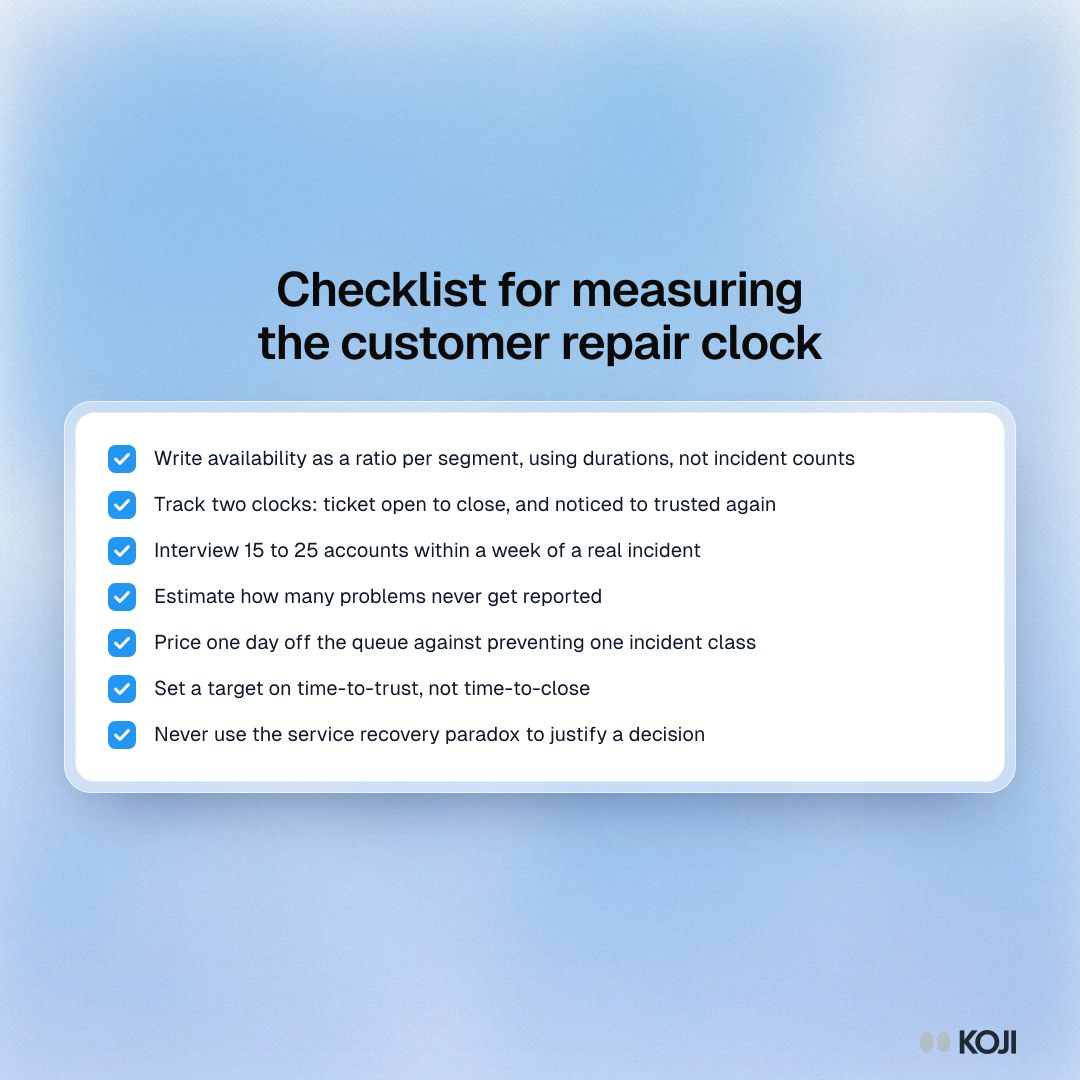
Checklist for measuring the customer repair clock
Seven steps for measuring time to repair the way customers live it, not the way a ticket system logs it. Track availability as a ratio of durations, run a system clock and a customer clock side by side, interview 15 to 25 accounts after real incidents, estimate the problems nobody reports and set a target on time-to-trust. Use it to plan research on reliability and support. Koji runs the post-incident interviews by voice or text.
Where this appears
What's in this checklist
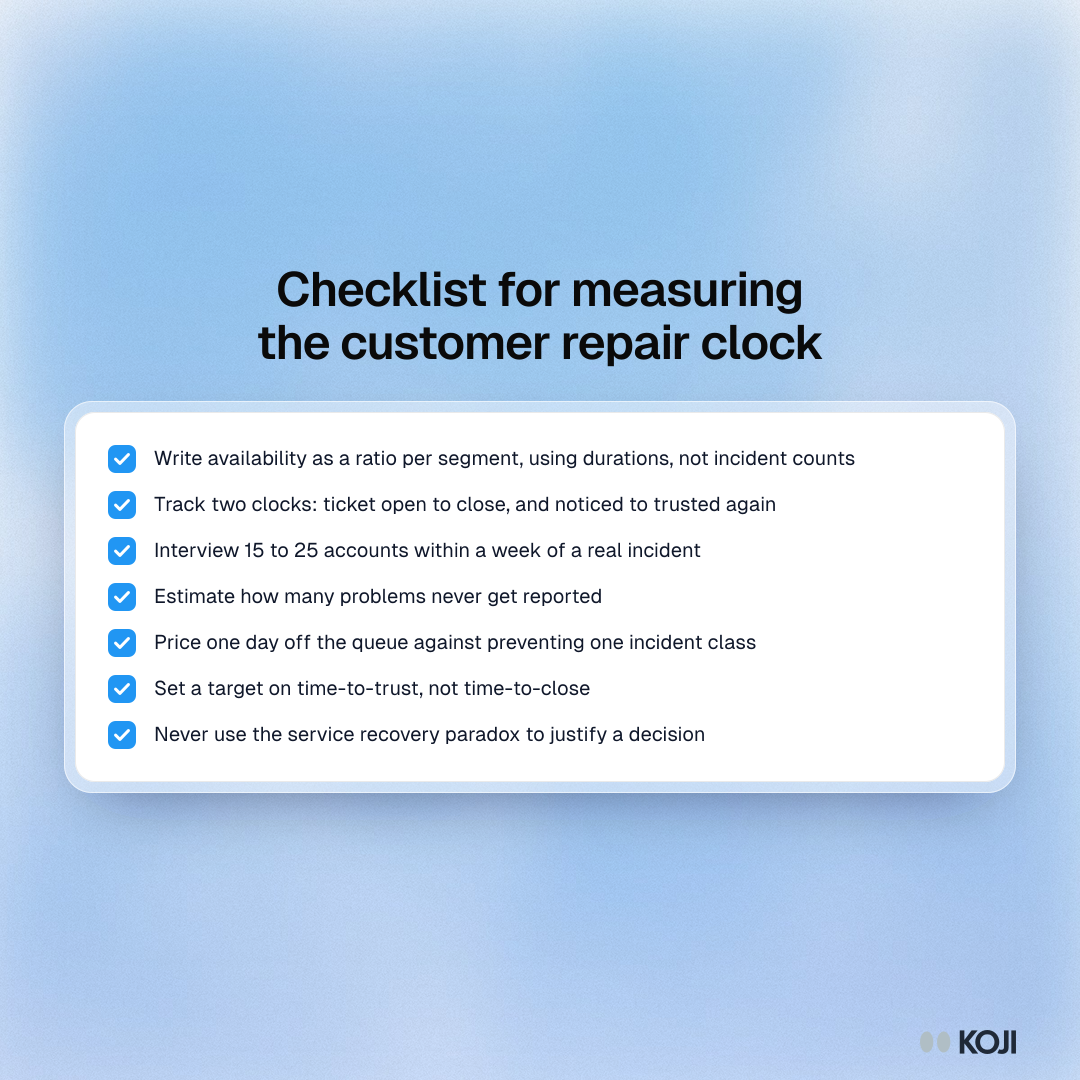
- Write availability as a ratio per segment, using durations, not incident counts
- Track two clocks: ticket open to close, and noticed to trusted again
- Interview 15 to 25 accounts within a week of a real incident
- Estimate how many problems never get reported
- Price one day off the queue against preventing one incident class
- Set a target on time-to-trust, not time-to-close
- Never use the service recovery paradox to justify a decision
Use this image
Free to use in your docs, decks and posts under CC BY 4.0, as long as you credit Koji with a link to this page. To embed it, paste this into your page:
html
<a href="https://www.koji.so/visuals/customer-time-to-repair-research-checklist"><img src="https://www.koji.so/visuals/customer-time-to-repair-research-checklist/customer-time-to-repair-research-checklist.png" alt="Checklist of seven steps for measuring customer time to repair, from tracking two clocks to setting a target on time-to-trust instead of time-to-close." width="1080" height="1080" /></a>
<p>Source: <a href="https://www.koji.so/visuals/customer-time-to-repair-research-checklist">Checklist for measuring the customer repair clock</a>, Koji</p>