Reference table
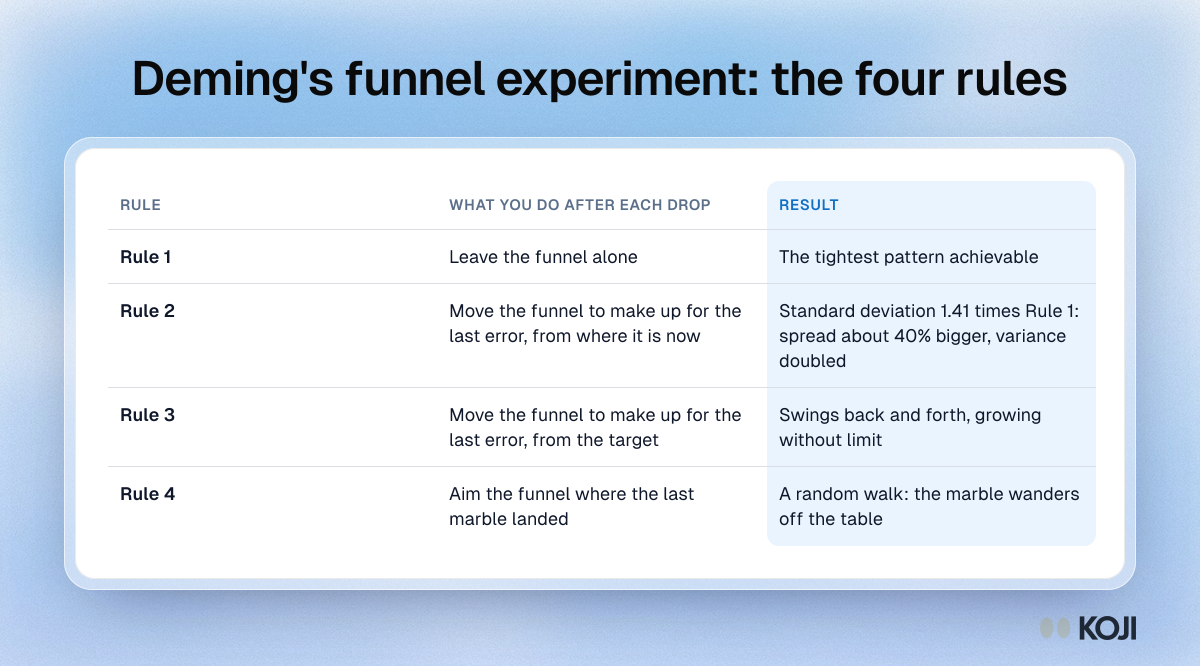
Deming's funnel experiment: the four rules
Why adjusting a stable process after every result makes it worse
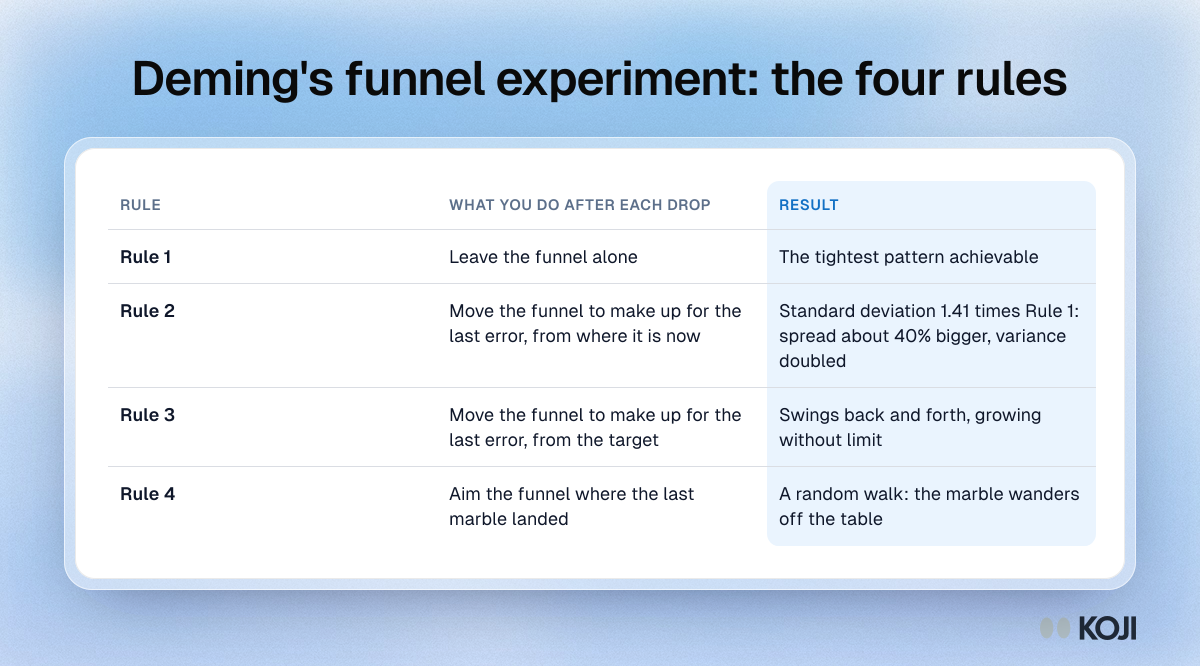
A table of W. Edwards Deming's funnel experiment, which shows what happens when you adjust a stable process after each result. Leaving the funnel alone gives the tightest pattern. Correcting for the last error raises the standard deviation 1.41 times, and the other two rules swing out of control or wander off. Research teams can use it to explain tampering: rewriting questions or resetting targets after one reading of a metric.
Where this appears
What's in this reference table
| Rule | What you do after each drop | Result |
|---|---|---|
| Rule 1 | Leave the funnel alone | The tightest pattern achievable |
| Rule 2 | Move the funnel to make up for the last error, from where it is now | Standard deviation 1.41 times Rule 1: spread about 40% bigger, variance doubled |
| Rule 3 | Move the funnel to make up for the last error, from the target | Swings back and forth, growing without limit |
| Rule 4 | Aim the funnel where the last marble landed | A random walk: the marble wanders off the table |
Use this image
Free to use in your docs, decks and posts under CC BY 4.0, as long as you credit Koji with a link to this page. To embed it, paste this into your page:
html
<a href="https://www.koji.so/visuals/deming-funnel-experiment-four-rules"><img src="https://www.koji.so/visuals/deming-funnel-experiment-four-rules/deming-funnel-experiment-four-rules.png" alt="Table of the four rules in Deming's funnel experiment, from leaving the funnel alone to aiming at the last landing spot, and the result of each." width="1200" height="666" /></a>
<p>Source: <a href="https://www.koji.so/visuals/deming-funnel-experiment-four-rules">Deming's funnel experiment: the four rules</a>, Koji</p>