Matrix
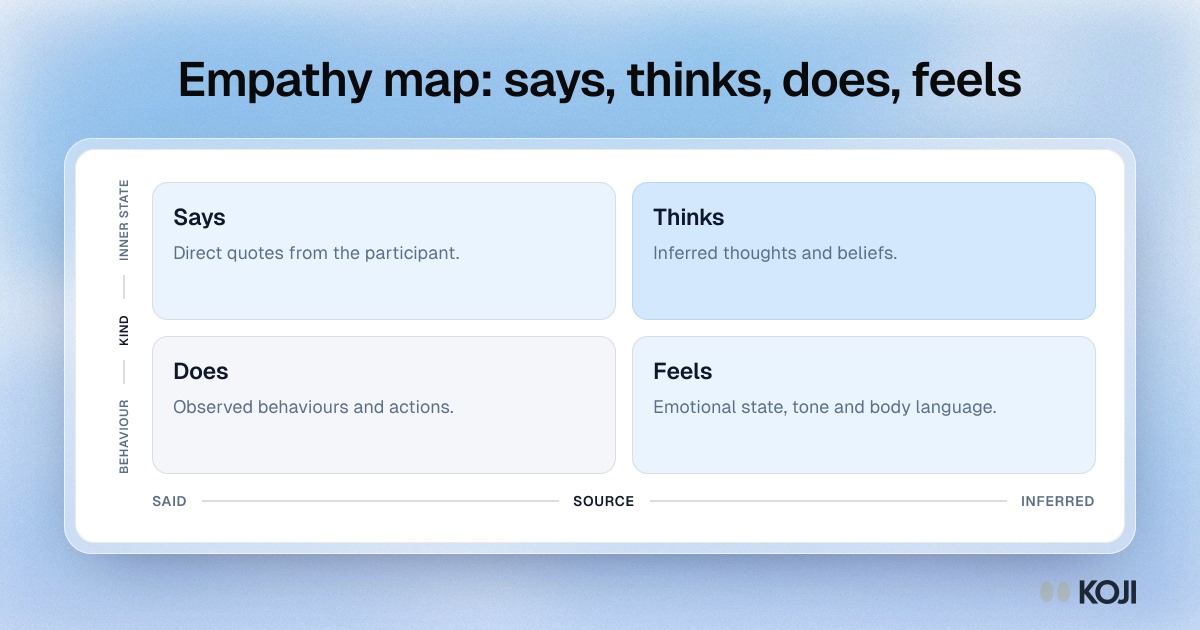
Empathy map: says, thinks, does, feels
The four quadrants used to synthesise empathy interviews
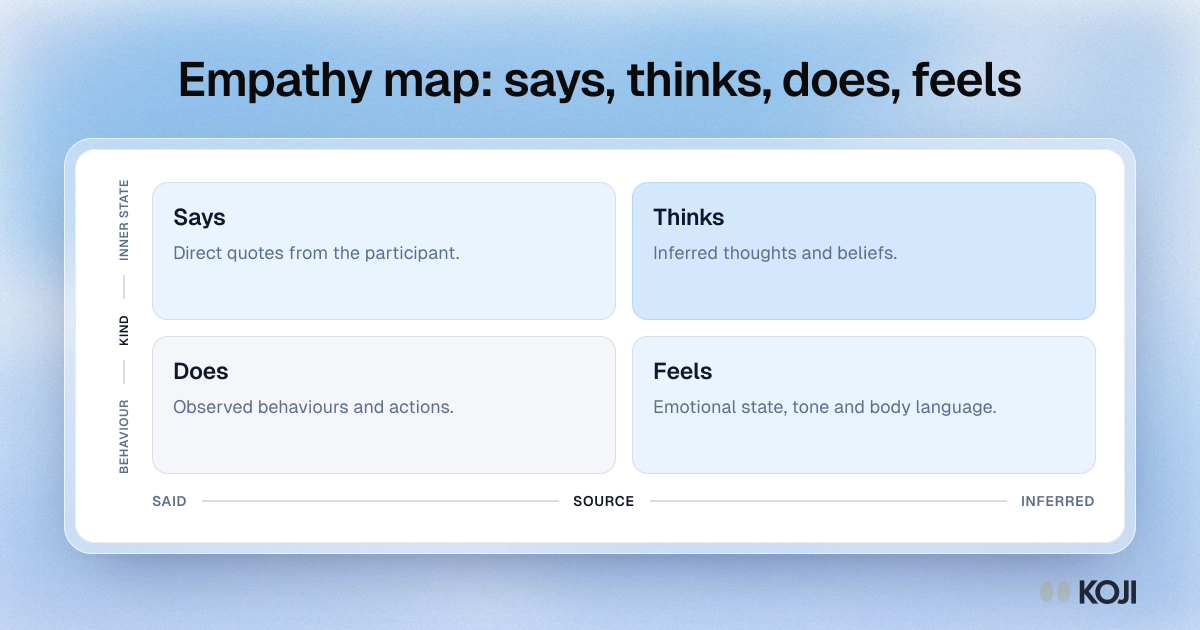
The empathy map is the standard synthesis tool from the Stanford d.school. It sorts what you heard and saw in an interview into four groups: what the person says, thinks, does and feels. Fill one in for each participant, then compare them to find the patterns that become design opportunities.
Where this appears
What's in this matrix
Vertical axis: Kind (Behaviour to Inner state). Horizontal axis: Source (Said to Inferred).
- Says (Inner state kind, Said source): Direct quotes from the participant.
- Thinks (Inner state kind, Inferred source): Inferred thoughts and beliefs.
- Does (Behaviour kind, Said source): Observed behaviours and actions.
- Feels (Behaviour kind, Inferred source): Emotional state, tone and body language.
Use this image
Free to use in your docs, decks and posts under CC BY 4.0, as long as you credit Koji with a link to this page. To embed it, paste this into your page:
html
<a href="https://www.koji.so/visuals/empathy-map-says-thinks-does-feels"><img src="https://www.koji.so/visuals/empathy-map-says-thinks-does-feels/empathy-map-says-thinks-does-feels.png" alt="Empathy map with four quadrants used to synthesise interviews: says, thinks, does and feels, each with what to capture from the participant." width="1200" height="630" /></a>
<p>Source: <a href="https://www.koji.so/visuals/empathy-map-says-thinks-does-feels">Empathy map: says, thinks, does, feels</a>, Koji</p>