Framework
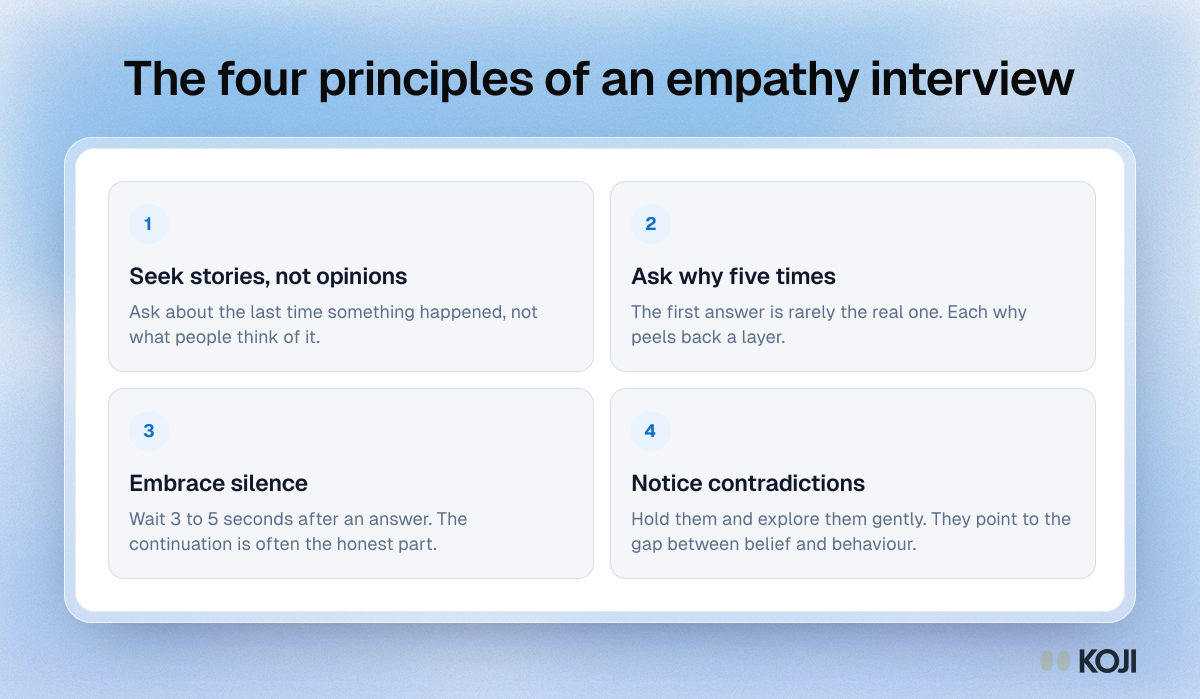
The four principles of an empathy interview
How the Stanford d.school trains interviewers to hear the story behind the answer
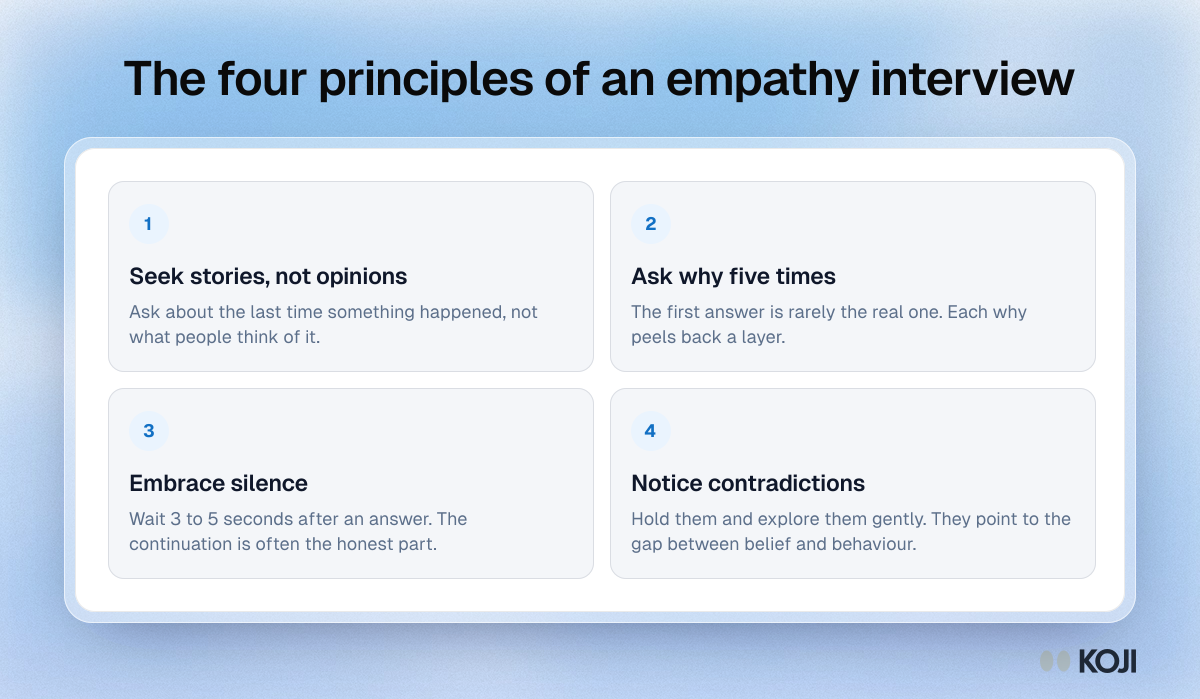
The four working principles of an empathy interview, as taught in the Stanford d.school design thinking approach. Use it as a reminder card before you interview someone about an experience they live with. Koji runs the same style of conversation with an AI interviewer that probes with follow-up questions.
Where this appears
What's in this framework
- Seek stories, not opinions: Ask about the last time something happened, not what people think of it.
- Ask why five times: The first answer is rarely the real one. Each why peels back a layer.
- Embrace silence: Wait 3 to 5 seconds after an answer. The continuation is often the honest part.
- Notice contradictions: Hold them and explore them gently. They point to the gap between belief and behaviour.
Use this image
Free to use in your docs, decks and posts under CC BY 4.0, as long as you credit Koji with a link to this page. To embed it, paste this into your page:
html
<a href="https://www.koji.so/visuals/empathy-interview-four-principles"><img src="https://www.koji.so/visuals/empathy-interview-four-principles/empathy-interview-four-principles.png" alt="Framework showing the four principles of an empathy interview: seek stories not opinions, ask why five times, embrace silence and notice contradictions." width="1200" height="699" /></a>
<p>Source: <a href="https://www.koji.so/visuals/empathy-interview-four-principles">The four principles of an empathy interview</a>, Koji</p>