Framework
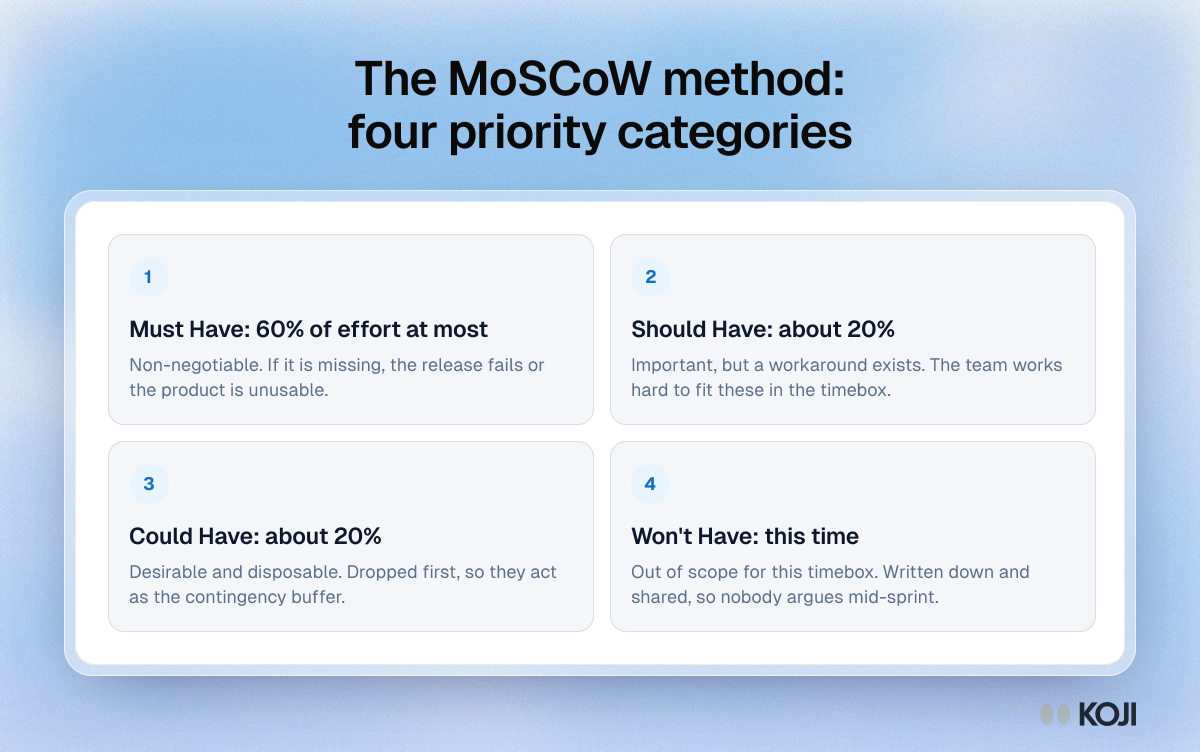
The MoSCoW method: four priority categories
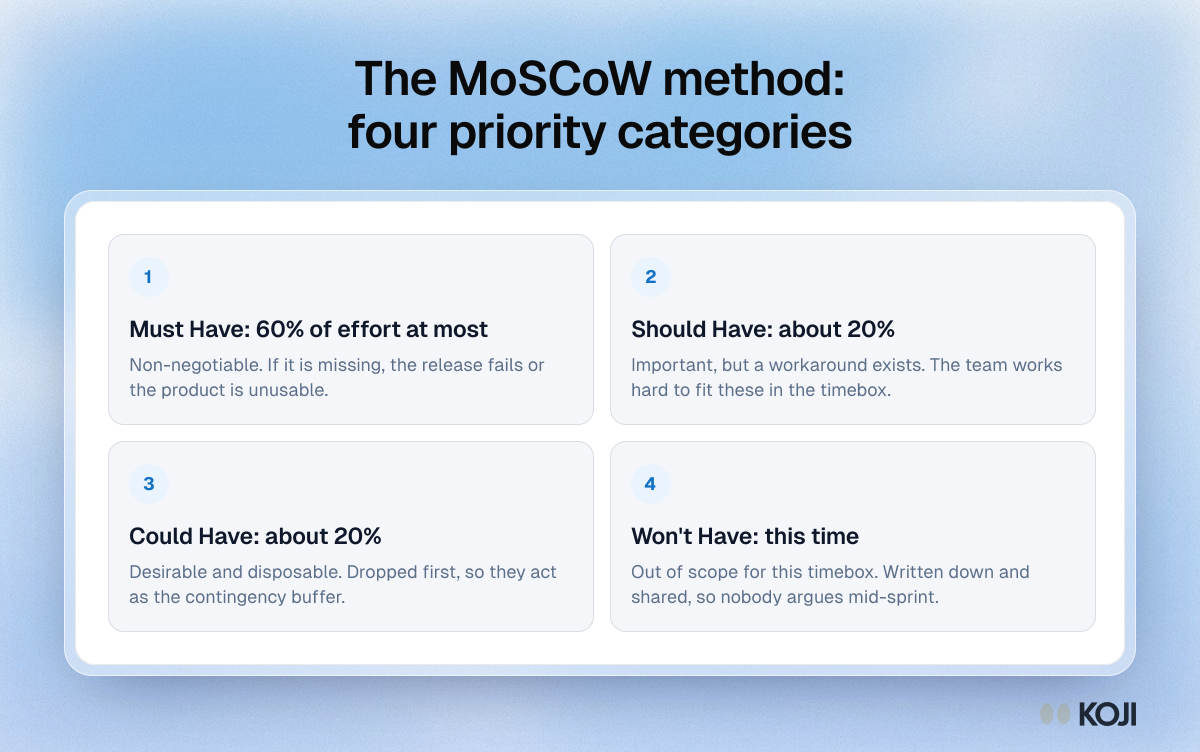
The MoSCoW method sorts requirements into Must Have, Should Have, Could Have and Won't Have within a fixed delivery timebox. Must Have effort stays at or below 60% of capacity, with about 20% each for Should and Could. Use it for release planning with 20 to 60 candidate items. Koji's AI interviews can test which items customers really treat as a Must Have.
Where this appears
What's in this framework
- Must Have: 60% of effort at most: Non-negotiable. If it is missing, the release fails or the product is unusable.
- Should Have: about 20%: Important, but a workaround exists. The team works hard to fit these in the timebox.
- Could Have: about 20%: Desirable and disposable. Dropped first, so they act as the contingency buffer.
- Won't Have: this time: Out of scope for this timebox. Written down and shared, so nobody argues mid-sprint.
Use this image
Free to use in your docs, decks and posts under CC BY 4.0, as long as you credit Koji with a link to this page. To embed it, paste this into your page:
html
<a href="https://www.koji.so/visuals/moscow-method-four-categories-framework"><img src="https://www.koji.so/visuals/moscow-method-four-categories-framework/moscow-method-four-categories-framework.png" alt="Framework showing the four MoSCoW categories, Must Have, Should Have, Could Have and Won't Have, with the share of effort each gets in a timebox." width="1200" height="752" /></a>
<p>Source: <a href="https://www.koji.so/visuals/moscow-method-four-categories-framework">The MoSCoW method: four priority categories</a>, Koji</p>