Process
How to counter the false consensus effect in research
A six-step routine for interviews, surveys and usability tests
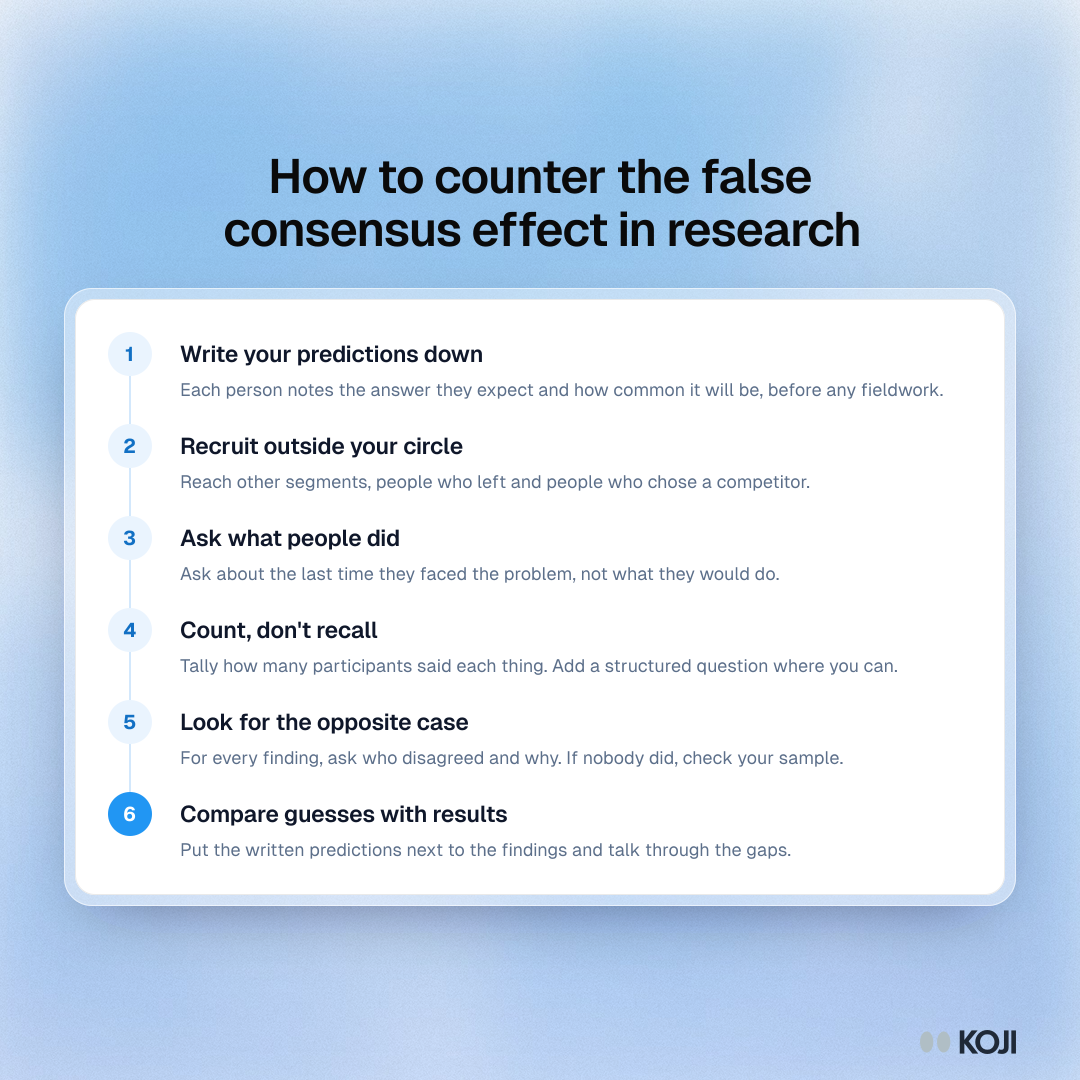
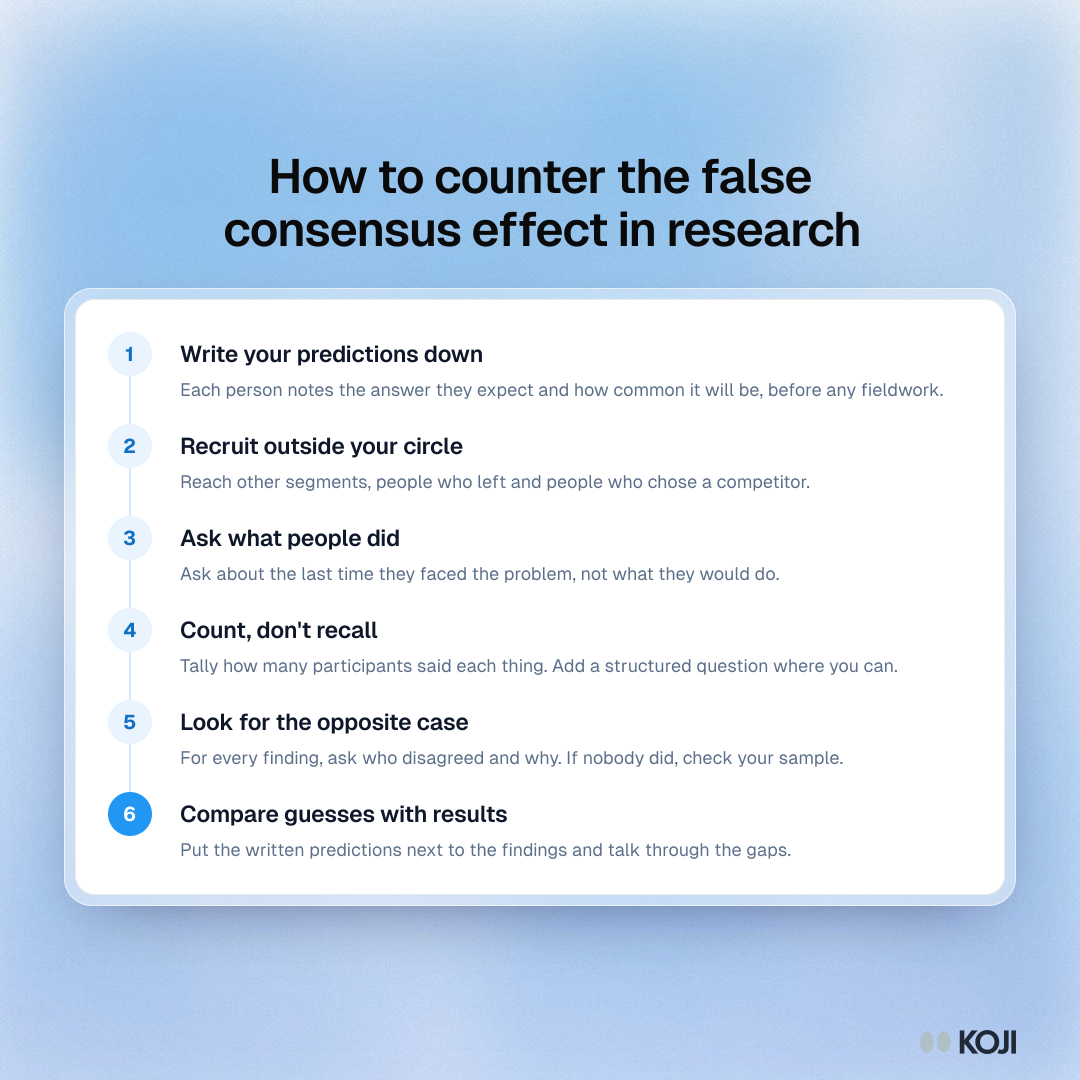
A six-step routine for catching the false consensus effect in user research: write predictions down before fieldwork, recruit outside your own circle, ask about past behaviour, count answers instead of recalling them, look for people who disagree, and compare the predictions with the results. It works for interviews, surveys and usability tests. Koji supports it with AI-moderated interviews and structured questions that give exact counts.
Where this appears
What's in this process
- Write your predictions down: Each person notes the answer they expect and how common it will be, before any fieldwork.
- Recruit outside your circle: Reach other segments, people who left and people who chose a competitor.
- Ask what people did: Ask about the last time they faced the problem, not what they would do.
- Count, don't recall: Tally how many participants said each thing. Add a structured question where you can.
- Look for the opposite case: For every finding, ask who disagreed and why. If nobody did, check your sample.
- Compare guesses with results: Put the written predictions next to the findings and talk through the gaps.
Use this image
Free to use in your docs, decks and posts under CC BY 4.0, as long as you credit Koji with a link to this page. To embed it, paste this into your page:
html
<a href="https://www.koji.so/visuals/false-consensus-effect-research-process"><img src="https://www.koji.so/visuals/false-consensus-effect-research-process/false-consensus-effect-research-process.png" alt="Process showing six steps to counter the false consensus effect in research, from writing predictions down to comparing them with what people said" width="1080" height="1080" /></a>
<p>Source: <a href="https://www.koji.so/visuals/false-consensus-effect-research-process">How to counter the false consensus effect in research</a>, Koji</p>