Process
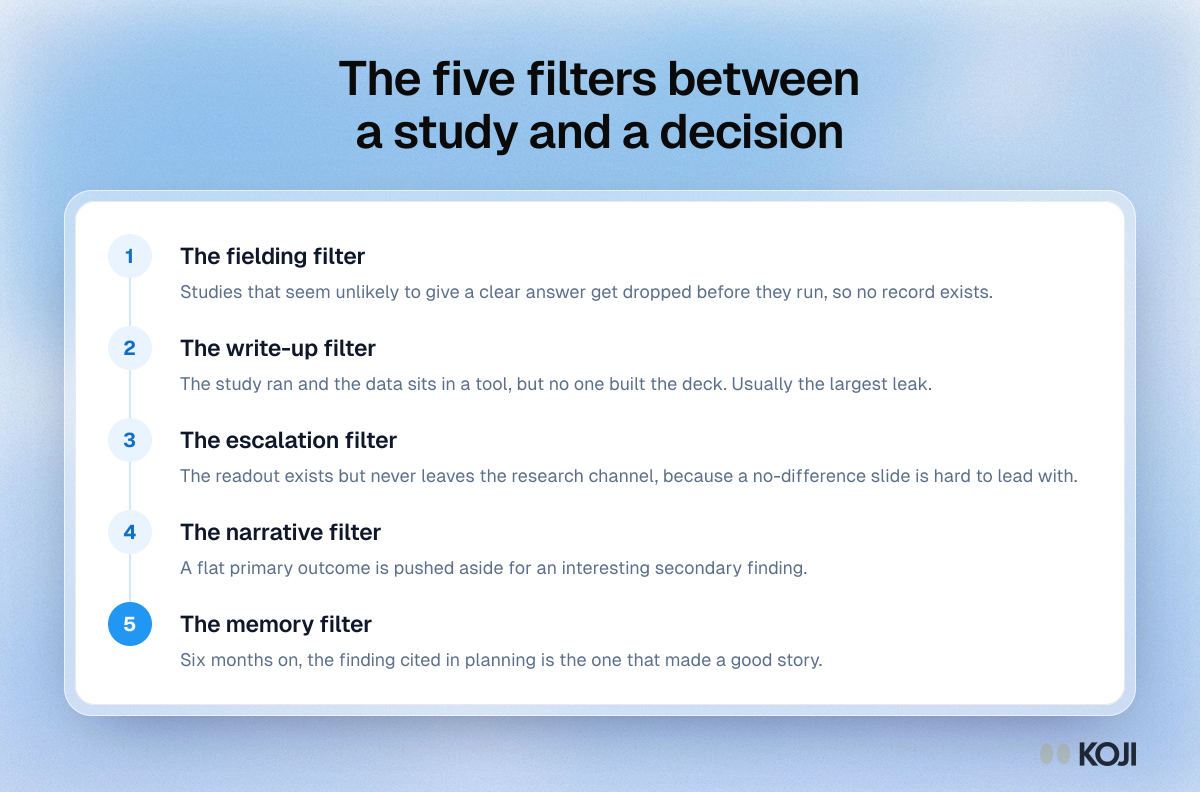
The five filters between a study and a decision
Where null results get lost inside a product organisation
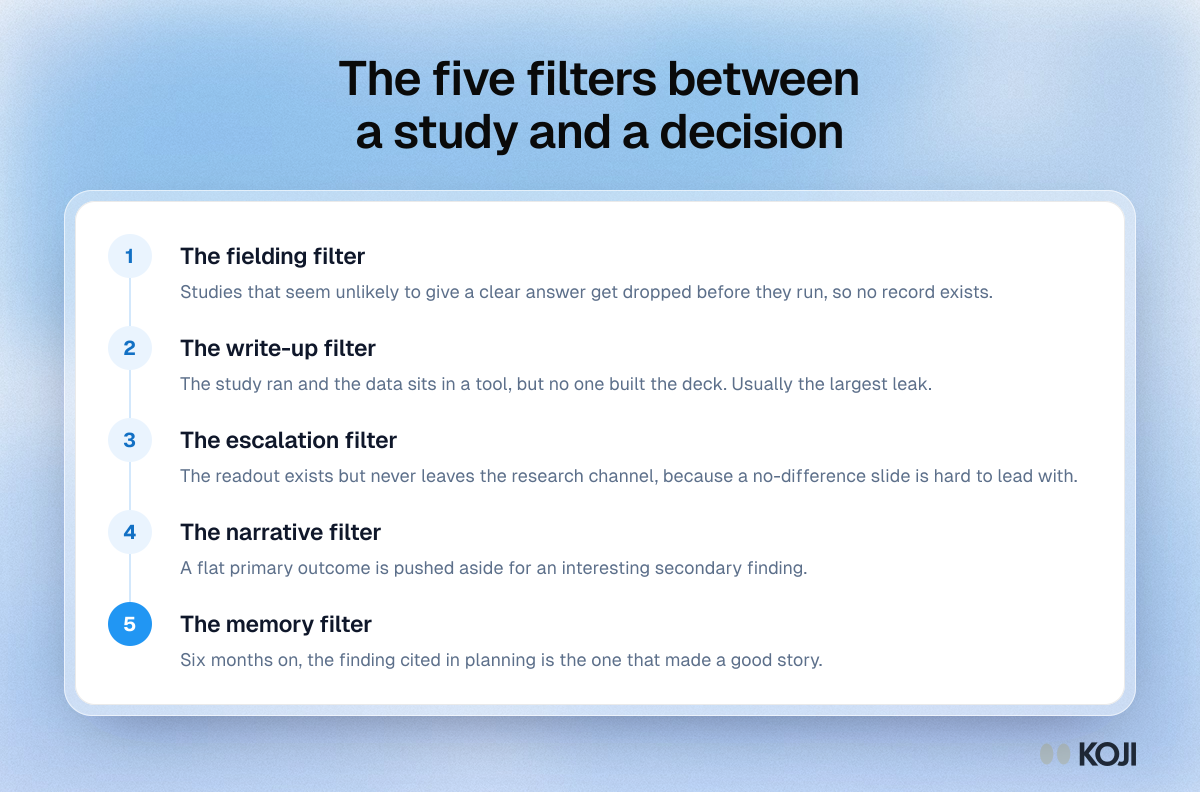
A five-stage diagram of how publication bias happens inside a company: the fielding, write-up, escalation, narrative and memory filters. At each stage a null result is more likely to be lost than a positive one, without anyone suppressing anything. Use it to audit where your own research programme leaks findings. Koji closes the write-up filter by producing a structured report for every study as responses arrive.
Where this appears
What's in this process
- The fielding filter: Studies that seem unlikely to give a clear answer get dropped before they run, so no record exists.
- The write-up filter: The study ran and the data sits in a tool, but no one built the deck. Usually the largest leak.
- The escalation filter: The readout exists but never leaves the research channel, because a no-difference slide is hard to lead with.
- The narrative filter: A flat primary outcome is pushed aside for an interesting secondary finding.
- The memory filter: Six months on, the finding cited in planning is the one that made a good story.
Use this image
Free to use in your docs, decks and posts under CC BY 4.0, as long as you credit Koji with a link to this page. To embed it, paste this into your page:
html
<a href="https://www.koji.so/visuals/five-filters-between-a-study-and-a-decision"><img src="https://www.koji.so/visuals/five-filters-between-a-study-and-a-decision/five-filters-between-a-study-and-a-decision.png" alt="Process diagram of five filters where null results get lost: fielding, write-up, escalation, narrative and memory, from study plan to planning doc." width="1200" height="792" /></a>
<p>Source: <a href="https://www.koji.so/visuals/five-filters-between-a-study-and-a-decision">The five filters between a study and a decision</a>, Koji</p>