Guide
Five rules for rating scale questions
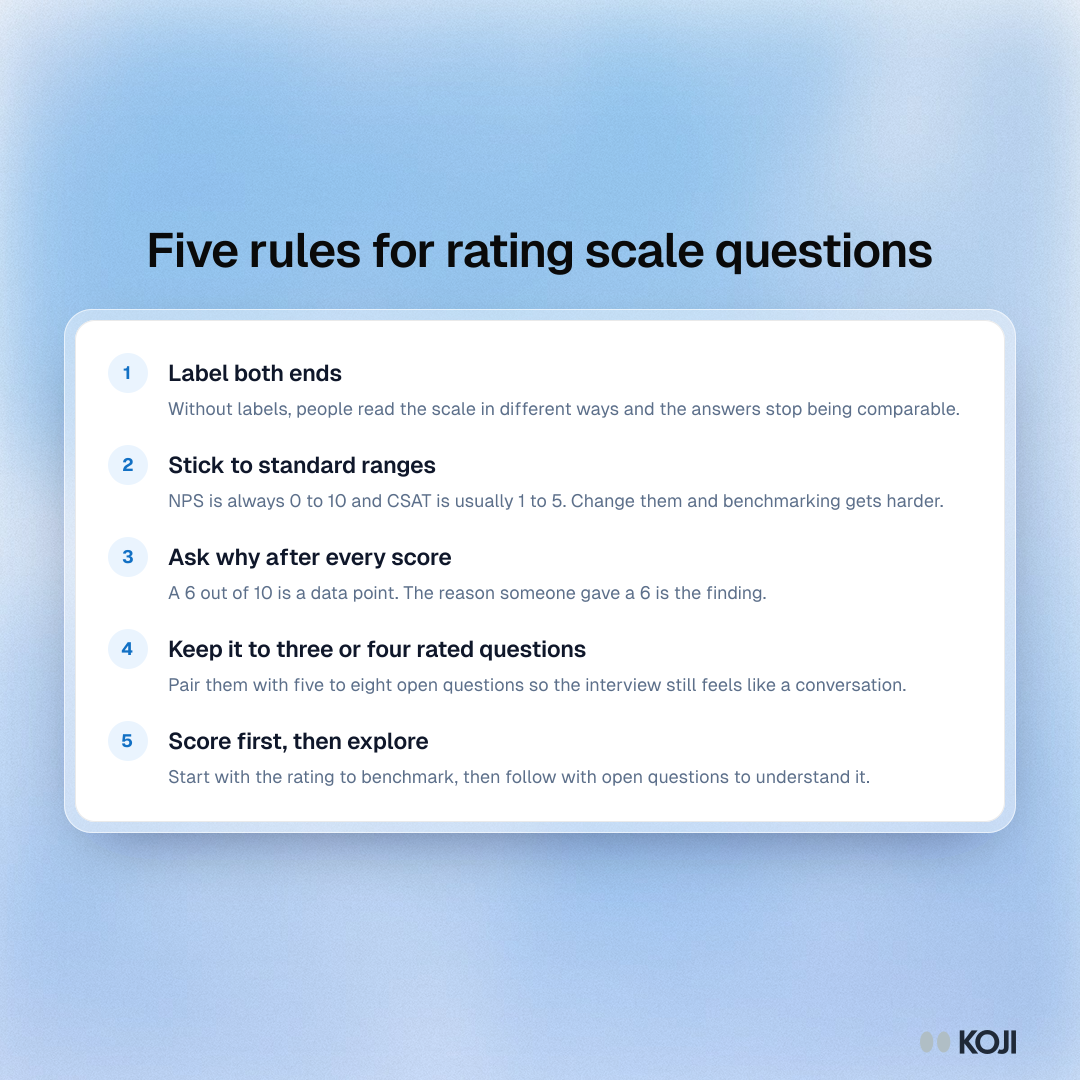
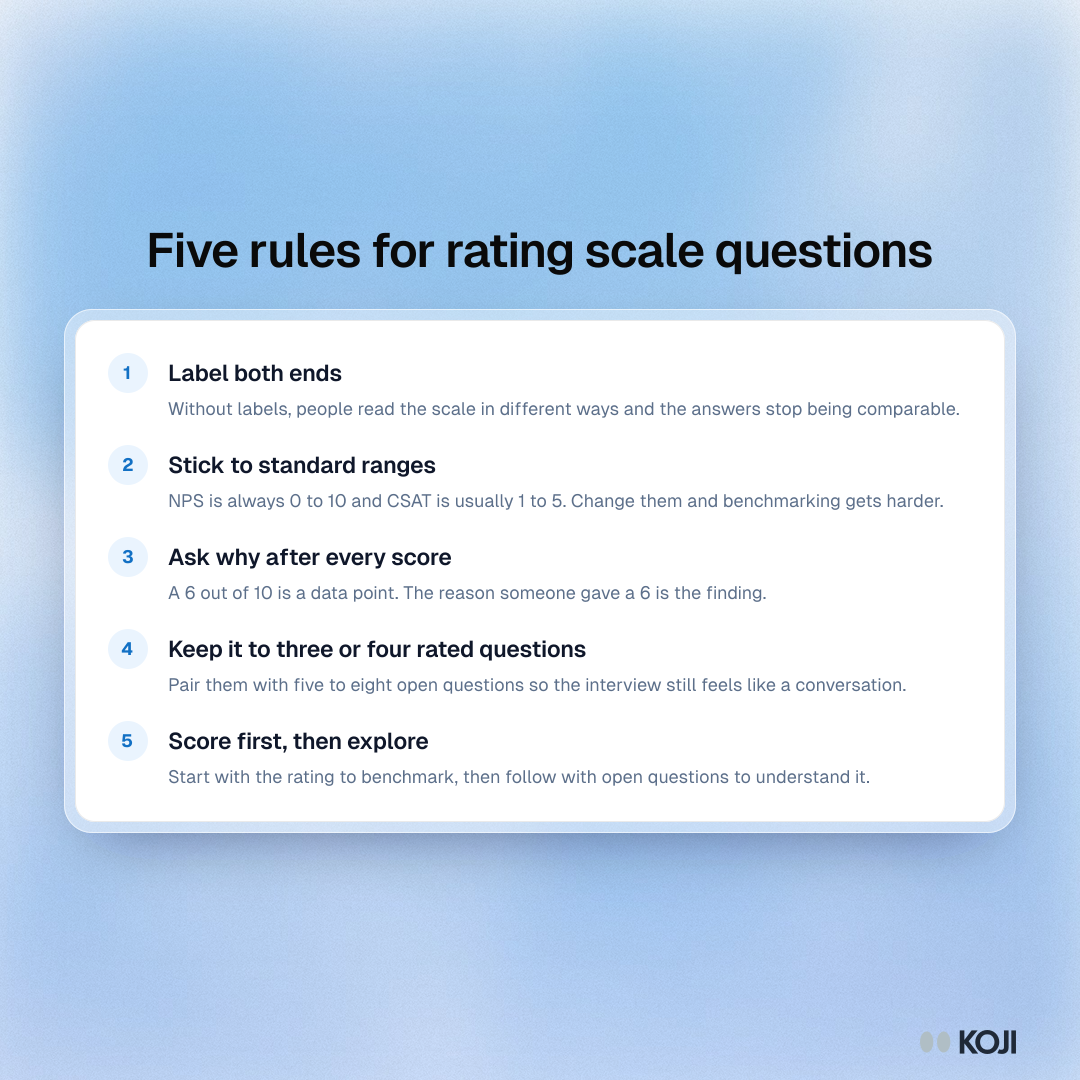
Five practical rules for writing rating scale questions in surveys and customer interviews. They cover labelling the ends of the scale, keeping standard ranges for benchmark metrics like NPS and CSAT, following every score with a why question, capping rated questions at three or four per study and putting the score before the open questions. Koji applies the follow-up rule automatically by probing on each rating.
Where this appears
What's in this guide
- Label both ends: Without labels, people read the scale in different ways and the answers stop being comparable.
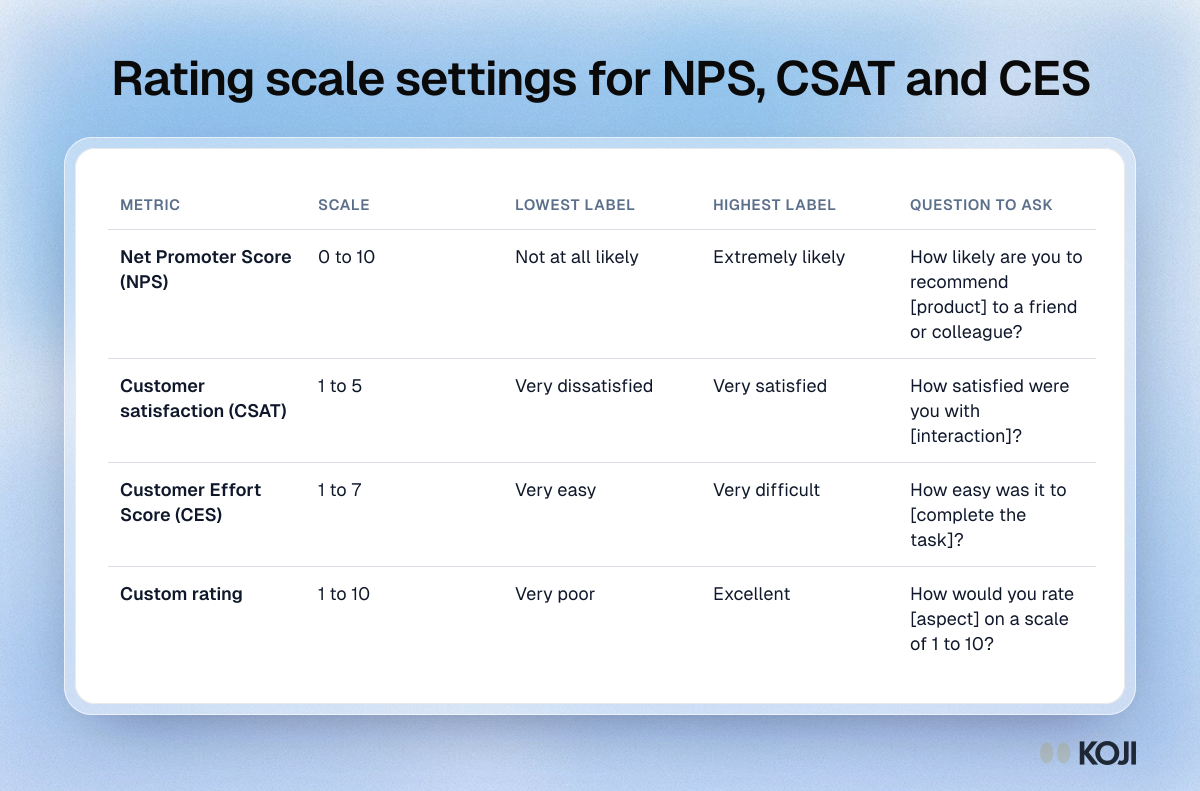
- Stick to standard ranges: NPS is always 0 to 10 and CSAT is usually 1 to 5. Change them and benchmarking gets harder.
- Ask why after every score: A 6 out of 10 is a data point. The reason someone gave a 6 is the finding.
- Keep it to three or four rated questions: Pair them with five to eight open questions so the interview still feels like a conversation.
- Score first, then explore: Start with the rating to benchmark, then follow with open questions to understand it.
Use this image
Free to use in your docs, decks and posts under CC BY 4.0, as long as you credit Koji with a link to this page. To embed it, paste this into your page:
html
<a href="https://www.koji.so/visuals/five-rules-for-rating-scale-questions"><img src="https://www.koji.so/visuals/five-rules-for-rating-scale-questions/five-rules-for-rating-scale-questions.png" alt="List of five rules for rating scale questions: label both ends, use standard ranges, ask why, limit to three or four, score first." width="1080" height="1080" /></a>
<p>Source: <a href="https://www.koji.so/visuals/five-rules-for-rating-scale-questions">Five rules for rating scale questions</a>, Koji</p>