Guide
Five common pricing research mistakes
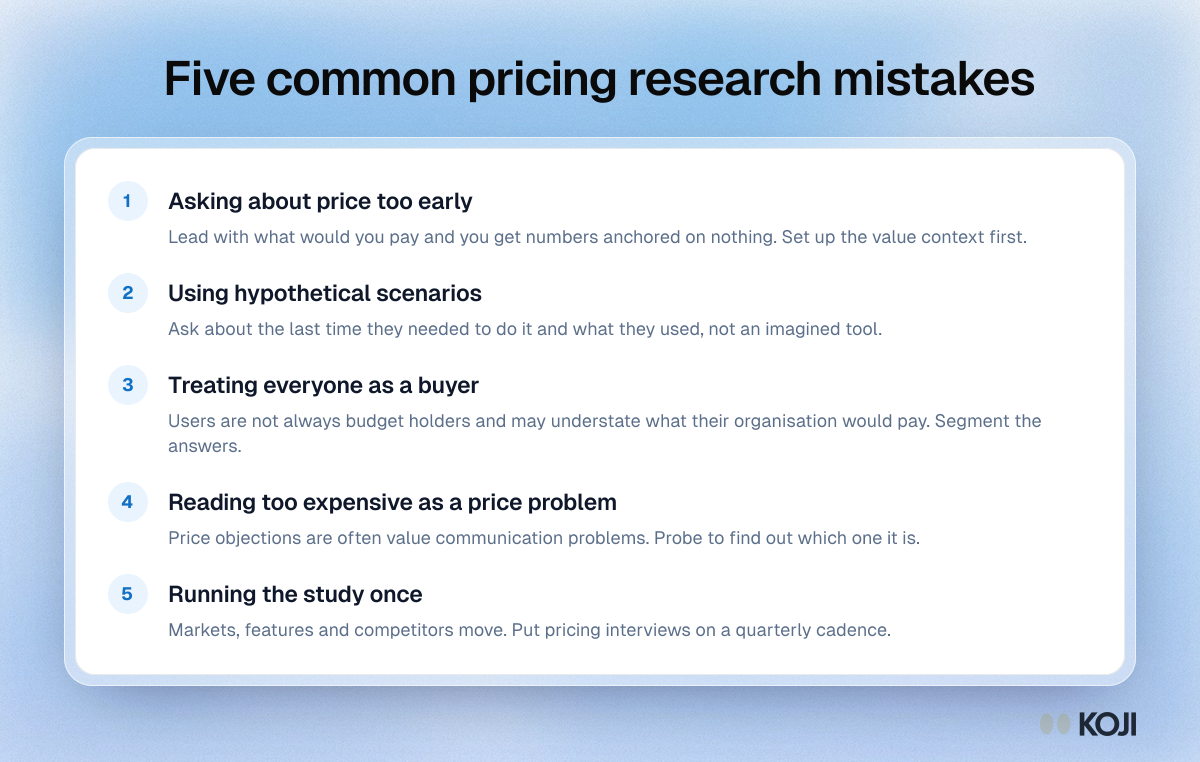
Five mistakes that make pricing research unreliable, with what to do instead. For anyone running willingness-to-pay interviews or surveys before a launch, a price change or a packaging decision. Check your discussion guide against the list before fieldwork. Koji runs pricing interviews with the same questions and probing for every participant, which makes it easier to repeat the study each quarter.
Where this appears
What's in this guide
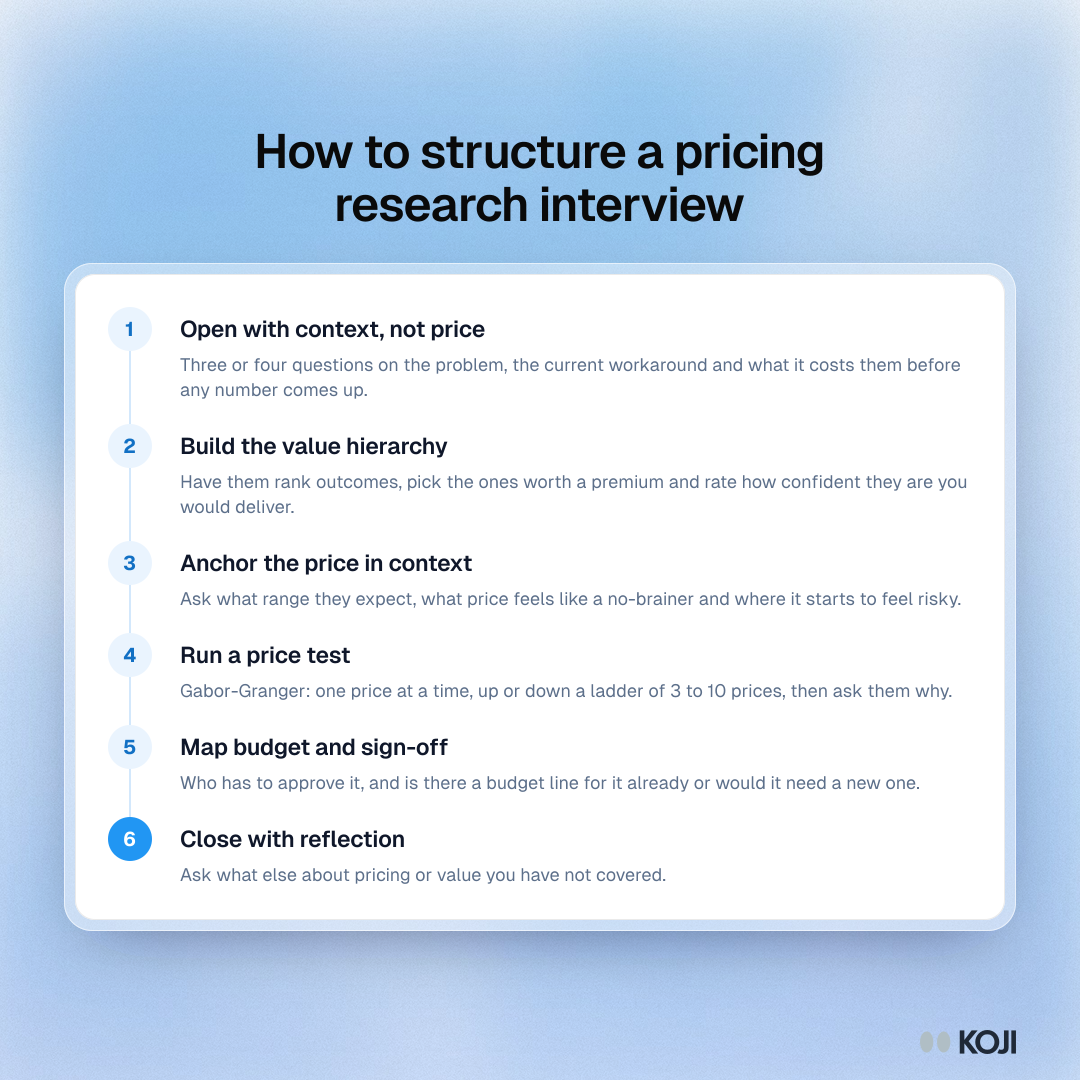
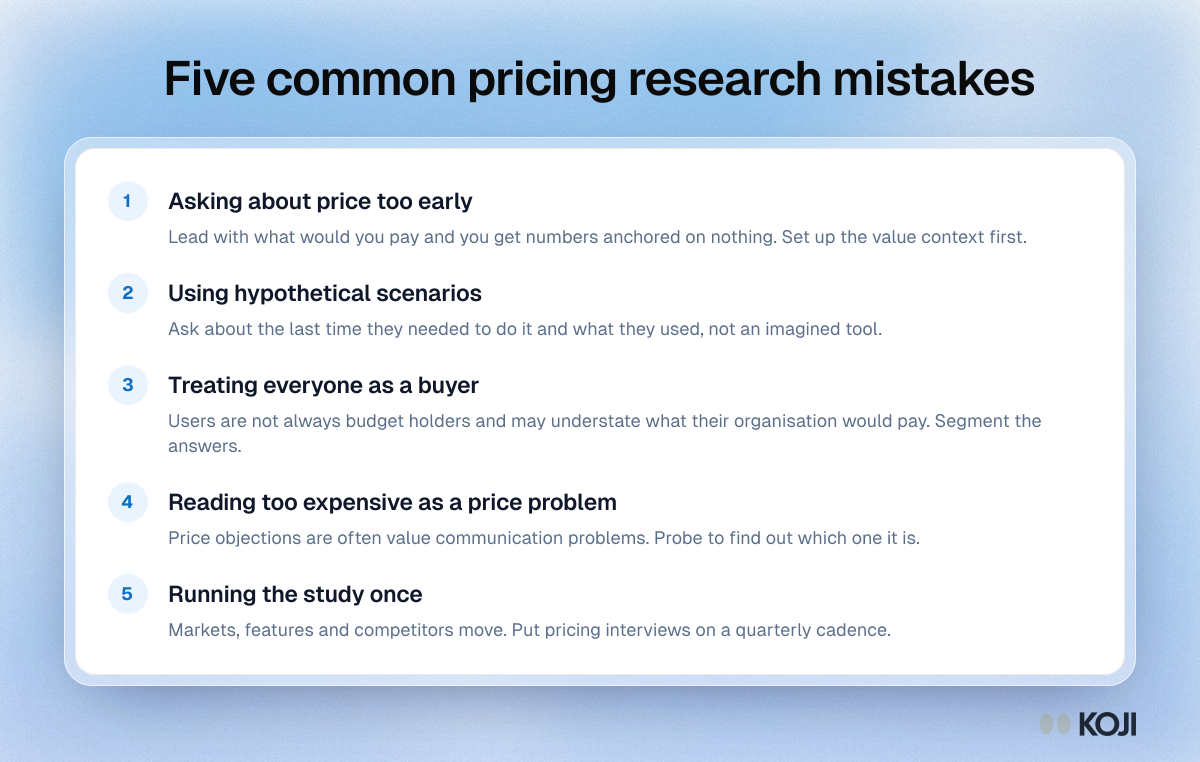
- Asking about price too early: Lead with what would you pay and you get numbers anchored on nothing. Set up the value context first.
- Using hypothetical scenarios: Ask about the last time they needed to do it and what they used, not an imagined tool.
- Treating everyone as a buyer: Users are not always budget holders and may understate what their organisation would pay. Segment the answers.
- Reading too expensive as a price problem: Price objections are often value communication problems. Probe to find out which one it is.
- Running the study once: Markets, features and competitors move. Put pricing interviews on a quarterly cadence.
Use this image
Free to use in your docs, decks and posts under CC BY 4.0, as long as you credit Koji with a link to this page. To embed it, paste this into your page:
html
<a href="https://www.koji.so/visuals/pricing-research-mistakes-five"><img src="https://www.koji.so/visuals/pricing-research-mistakes-five/pricing-research-mistakes-five.png" alt="Listicle of five pricing research mistakes: asking about price too early, hypotheticals, treating users as buyers, misreading price objections, running it once." width="1200" height="762" /></a>
<p>Source: <a href="https://www.koji.so/visuals/pricing-research-mistakes-five">Five common pricing research mistakes</a>, Koji</p>