Guide
Five mistakes when analyzing customer feedback
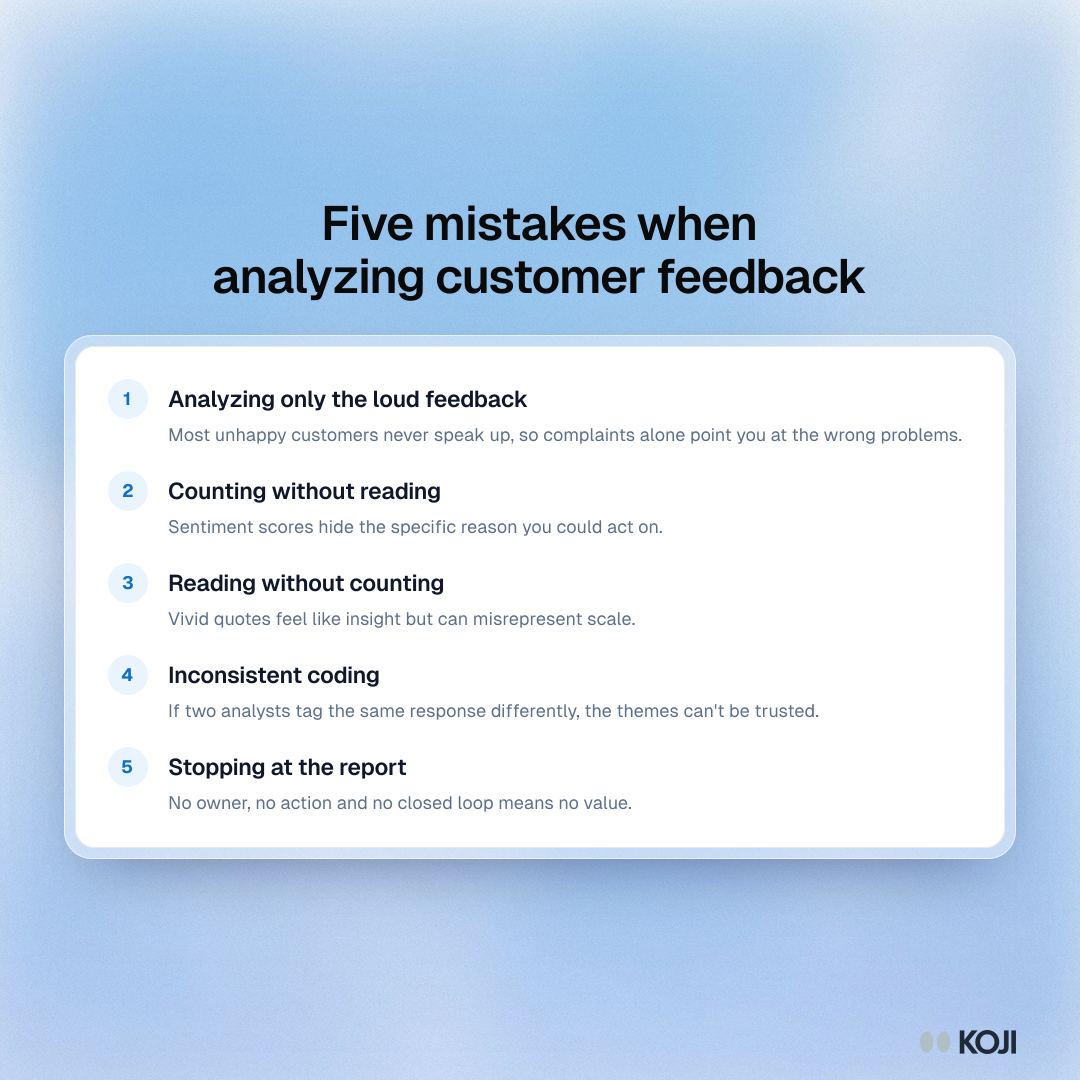
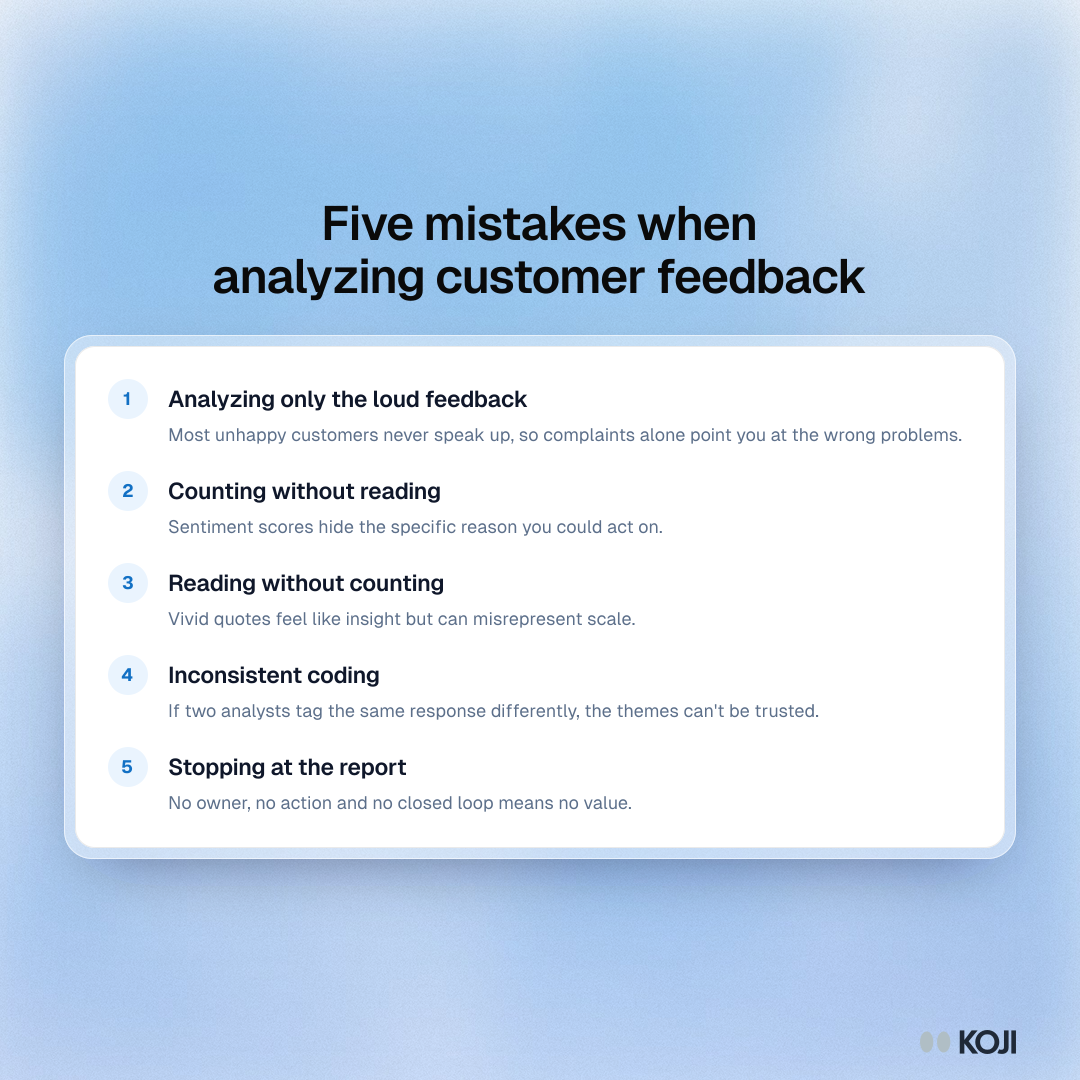
Five mistakes that weaken customer feedback analysis: listening only to the loudest customers, counting sentiment without reading the comments, quoting vivid comments without counting them, coding the same response differently across analysts, and stopping at the report. Run through it before you share findings with the team.
Where this appears
What's in this guide
- Analyzing only the loud feedback: Most unhappy customers never speak up, so complaints alone point you at the wrong problems.
- Counting without reading: Sentiment scores hide the specific reason you could act on.
- Reading without counting: Vivid quotes feel like insight but can misrepresent scale.
- Inconsistent coding: If two analysts tag the same response differently, the themes can't be trusted.
- Stopping at the report: No owner, no action and no closed loop means no value.
Use this image
Free to use in your docs, decks and posts under CC BY 4.0, as long as you credit Koji with a link to this page. To embed it, paste this into your page:
html
<a href="https://www.koji.so/visuals/customer-feedback-analysis-five-mistakes"><img src="https://www.koji.so/visuals/customer-feedback-analysis-five-mistakes/customer-feedback-analysis-five-mistakes.png" alt="List of five common mistakes in customer feedback analysis, from reacting only to the loudest feedback to stopping at the report without acting." width="1080" height="1080" /></a>
<p>Source: <a href="https://www.koji.so/visuals/customer-feedback-analysis-five-mistakes">Five mistakes when analyzing customer feedback</a>, Koji</p>