Comparison
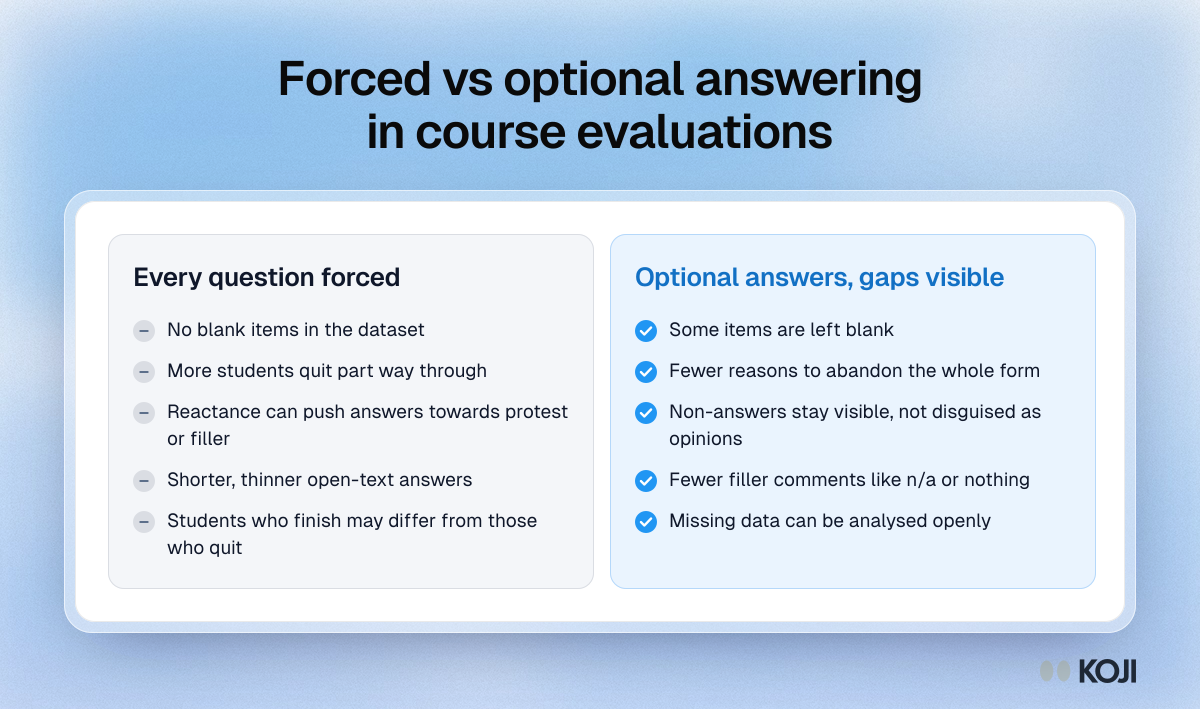
Forced vs optional answering in course evaluations
What making every question required does to dropout, reactance and answer quality
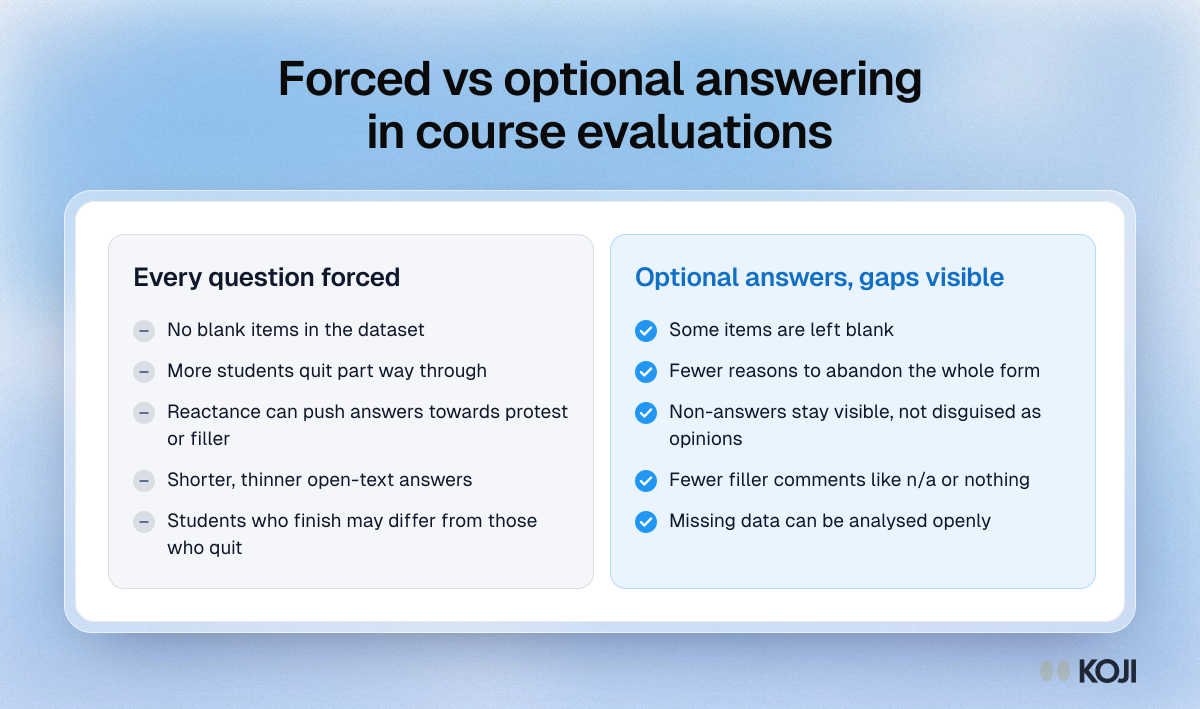
A side-by-side comparison of making every course evaluation question required versus leaving answers optional. It draws on Stieger, Reips and Voracek (2007), who found that forced response raised dropout among university students, and Sischka and colleagues (2022), who linked forced answering to reactance and weaker answers. Use it when deciding which questions, if any, to make compulsory. In Koji's conversational evaluations, a skipped or filler reply is recorded as not answered or off topic rather than as a value.
What's in this comparison
Every question forced
- No blank items in the dataset
- More students quit part way through
- Reactance can push answers towards protest or filler
- Shorter, thinner open-text answers
- Students who finish may differ from those who quit
Optional answers, gaps visible
- Some items are left blank
- Fewer reasons to abandon the whole form
- Non-answers stay visible, not disguised as opinions
- Fewer filler comments like n/a or nothing
- Missing data can be analysed openly
Use this image
Free to use in your docs, decks and posts under CC BY 4.0, as long as you credit Koji with a link to this page. To embed it, paste this into your page:
<a href="https://www.koji.so/visuals/forced-vs-optional-answering-course-evaluation"><img src="https://www.koji.so/visuals/forced-vs-optional-answering-course-evaluation/forced-vs-optional-answering-course-evaluation.png" alt="Comparison of forced and optional answering in course evaluations: forcing answers fills every item but raises dropout, reactance and filler answers." width="1200" height="709" /></a>
<p>Source: <a href="https://www.koji.so/visuals/forced-vs-optional-answering-course-evaluation">Forced vs optional answering in course evaluations</a>, Koji</p>