Framework
The four dimensions of user research methods
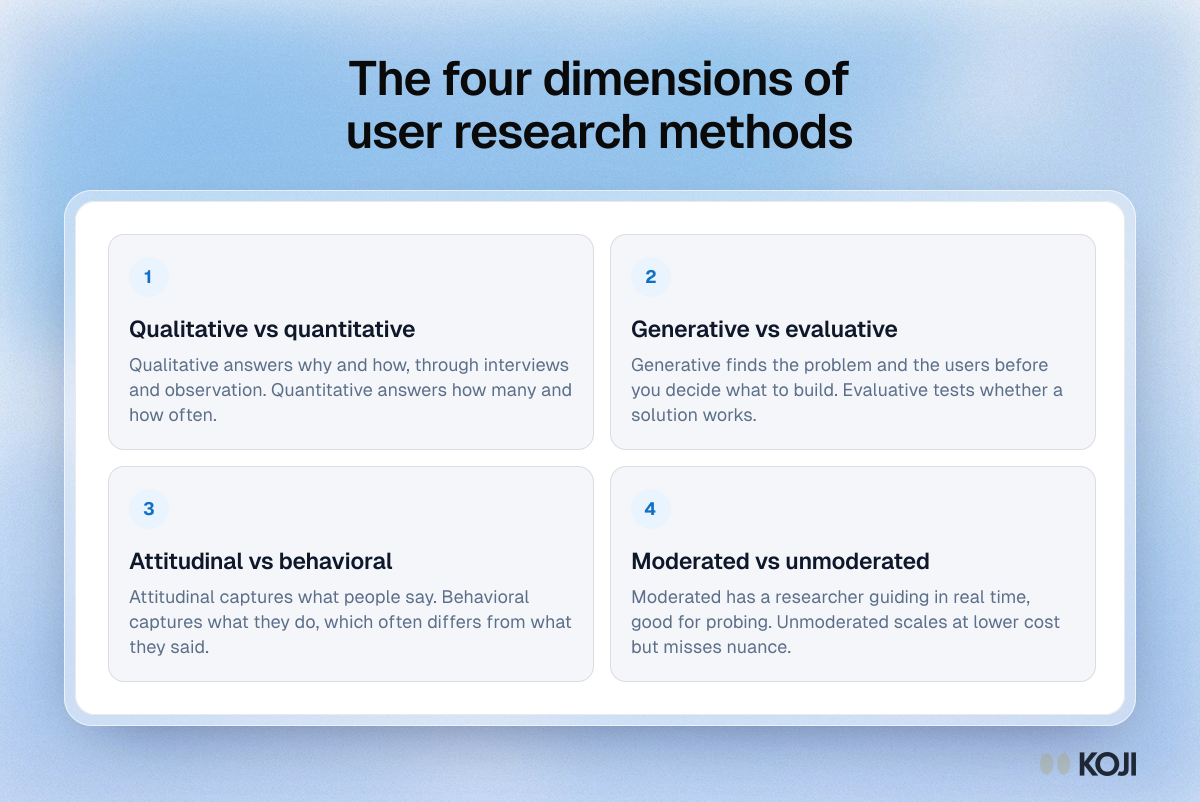
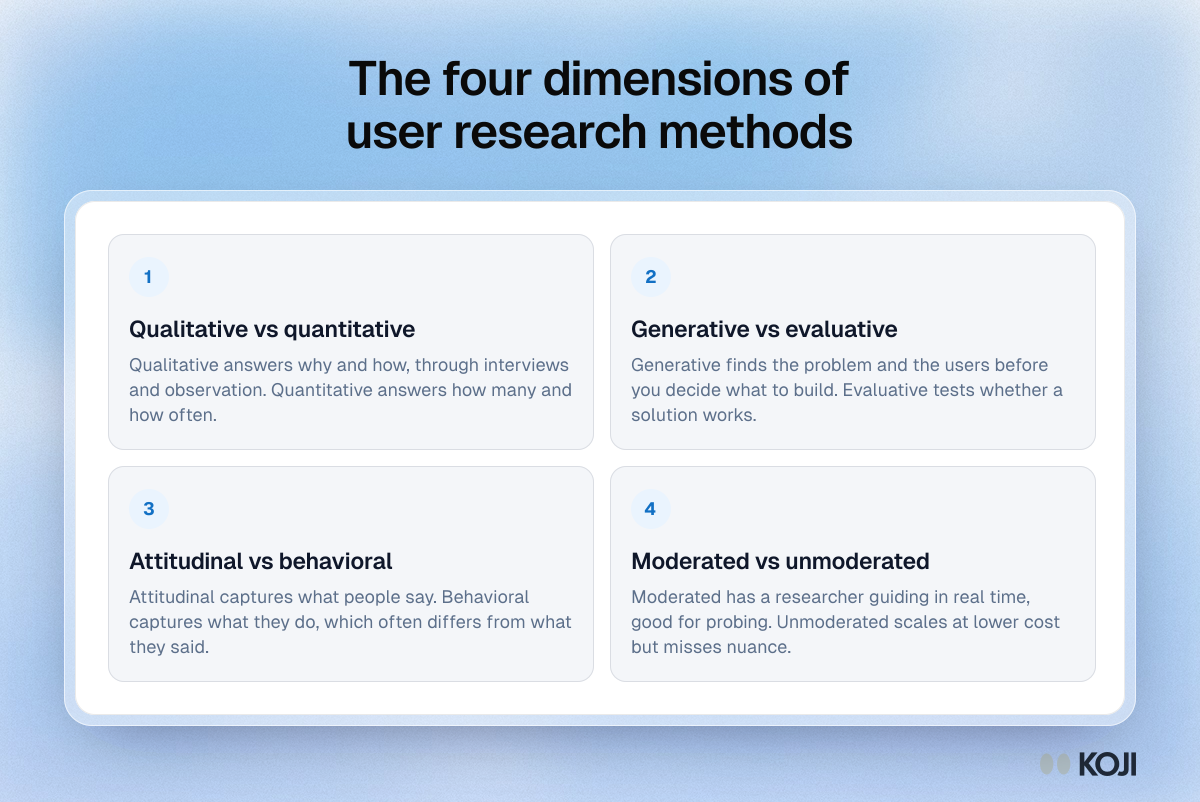
Every user research method sits somewhere on four dimensions: qualitative or quantitative, generative or evaluative, attitudinal or behavioral, and moderated or unmoderated. This card explains each pair in a line, so a team can see why an interview, a survey and a usability test give such different answers. Use it when choosing or mixing methods for a study. Koji's AI interviews are moderated and qualitative, with structured questions for numbers.
Where this appears
What's in this framework
- Qualitative vs quantitative: Qualitative answers why and how, through interviews and observation. Quantitative answers how many and how often.
- Generative vs evaluative: Generative finds the problem and the users before you decide what to build. Evaluative tests whether a solution works.
- Attitudinal vs behavioral: Attitudinal captures what people say. Behavioral captures what they do, which often differs from what they said.
- Moderated vs unmoderated: Moderated has a researcher guiding in real time, good for probing. Unmoderated scales at lower cost but misses nuance.
Use this image
Free to use in your docs, decks and posts under CC BY 4.0, as long as you credit Koji with a link to this page. To embed it, paste this into your page:
html
<a href="https://www.koji.so/visuals/four-dimensions-of-user-research-methods"><img src="https://www.koji.so/visuals/four-dimensions-of-user-research-methods/four-dimensions-of-user-research-methods.png" alt="Framework of four dimensions of user research: qualitative or quantitative, generative or evaluative, attitudinal or behavioral, moderated or unmoderated." width="1200" height="802" /></a>
<p>Source: <a href="https://www.koji.so/visuals/four-dimensions-of-user-research-methods">The four dimensions of user research methods</a>, Koji</p>