Guide
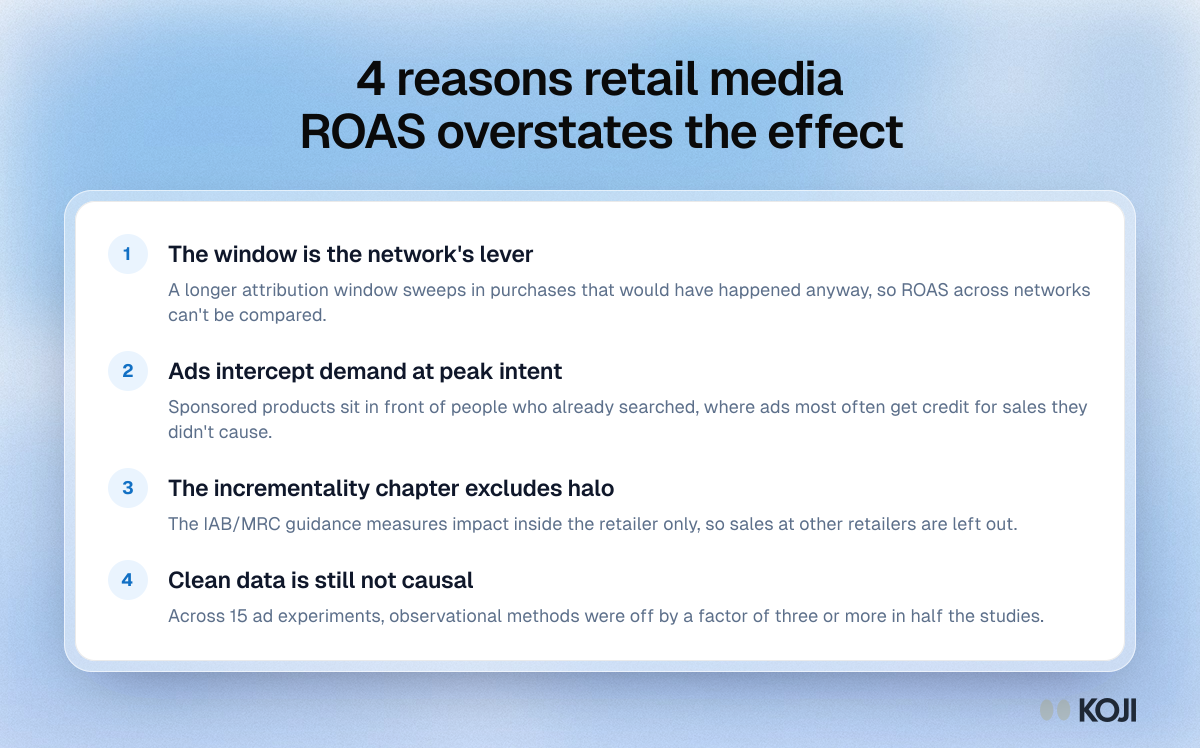
4 reasons retail media ROAS overstates the effect
Why a network-reported ROAS is a self-assessment, not a measurement
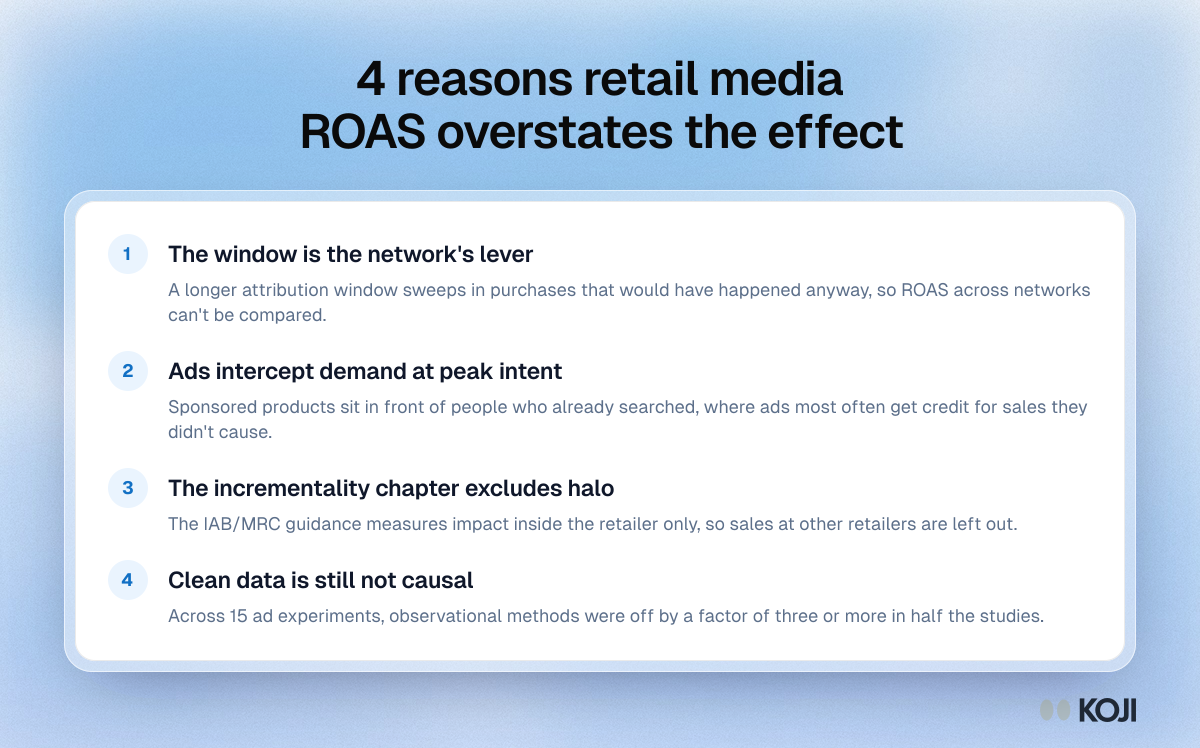
A summary of four structural reasons a retail media network ROAS overstates what the advertising caused: the network picks the attribution window, sponsored products sit at the point of highest intent, the IAB/MRC incrementality chapter measures inside the retailer only, and observational data stays observational however clean it is. For brand and media teams deciding how much weight to give a network dashboard. Koji interviews shoppers to find out what the ad changed.
Where this appears
What's in this guide
- The window is the network's lever: A longer attribution window sweeps in purchases that would have happened anyway, so ROAS across networks can't be compared.
- Ads intercept demand at peak intent: Sponsored products sit in front of people who already searched, where ads most often get credit for sales they didn't cause.
- The incrementality chapter excludes halo: The IAB/MRC guidance measures impact inside the retailer only, so sales at other retailers are left out.
- Clean data is still not causal: Across 15 ad experiments, observational methods were off by a factor of three or more in half the studies.
Use this image
Free to use in your docs, decks and posts under CC BY 4.0, as long as you credit Koji with a link to this page. To embed it, paste this into your page:
html
<a href="https://www.koji.so/visuals/four-reasons-retail-media-roas-overstates-effect"><img src="https://www.koji.so/visuals/four-reasons-retail-media-roas-overstates-effect/four-reasons-retail-media-roas-overstates-effect.png" alt="List of four reasons retail media ROAS overstates the causal effect: the attribution window, peak-intent placement, no halo, and observational data." width="1200" height="748" /></a>
<p>Source: <a href="https://www.koji.so/visuals/four-reasons-retail-media-roas-overstates-effect">4 reasons retail media ROAS overstates the effect</a>, Koji</p>