Guide
Four ways to detect nonresponse bias
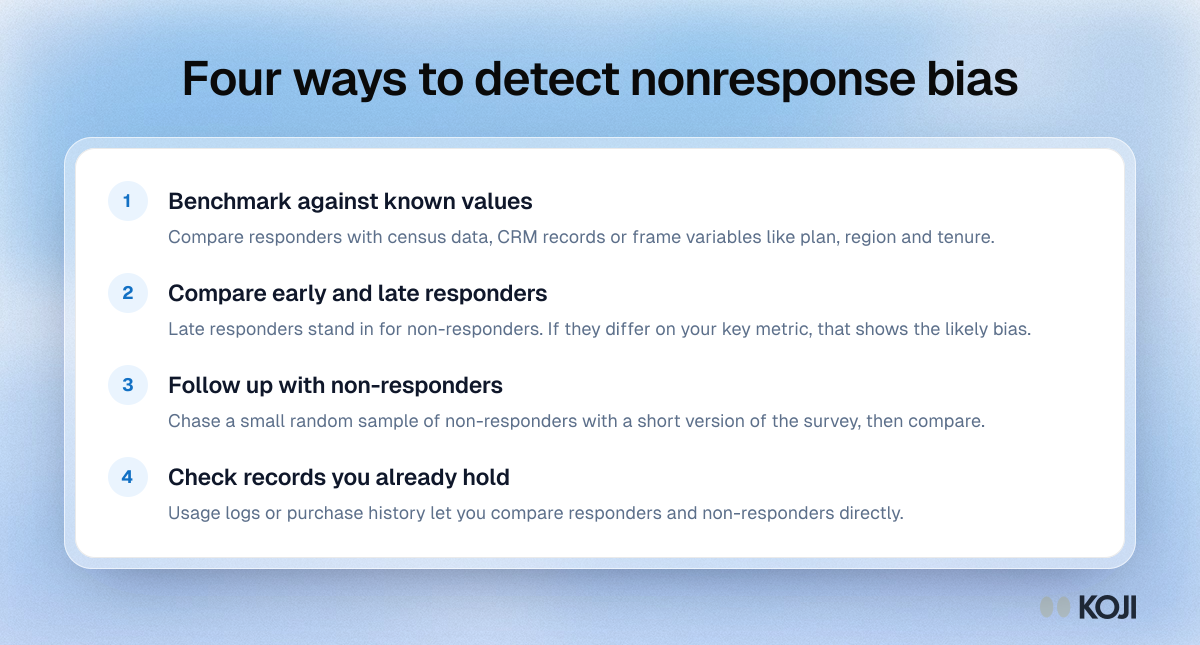
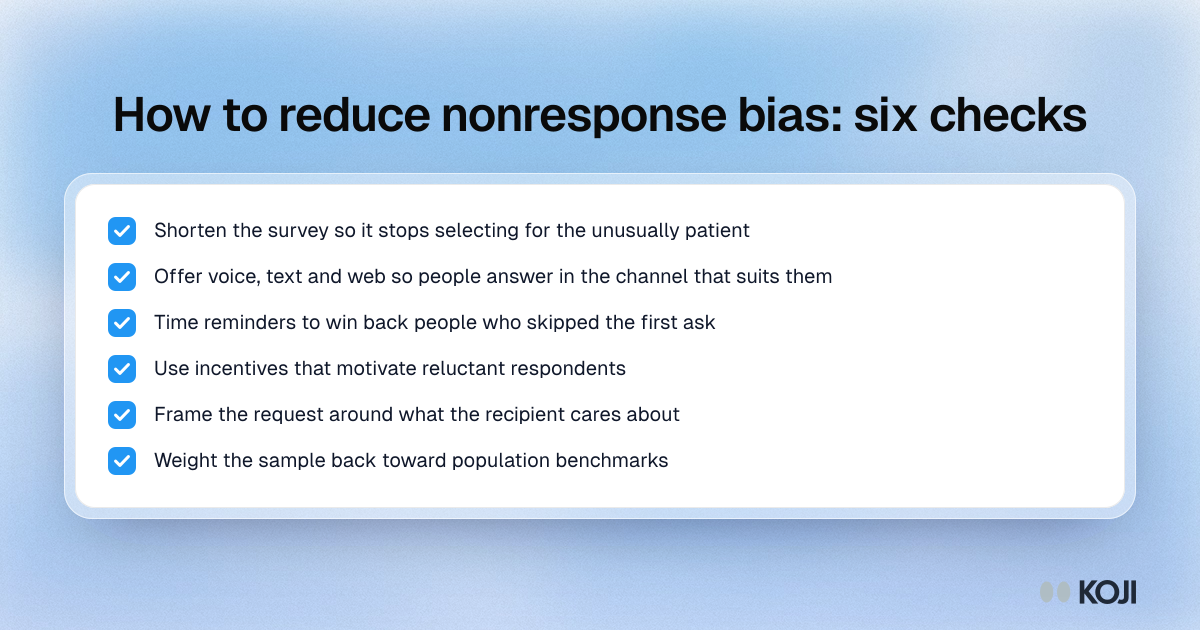
Four practical checks for nonresponse bias in a survey or interview study: benchmark responders against known population values, compare early and late responders, follow up a random sample of non-responders, and compare against usage or purchase records. They matter because Robert Groves found response rate alone says little about bias. In Koji, structured questions capture the variables you need to benchmark who answered.
Where this appears
What's in this guide
- Benchmark against known values: Compare responders with census data, CRM records or frame variables like plan, region and tenure.
- Compare early and late responders: Late responders stand in for non-responders. If they differ on your key metric, that shows the likely bias.
- Follow up with non-responders: Chase a small random sample of non-responders with a short version of the survey, then compare.
- Check records you already hold: Usage logs or purchase history let you compare responders and non-responders directly.
Use this image
Free to use in your docs, decks and posts under CC BY 4.0, as long as you credit Koji with a link to this page. To embed it, paste this into your page:
html
<a href="https://www.koji.so/visuals/four-ways-to-detect-nonresponse-bias"><img src="https://www.koji.so/visuals/four-ways-to-detect-nonresponse-bias/four-ways-to-detect-nonresponse-bias.png" alt="List of four ways to detect nonresponse bias: benchmark against known values, compare early and late responders, follow up non-responders, check records." width="1200" height="645" /></a>
<p>Source: <a href="https://www.koji.so/visuals/four-ways-to-detect-nonresponse-bias">Four ways to detect nonresponse bias</a>, Koji</p>