Process
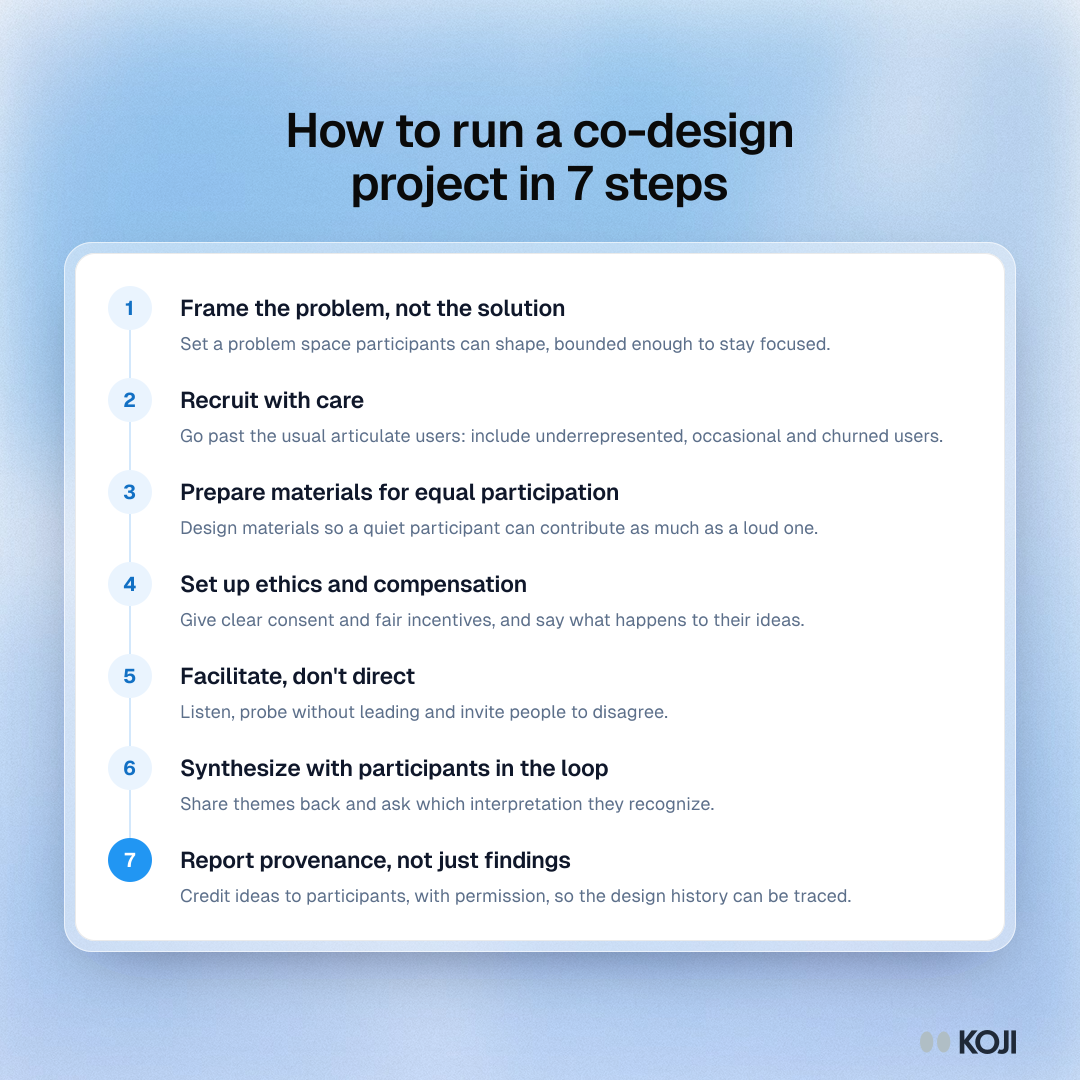
How to run a co-design project in 7 steps
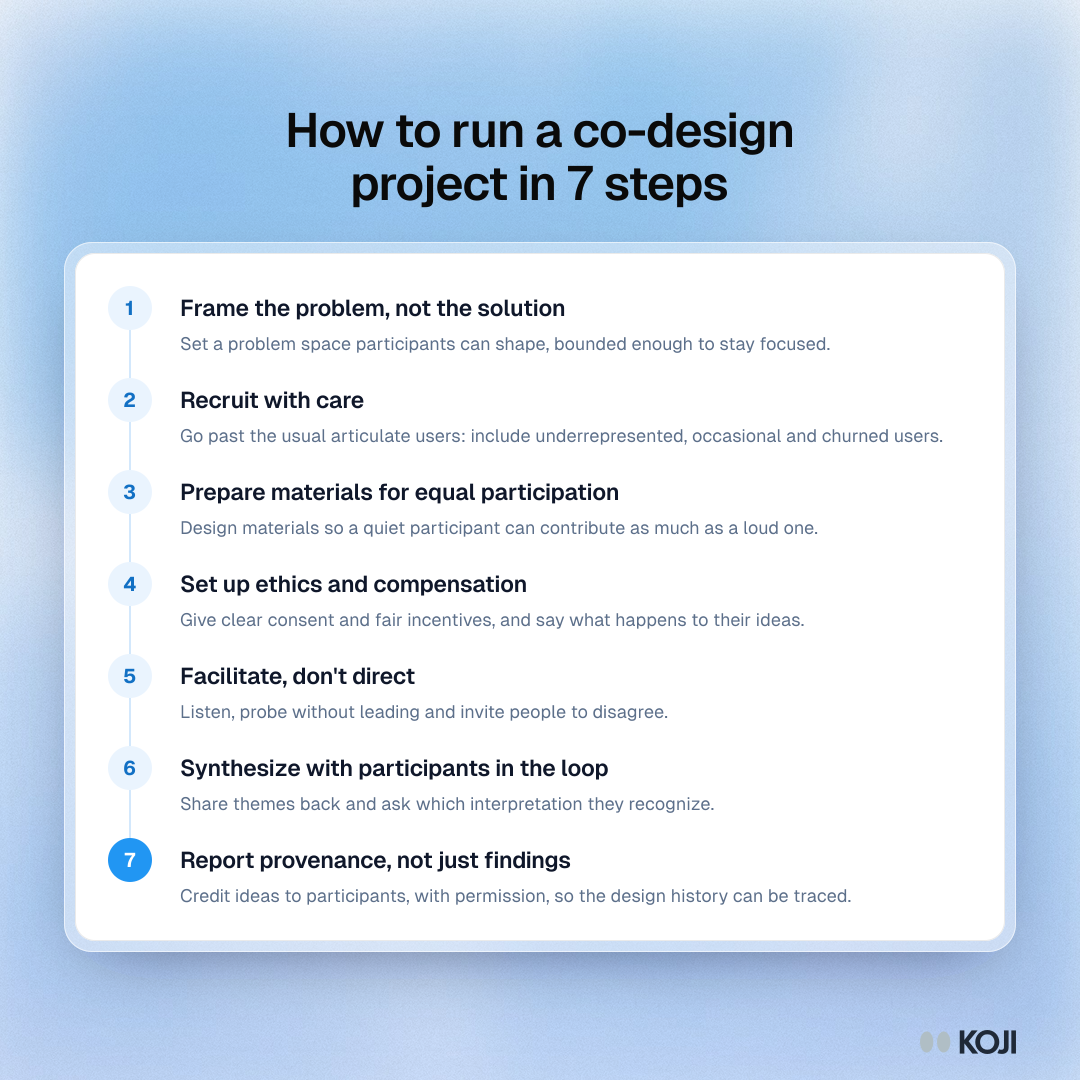
Seven steps for running a co-design project with users. Frame a problem rather than a solution, recruit beyond the usual voices, prepare materials that let quiet people contribute, set up consent and compensation, facilitate without steering, share synthesis back with participants and report who contributed which ideas. Koji can run distributed co-design studies and share emerging themes back to participants within a day.
Where this appears
What's in this process
- Frame the problem, not the solution: Set a problem space participants can shape, bounded enough to stay focused.
- Recruit with care: Go past the usual articulate users: include underrepresented, occasional and churned users.
- Prepare materials for equal participation: Design materials so a quiet participant can contribute as much as a loud one.
- Set up ethics and compensation: Give clear consent and fair incentives, and say what happens to their ideas.
- Facilitate, don't direct: Listen, probe without leading and invite people to disagree.
- Synthesize with participants in the loop: Share themes back and ask which interpretation they recognize.
- Report provenance, not just findings: Credit ideas to participants, with permission, so the design history can be traced.
Use this image
Free to use in your docs, decks and posts under CC BY 4.0, as long as you credit Koji with a link to this page. To embed it, paste this into your page:
html
<a href="https://www.koji.so/visuals/how-to-run-a-co-design-project-steps"><img src="https://www.koji.so/visuals/how-to-run-a-co-design-project-steps/how-to-run-a-co-design-project-steps.png" alt="Process of seven steps for a co-design project, from framing the problem to synthesizing with participants and reporting who contributed what." width="1080" height="1080" /></a>
<p>Source: <a href="https://www.koji.so/visuals/how-to-run-a-co-design-project-steps">How to run a co-design project in 7 steps</a>, Koji</p>