Reference table
MaxDiff vs other prioritization methods
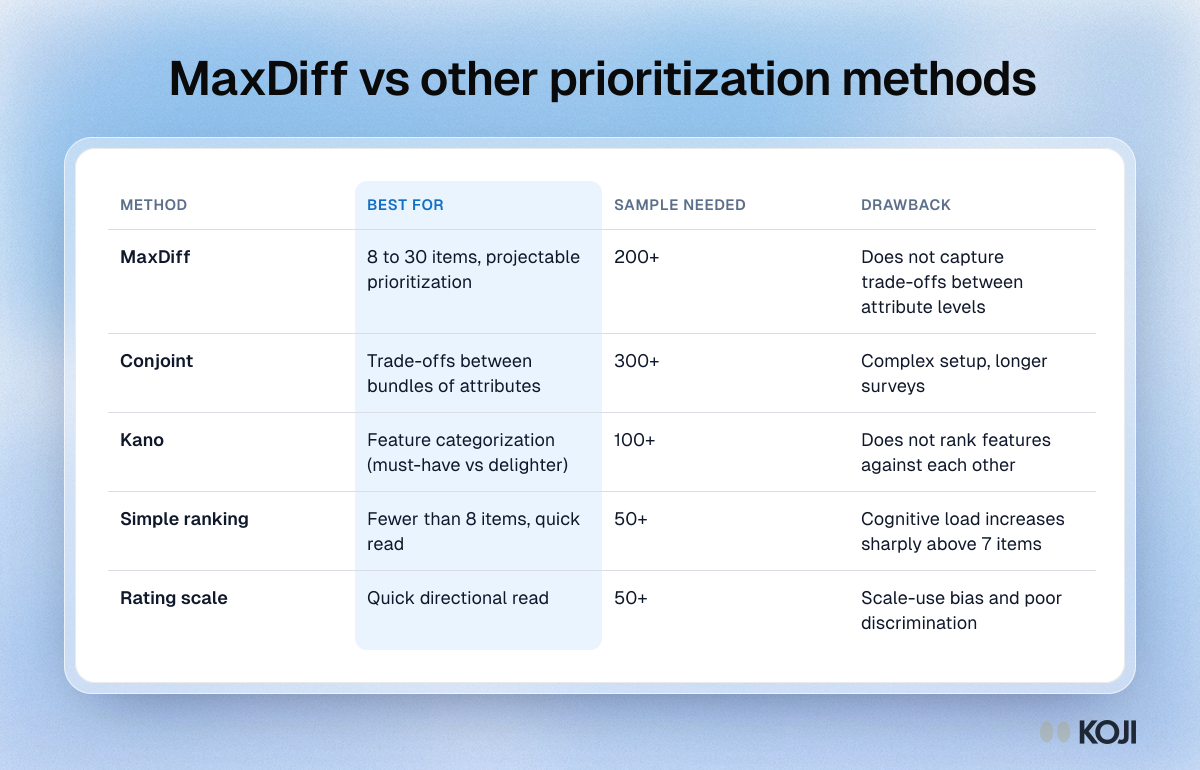
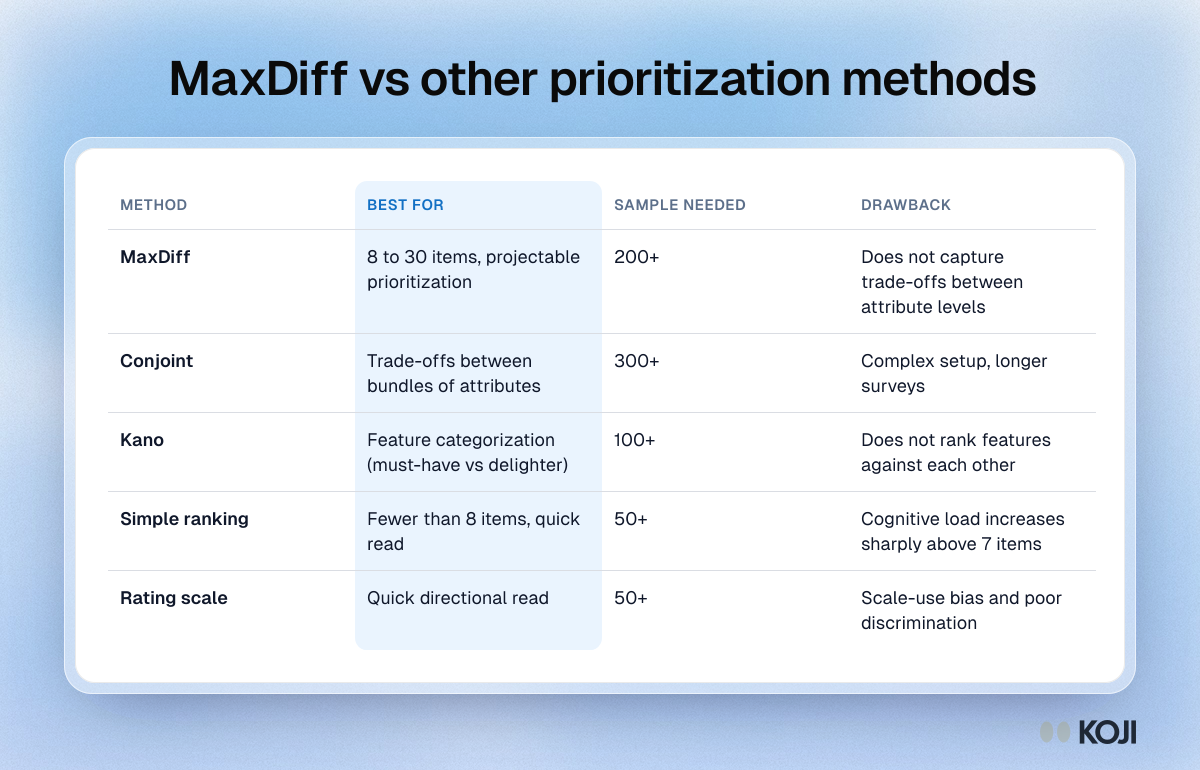
A comparison of five ways to prioritize features, messages or benefits: MaxDiff, conjoint analysis, the Kano model, simple ranking and rating scales. For each it shows what the method is best for, a rough minimum sample and its main drawback. Use it to choose a method before you write a prioritization study.
Where this appears
What's in this reference table
| Method | Best for | Sample needed | Drawback |
|---|---|---|---|
| MaxDiff | 8 to 30 items, projectable prioritization | 200+ | Does not capture trade-offs between attribute levels |
| Conjoint | Trade-offs between bundles of attributes | 300+ | Complex setup, longer surveys |
| Kano | Feature categorization (must-have vs delighter) | 100+ | Does not rank features against each other |
| Simple ranking | Fewer than 8 items, quick read | 50+ | Cognitive load increases sharply above 7 items |
| Rating scale | Quick directional read | 50+ | Scale-use bias and poor discrimination |
Use this image
Free to use in your docs, decks and posts under CC BY 4.0, as long as you credit Koji with a link to this page. To embed it, paste this into your page:
html
<a href="https://www.koji.so/visuals/maxdiff-vs-other-prioritization-methods"><img src="https://www.koji.so/visuals/maxdiff-vs-other-prioritization-methods/maxdiff-vs-other-prioritization-methods.png" alt="Table comparing MaxDiff, conjoint, Kano, simple ranking and rating scales by what each is best for, the sample needed and the main drawback." width="1200" height="770" /></a>
<p>Source: <a href="https://www.koji.so/visuals/maxdiff-vs-other-prioritization-methods">MaxDiff vs other prioritization methods</a>, Koji</p>