Process
How to run a MaxDiff study in five steps
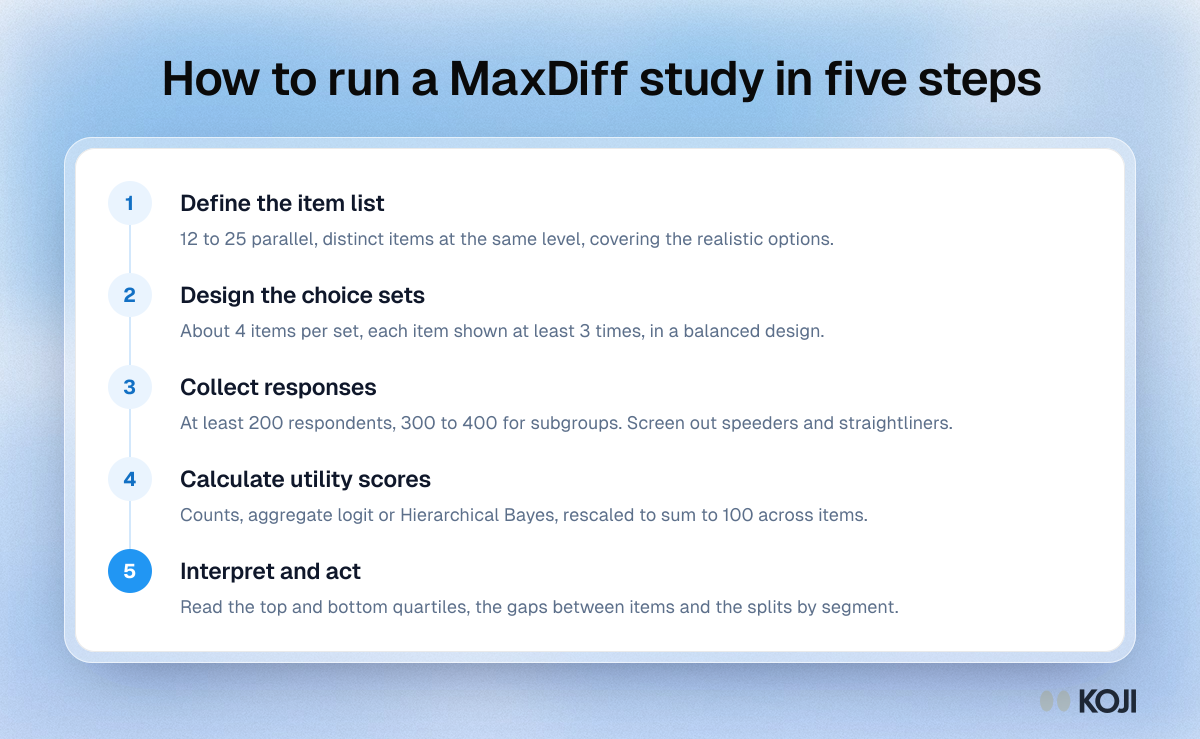
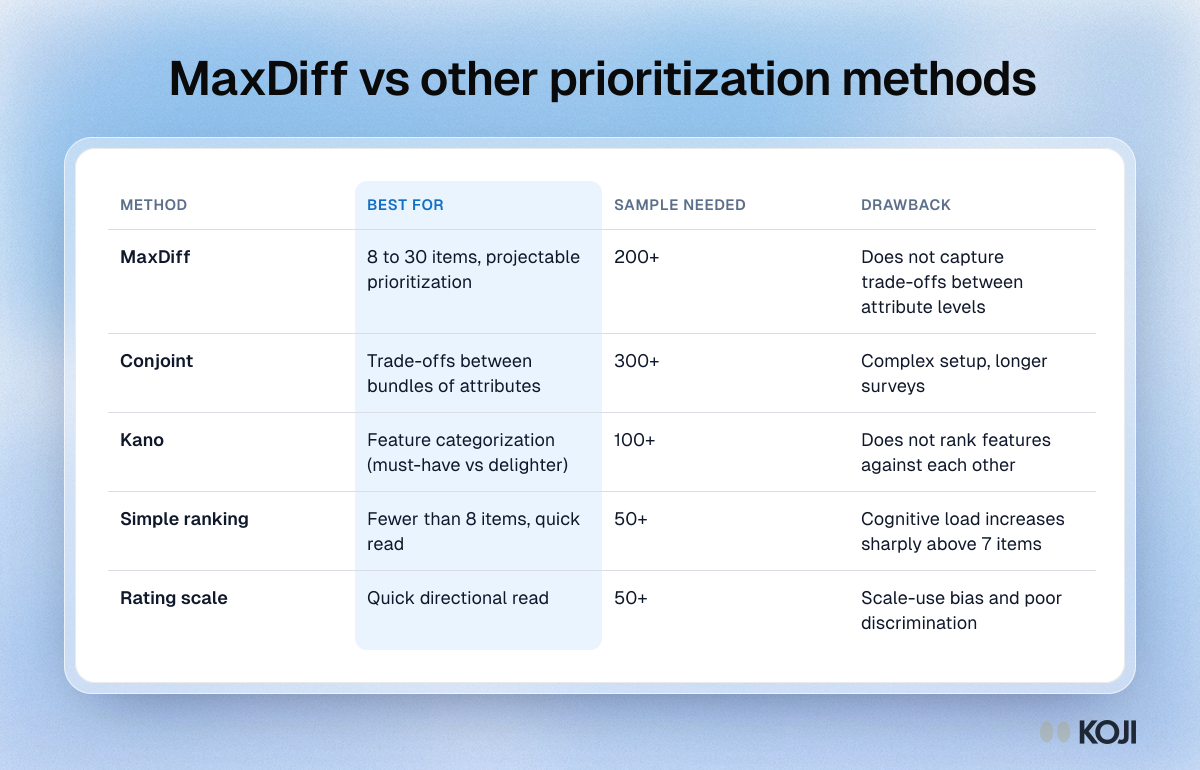
A five-step process for running a MaxDiff (best-worst scaling) study, from writing a parallel item list to reading the results by quartile and segment. It gives the working numbers for each step: 12 to 25 items, about four per set, each shown at least three times, and 200 or more respondents. Use it to plan a feature, message or benefit prioritization study. In Koji, a ranking question with AI follow-ups can capture the reasons behind the order.
Where this appears
What's in this process
- Define the item list: 12 to 25 parallel, distinct items at the same level, covering the realistic options.
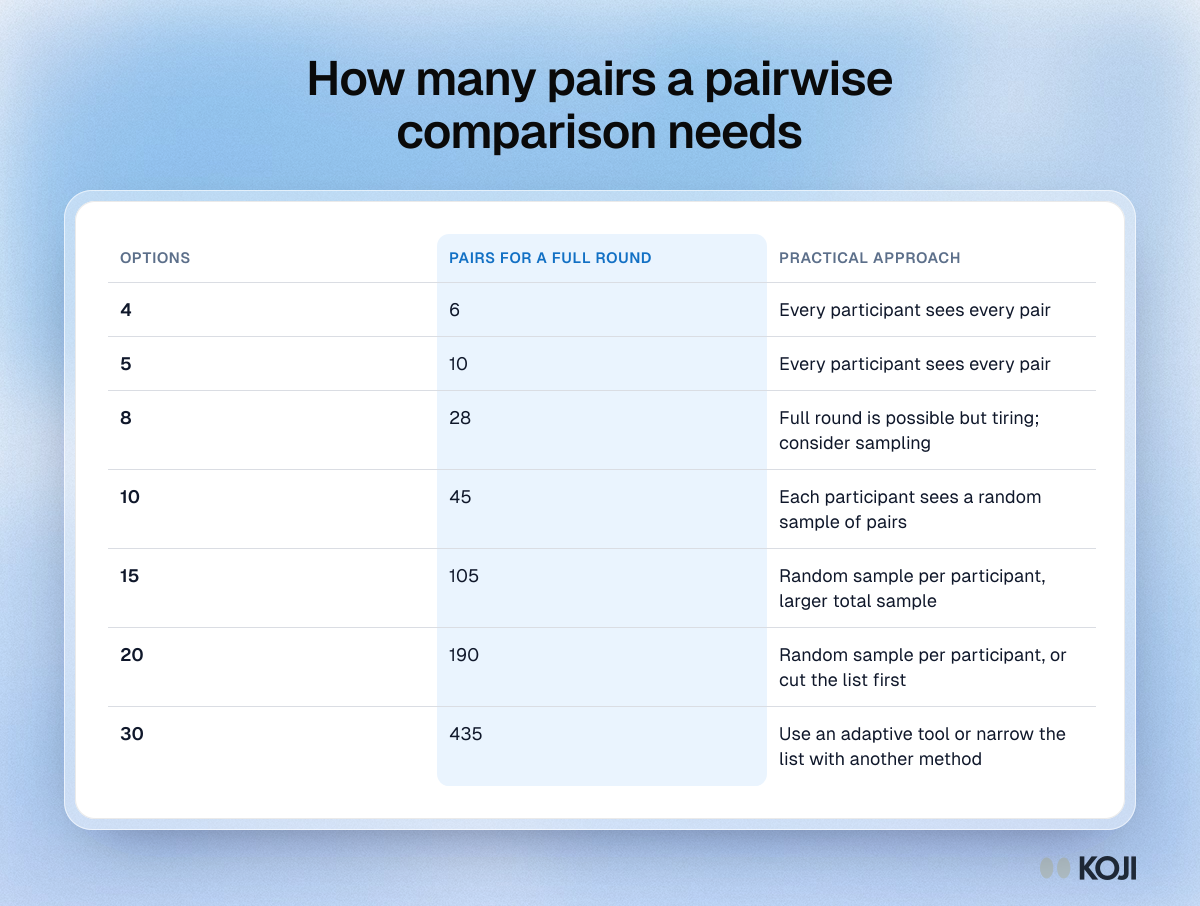
- Design the choice sets: About 4 items per set, each item shown at least 3 times, in a balanced design.
- Collect responses: At least 200 respondents, 300 to 400 for subgroups. Screen out speeders and straightliners.
- Calculate utility scores: Counts, aggregate logit or Hierarchical Bayes, rescaled to sum to 100 across items.
- Interpret and act: Read the top and bottom quartiles, the gaps between items and the splits by segment.
Use this image
Free to use in your docs, decks and posts under CC BY 4.0, as long as you credit Koji with a link to this page. To embed it, paste this into your page:
html
<a href="https://www.koji.so/visuals/maxdiff-study-five-steps"><img src="https://www.koji.so/visuals/maxdiff-study-five-steps/maxdiff-study-five-steps.png" alt="Process showing five steps to run a MaxDiff study: define the items, design choice sets, collect responses, calculate utility scores and act on them." width="1200" height="739" /></a>
<p>Source: <a href="https://www.koji.so/visuals/maxdiff-study-five-steps">How to run a MaxDiff study in five steps</a>, Koji</p>